
A useful listing starts with the right audience
A good product can remain almost invisible when every discovery path depends on the same social feed. A potential customer might miss your launch post, search for a category instead of your brand, or ask another founder which tool solves a particular problem. Software directories create another route into that conversation. They collect products around a need, category, platform, or launch date, giving someone who has never encountered your company a place to understand what you do and decide whether to visit.
This guide brings together 86 directories and launch platforms that we encountered while researching places to introduce SMTasker. Each had a free submission route tied to a backlink or badge when checked. They cover AI applications, SaaS, developer tools, small independent products, and broader business websites. This is a research shortlist, not a ranking of guaranteed traffic sources. Some have lengthy queues, participation requirements, or restrictions that make them unsuitable for a particular product. Their current submission pages should always be the final reference.
For a social media business, directories can complement the work already happening on Instagram, LinkedIn, TikTok, Threads, or other channels. Social content explains your approach over time; a directory profile gives an interested visitor a compact product summary, pricing model, screenshots, and a website link. Neither channel replaces the other. A useful launch plan connects them: publish a demonstration, make the listing accurate, answer questions, and give visitors a clear next step on your own site.
What directories can realistically help with
The first benefit is discovery by context. Someone browsing marketing automation tools is closer to your subject than a random person scrolling past a general announcement. The second is a durable reference: a product page can remain available after a launch week finishes. The third is learning. Comparing neighboring listings reveals which features buyers expect, which descriptions are confusing, and how competitors explain their setup requirements. Community comments can also expose questions that deserve a better answer in your documentation.
A listing may send referral traffic and make your product easier to find, but publication is not evidence of sales, search rankings, or inclusion in an AI answer. Treat a directory’s traffic totals, audience counts, and Domain Rating as its stated metrics unless you verify them independently. Domain Rating is a third-party measure, not a Google quality score. A small, relevant directory can produce more useful conversations than a larger general catalog. Measure the visitors who actually arrive and what they do after arrival.
Backlinks deserve the same practical perspective. A normal editorial reference can help readers move between useful resources. A large collection of exchanges created mainly to manipulate rankings is a different proposition: Google’s spam policies specifically discuss excessive link exchanges. Its outbound-link guidance also explains how to identify paid placements and other link relationships. Read those policies before treating a badge campaign as an SEO strategy. The dependable reason to pursue a listing is that the audience and profile can help a real prospective user.
Choose the niche before preparing the submission
Start with the job your product performs. AI directories suit software with a concrete AI capability that you can demonstrate; adding the word AI to an ordinary feature is not enough. Developer directories favor useful technical detail, platform support, documentation, and integration requirements. SaaS catalogs fit subscription software with a clear buyer and recurring use case. Independent-maker launch boards can suit focused apps, extensions, templates, and small services. Broader business directories may include agencies and professional services, but their categories still need to match your offer.
For social media tools, consider several honest entry points: content production, publishing, analytics, collaboration, marketing automation, or customer conversations. Select the categories supported by the product today. If your software requires a connected device, a desktop client, a paid AI provider, or human approval, say so. These details help the right person recognize a fit and prevent a promising click from turning into disappointment. Clear limitations often make a listing more useful than another paragraph of ambitious growth language.
Prepare a small public submission kit before opening forms: the canonical website address, a short tagline, two description lengths, a clean logo, product screenshots, pricing, trial conditions, and a business contact email. Keep account credentials in a separate private record. Use screenshots with sample data and remove customer information before uploading anything. Check for an existing listing first, especially if a teammate has already submitted the product. Managing an existing profile is usually more useful than creating a duplicate.

Understand the real cost of a free listing
Free can still mean work and an ongoing commitment. A directory may require its exact badge, a visible homepage placement, a footer link, a minimum domain metric, several community interactions, or an available launch slot. A plain text link inside a blog article will satisfy some forms and fail others. Where the rules say homepage, do not assume a resources page qualifies. Where they only say website, inspect the verification step or ask the directory before promising a placement you cannot maintain.
Keep a record of the submission date, account, selected plan, backlink location, verification result, review estimate, and final public URL. Separate drafts, successfully submitted requests, scheduled launches, and published profiles. These are different stages. Recheck important listings after a redesign because moving or removing a required badge can pause a profile or change its link treatment. Queues and pricing change, so review an old note before relying on it for a new campaign.
Turn a listing into a measured launch workflow
Choose a manageable first group instead of submitting everywhere at once. Pair each live listing with a relevant social post: a short demonstration, a specific customer problem, or a candid explanation of a product decision. Ask for feedback without promising reciprocal votes or posting repetitive promotional comments. With SMTasker, teams can organize supported publishing and engagement routines alongside that launch work; they still need to choose appropriate messages, review settings, and follow each platform’s rules. Directory participation should remain thoughtful and relevant.
After launch, compare referral visits, engaged sessions, trial starts, and useful inquiries over a consistent period. Add campaign parameters only where the directory permits them and preserve a clean canonical product address. A modest stream of qualified visitors can justify maintaining a profile; an impressive vote count without relevant visits may not. The directory notes below focus on positioning, practical submission requirements, and tradeoffs so you can make that decision with more context. Screenshots show the sites as encountered during our November 2026 research.
Backlink placement check: Use the product homepage as the listing destination when the directory offers a separate badge verification URL. Where its rules allow a content page but verification is tied to the submitted URL, this guide can be the listing destination, with the product homepage included in the description. A successful technical check may still leave editorial review outstanding. We omit applications that require a badge on our homepage or footer, and we do not assume a paid option is necessary when a suitable free route exists.
1. Fazier

Fazier combines daily product discovery with a community launch format. Its front page separates today’s products, yesterday’s launches, and leading products from earlier periods, so a listing sits within an active stream rather than only an alphabetical catalog. The range is broad: SaaS, utilities, creative applications, and other independent products appear together. It is a sensible research stop when your product has a clear, easily demonstrated benefit that another maker can understand quickly.
The free Basic route we checked required more than a product description. It included a badge, an English-language website, a positive domain rating, and three useful comments on other products. Those comments should contribute something specific, such as a question about a workflow or feedback based on a real demonstration. Budget time for participation before planning a launch date.
Prepare a concise explanation of the problem solved and a screenshot that remains understandable at thumbnail size. For a social media product, describe the actual publishing or account-management workflow rather than promising followers. Fazier’s community exposure can be valuable, but neither votes nor acceptance establish commercial results.
2. DANG! AI Tools Directory

DANG is an AI tools directory organized around categories such as writing, productivity, assistants, marketing, image creation, and social applications. Its homepage distinguishes promoted and featured placements from the wider collection. That structure makes it useful for discovering how an AI product is positioned among tools with similar jobs, while reminding a submitter that paid visibility and ordinary discovery are different experiences.
The free route we reviewed required a custom domain and a crawlable followed backlink, supplied as a badge or text link. The link needed to remain available to retain the listing. The exact accepted location was not clearly established in the earlier form, so a blog reference should be tested through the current verification flow rather than assumed sufficient. Keep the submitted product URL separate from any backlink-page field.
DANG fits products with a demonstrable AI capability. A social media application might explain how its assistant prepares settings or helps interpret activity, including any separate AI-provider charges. Inspect the surrounding categories and advertising before deciding whether the presentation suits your brand. A broad AI audience is not automatically your ideal buying audience.
Explore DANG! AI Tools Directory →Back to the directory index ↑
3. Findly.tools

Findly.tools brings software discovery into one catalog with categories including AI, productivity, marketing, SEO, automation, development, design, and analytics. Its homepage also shows recent tools and deals, giving buyers several ways to browse beyond a single launch ranking. That breadth can suit a product that crosses categories, provided its description explains one primary use case instead of trying to appear relevant to every visitor.
The submission process we examined allowed a draft with descriptions, audiences, pricing information, and platform details. Publication on the free route was gated by a badge in the website footer. An account and a completed draft therefore do not mean a product is publicly listed. Save the draft identifier and return to the listing step after installing the required reference; check what the verifier accepts before treating a text link as a substitute for the badge.
For social media software, the marketing and automation categories are useful places to compare descriptions. Explain whether the product is web based, desktop assisted, or device dependent, and label a time-limited trial accurately. A tidy profile with realistic setup details gives a buyer more to work with than a long list of unsupported benefits.
4. Turbo0

Turbo0 focuses its discovery experience on content-creation products. Its categories include video and audio editing, image resources, screen recording, typography, copywriting, website creation, management, and growth. This gives it a particularly relevant angle for tools used by creators and social media teams, even though the catalog also contains broader utilities. Product cards display practical labels such as platform and pricing, which can help a visitor decide what to investigate.
The free submission route checked for a domain rating above ten and a backlink or badge. The draft flow included an introduction and cover image before a verification step, so it is worth preparing those assets before beginning. A successful domain-rating check is only one prerequisite; the badge can still be reported missing and leave publication incomplete. The current verifier inspects the product homepage and looks for the badge or the exact Turbo0 item link; it does not offer a separate backlink-page field.
Use a cover that shows the product doing a recognizable task rather than presenting a vague promotional slogan. If your application coordinates content or manages publishing, describe how it fits alongside creation tools. Recheck the review estimate and accepted backlink location in the current form. Turbo0’s audience positioning is relevant, but listing there does not guarantee campaign reach or creator adoption.
5. ToolPilot AI

ToolPilot presents AI software through categories, collections, filters, user reviews, and product pages. Its homepage includes featured tools as well as links to free tools, new tools, guides, and coupon codes. This format can suit products whose value needs a little explanation, because a prospective customer can compare positioning and pricing rather than relying exclusively on a short launch-day tagline.
The free submission form we checked requested the URL of a page containing the backlink, which is useful when you want to test an editorial resource page. It did not explicitly require the homepage in that field. It also asked for a square JPG logo with a background at 500 by 500 pixels. A smaller transparent logo may need a careful format conversion and resize before the form will accept it. The stated free review window could extend to sixty days.
For a social media product with an AI assistant, explain both the assistant’s role and the underlying operational requirements. Do not imply that an AI feature eliminates the need to review settings. ToolPilot is worth assessing for its comparison-oriented presentation, while keeping the distinction between submitting a tool and receiving editorial approval clear.

6. ShowMeBest.AI

ShowMeBest.AI organizes AI tools around productivity, business, and creative work. Its homepage combines category browsing, search suggestions, AI news, and featured entries. It can be a useful place to research how different tools describe the same need, especially when your application spans content production, marketing, or an assistant-based workflow. The visible catalog is broader than social media alone, so relevance depends on selecting an accurate category.
The free submission route we reviewed explicitly requested a badge or link in the website footer. That is an important distinction: an article mentioning the directory does not automatically satisfy a footer requirement. The review timing displayed on the actual submission page ranged from seventy-two hours to several weeks, illustrating why a third-party directory list should not be treated as the final promise of publication speed.
Prepare a short description that explains what the AI actually changes for a user. A content tool might emphasize editing or ideation; an automation tool should identify the routine it supports. Consider the surrounding featured placements when evaluating brand fit, and record the final public page only after approval rather than counting the initial form as a live listing.
7. Smol Launch

Smol Launch is structured around weekly product launches, with product pages, guides, and a board for the current week. Its visible mix includes design tools, content applications, developer products, and other small software businesses. The weekly rhythm makes it useful for a coordinated launch: a founder can prepare a demonstration and a small set of social posts around a specific period instead of treating submission as an isolated administrative task.
The free flow we checked required a homepage badge and five votes during the current week, alongside a limited number of weekly places. A product draft can exist before those conditions are completed. A blog article is therefore useful as a resource for readers but does not replace the stated homepage badge. Community votes should reflect a real assessment of the products, and any additional public participation needs to be considered separately.
Use the product page to explain one audience and one strong use case. If the launch is aimed at agencies, show an agency workflow rather than a generic feature collage. Watch the available launch week and distinguish an approved submission from a scheduled or already published product.
8. Submit AI Tools
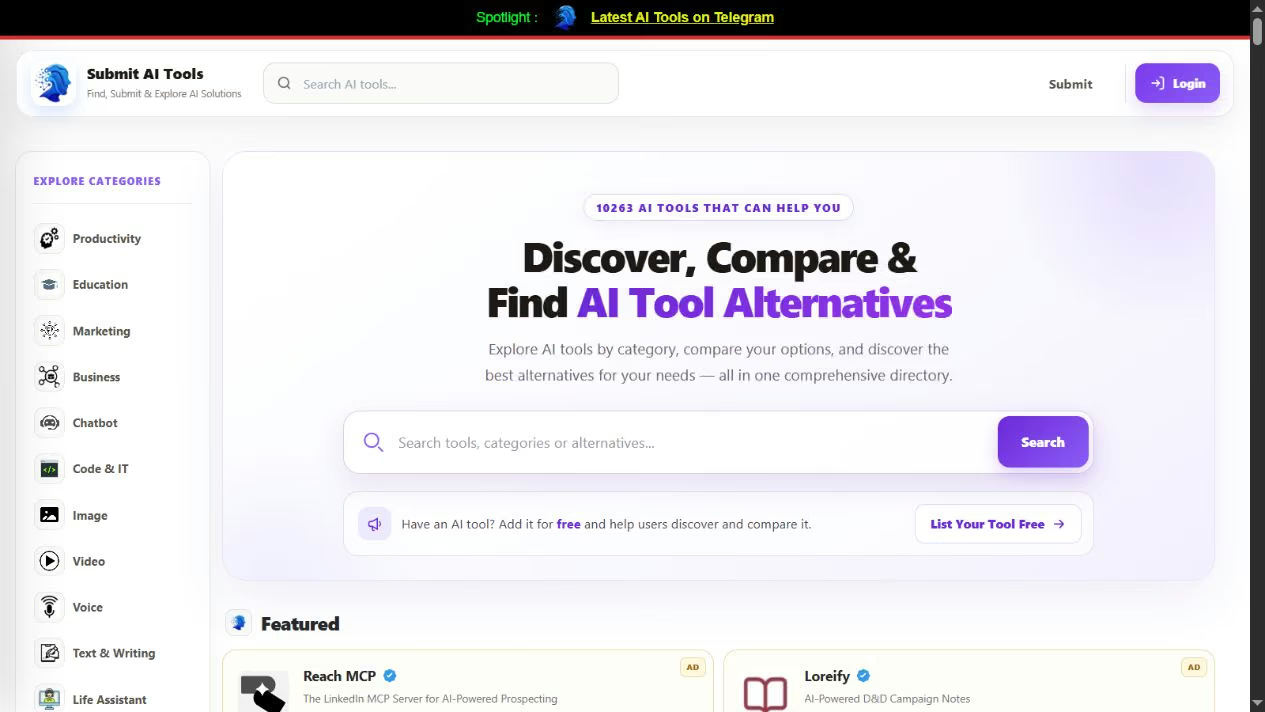
Submit AI Tools is a category-based AI directory with search, comparisons, alternatives, deals, and profession-oriented discovery. Its navigation covers marketing, business, productivity, image, video, writing, coding, and several other AI use cases. That organization gives a product multiple relevant research contexts, but the best submission still begins with the task a user is trying to complete, not with the largest possible collection of category labels.
The free route required authentication and a verified backlink that remains in place. The submission page indicated a review period of five business days when we checked it. Human verification may also appear in the process. These steps should be completed through the normal interface, and a successful login should not be confused with successful product submission. Preserve any confirmation and the eventual public profile URL in your launch record.
A social media application can be relevant when it has a genuine AI or marketing workflow to describe. Include the pricing model, supported platforms, and any account or device requirement. The directory’s alternatives angle also makes a precise differentiator useful: explain a concrete operational distinction instead of claiming to be universally better than other tools.
9. ToolFame

ToolFame presents a broad online-tools catalog rather than restricting discovery to one kind of AI application. Its homepage includes social media, content creation, development, productivity, marketing, SEO, and many other categories. This makes it suitable for researching products that sit between workflows, such as software used to create assets and then organize marketing activity. It also means a visitor’s intent can vary widely across the site.
The free route we examined required a minimum domain rating of ten and a badge that is verified and retained. Its advertised review window extended as far as one hundred eighty days, so this is better treated as a long-term distribution task than an urgent launch dependency. A completed form may enter a queue rather than produce an immediate public page. Check current terms and verification behavior before promising a date to your team.
Choose a category that reflects the buyer’s main reason to use your product. For social media software, a clear workflow explanation and a realistic trial label are more informative than repeating the directory’s traffic statistics. Keep the badge obligation in your website-maintenance notes so a later redesign does not accidentally affect the listing.
10. AI Agents Directory

AI Agents Directory focuses on agents, skills, and AI solutions, with discovery paths for marketing, customer service, development, and other use cases. Its homepage separates featured items from newly added entries and provides several ways to explore the agent ecosystem. It is most relevant when your product includes an assistant that performs a defined job, rather than only adding a chat box to an otherwise unrelated service.
The submission flow we reviewed asked for source model, pricing, category, description, and a public logo. A free application can be received while remaining pending. Its confirmation screen explicitly required the official linked badge on the homepage or in the footer within seventy-two hours. A badge in a separate editorial article alone does not meet that placement rule. Check the confirmation screen as well as the initial form, because the more specific requirement appeared after submission.
Explain an agent’s boundaries as carefully as its capabilities. For example, say whether a user reviews prepared changes, what integrations are supported, and which costs are separate. An accurate agent profile helps both technical evaluators and business buyers decide whether the tool belongs in their workflow.

11. LaunchIgniter

LaunchIgniter combines product launches with a maker-oriented community and ongoing posts. The homepage emphasizes early users and feedback, showing featured products alongside recent launches and discussions. Its mix of applications and business tools makes it a possible fit for a SaaS product with a focused explanation and a founder who can answer practical questions. The community context is worth considering alongside the directory page itself.
The free route we checked required manual review, a badge on the product homepage, and votes for at least five different products on the day of submission, measured in UTC. Followed-link treatment was linked to finishing among the top three. The first free week shown during our November check was in May 2027, with timing subject to availability. These are substantial participation and scheduling conditions; read the actual free-plan details before planning a campaign.
Prepare a launch message built around a real problem, and make the website ready for visitors who have never heard of the product. A social media team could support the launch with a short demo and an explanation of a repeatable workflow. Evaluate any feedback and referral activity separately from the ranking position; each tells a different part of the story.
12. Neeed Directory

Neeed Directory is a broad discovery resource for makers, covering developer tools, design resources, SaaS, marketing, social media, and other work categories. Its homepage separates featured placements from recently launched products and offers a detailed category sidebar. That can be useful when your product solves a specific operational problem and you want it to appear near comparable tools rather than only in a time-limited launch competition.
The submission route we checked described a free option with the directory’s badge and automatic verification, alongside a paid option without the badge. Some wording about followed links was not completely clear in the earlier flow, so verify the current plan details before treating a particular link attribute as guaranteed. Authentication was also part of the submission path. A blog reference and a correctly installed badge may be evaluated differently by the verifier.
Select the narrowest accurate category and use a description that answers who the tool is for, what it does, and what is required to start. For social media applications, avoid crowding the listing with every supported action. A coherent primary use case makes the profile easier for a buyer to understand.
13. Aura++

Aura++ combines launch discovery with a broader product-promotion platform. Its homepage shows projects launching today across categories such as productivity, marketing, design, and SaaS. It also promotes AI-assisted submission and additional distribution services. Treat these as distinct offerings: a free project listing is not automatically the same package as a launch article, social posts, or other promotional work described elsewhere on the site.
The free route required backlink verification and showed its first availability in May 2027 during our November check. Although the instructions allowed a link on any visible page, the wizard checked the fixed product homepage and provided no separate backlink-page field. Our article link did not unlock it. An imported product draft also needed review for pricing and platform accuracy. A saved draft is useful progress, but it is not a confirmed launch booking.
Aura++ is worth exploring for a product with a clear maker or small-business audience. Connect the launch to a genuine demonstration and a practical social announcement, while keeping expectations realistic about timing. Record the chosen plan, verification result, and confirmed date instead of relying on the homepage’s general promises about online visibility.
14. Dofollow.Tools

Dofollow.Tools offers category-based browsing across AI, SaaS, developer tools, automation, design, marketing, social media, and more. The homepage includes featured entries and recent tools, while additional navigation covers affiliates and discounts. This makes it a useful comparison surface for products that have an identifiable software workflow and need a concise description of the buyer benefit. Its name emphasizes backlinks, but audience fit should still guide the decision to submit.
The free listing route required a followed badge link that stays on the website, with recurring checks after publication and a seven-day review queue. Its daily capacity was shared across all users: all five free places were already used during our check. A complete form therefore could not be submitted that day. Check available capacity before investing in a time-sensitive launch, and keep the continuing badge obligation in your website-maintenance notes.
For marketing software, a useful profile explains the activity supported and the setup needed to run it. Keep a record of any badge requirement when updating your site. A followed link is a technical relationship between pages; it is not a promise of customers, search placement, or measurable revenue.
15. DeepLaunch

DeepLaunch is a tools-and-resources directory with a broad software category system, including content creation, social media, automation, analytics, development, and AI. Its homepage distinguishes paid featured placements and also points visitors toward a backlink research library. For a founder, the useful starting point is still the catalog itself: inspect the categories and product descriptions to determine whether someone browsing there could reasonably need your tool.
The free submission option we checked required a followed badge and recurring verification, with a limited number of free places each day. The flow also involved selecting a launch date. This means that adding a link is only part of the task; the date, available capacity, and ongoing visibility of the badge matter too. Reconfirm these conditions in the current form before scheduling supporting marketing work.
A product profile should describe a repeatable job and the audience that performs it. For a social media team, that might be preparing a publishing routine or reviewing campaign activity. Do not borrow the site’s claims about reach as your own forecast. Judge the listing by relevant visits and useful conversations after it becomes public.
16. ScrollLaunch

ScrollLaunch is a weekly launch platform with product pages, past-week archives, maker profiles, and category discovery. The homepage explains its current-week leaderboard and distinguishes premium placement from other entries. Its permanent product pages can provide a reference after launch week, while the weekly board creates a specific moment around which to plan outreach. Products for creators, marketers, and small software teams can fit if their use case is clear.
The free path allowed an imported draft but required a badge in the server-rendered homepage HTML, such as a footer or an appropriate featured-on block. The verifier did not offer a separate article-page field. Free weeks had limited capacity; the first shown during our November check was in January 2027. The account flow also included a newsletter subscription. Review imported fields and the selected plan carefully, because paid upgrades were prominently presented.
A useful social launch can connect a product demonstration, the directory page, and an explanatory post on your own channels. Do not interpret the site’s claims about AI search discovery as a guarantee of citations. Record the confirmed launch week and public profile, then measure relevant referral visits after publication.
17. Launchpadly

Launchpadly offers weekly startup discovery with a launch board, founder profiles, reviews, community material, and an archive of earlier products. Its homepage separates paid featured visibility from community rankings, which is useful context when comparing positions on the page. The range of products includes SaaS, AI applications, and other tools made by small teams. A founder who can explain the product and answer questions has more to contribute than a logo alone.
The free submission path required a verified backlink before review and explicitly provided an optional page-with-badge URL on the same domain. In our November test, the link in this public article passed that check and the product entered the review queue. This is a practical example of a directory supporting a separate resource page. Keep the verifier result distinct from editorial approval: a successful backlink check does not mean the public listing is already live.
Prepare a short explanation of the customer problem, a representative screenshot, and an honest pricing label. For a social media workflow, show what a team actually configures or reviews. The community and weekly timing can support a launch conversation, but a high position on a board is not a substitute for evaluating whether the visitors become useful prospects.
18. SaaSFame

SaaSFame is a software catalog with a wide category system, from marketing and analytics to development, support, finance, and productivity. Its homepage shows featured products and practical labels such as platform and pricing. That makes it a possible research destination for recurring-use software with a clear buyer, rather than only for an application launched this week. Compare the categories before deciding where the product belongs.
The free plan required a domain rating of at least ten and a badge that is verified and kept on the website. Its review window could reach one hundred eighty days. In the form we tested, the verifier used the fixed product homepage and did not offer a separate field for an editorial article. The article link was not detected. Treat this as a long-term task and resolve the placement requirement before promising a publication date.
Use the description to explain the recurring job your software performs and any setup dependencies. A social media application should identify the supported work and the intended user, such as a solo operator or agency. Keep the badge requirement visible in maintenance notes, and evaluate the resulting profile on referral quality rather than catalog size alone.
19. AI Directories

AI Directories