Public-page evidence, clearly scoped
AI Search Readiness Checker
Check one public HTTPS page and its robots.txt. Review 20 observable indicators with evidence and next steps, while keeping unknowns and critical findings visible. Actual AI visibility is not measured.
A fictional report
Evidence before assumptions
AI Search Readiness Checker
One public page. Observable checks, not an AI visibility rating.
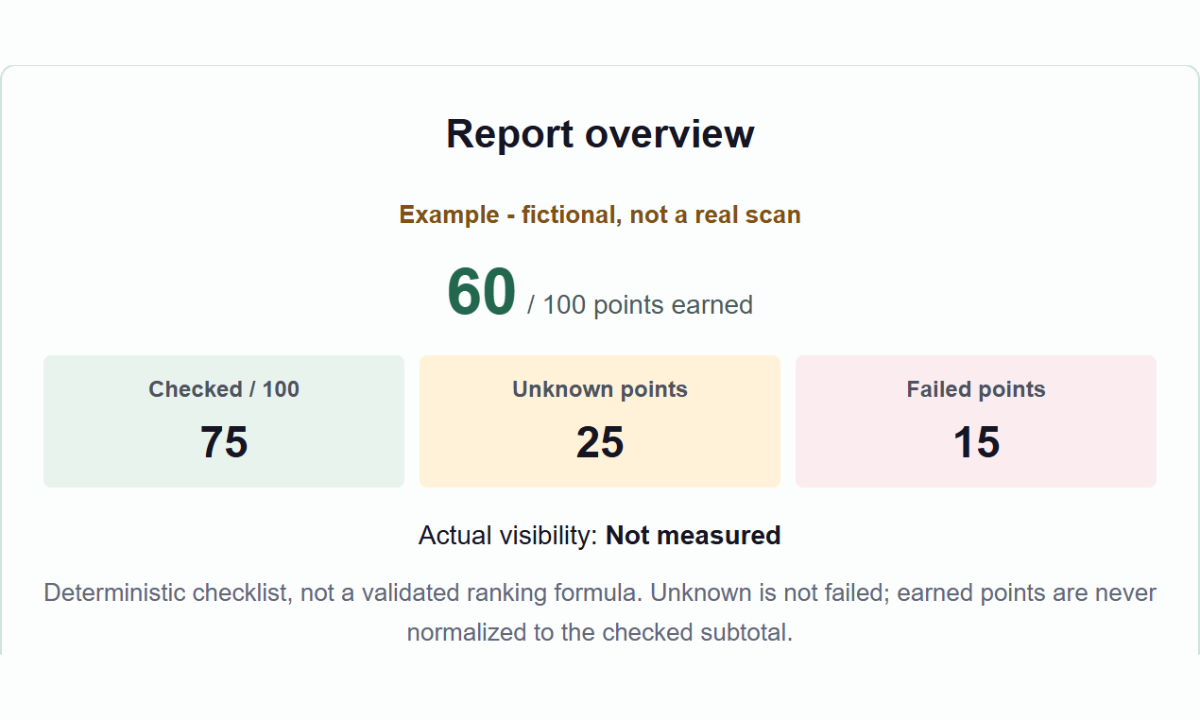
Report overview
No current report
- Checked / 100
- —
- Unknown points
- —
- Failed points
- —
Actual visibility: Not measured
Deterministic checklist, not a validated ranking formula. Unknown is not failed; earned points are never normalized to the checked subtotal.
A current report will include page scope, evidence, crawler file rules, and next steps.
Critical findings
Recommended next steps
All 20 checks
Each check is worth 5 points. Pass earns 5; fail earns 0; unknown leaves 5 points unverified.
Crawler file-rule observations
Not blocked means only that no matching disallow was observed in the file. It is not a real crawler-access test or proof of a bot visit.
Scope and limitations
Start with a page you are authorized to check, then read the evidence before deciding what to change. This free checker describes a bounded response from one URL, not your entire website or an AI engine’s opinion. The guides below help you investigate specific questions without turning a checklist into a promise of citations.
Choose the page and the decision first
A useful review begins with a decision you can actually make. Perhaps a documentation page describes a discontinued integration, a service page hides its delivery region, or a public product description seems difficult to identify outside its visual layout. Pick the exact page involved, not automatically the homepage. The checker requests that page and the relevant robots.txt only. It does not follow the navigation to assemble a more complete business profile. Write down the practical question beside your report so that a later edit solves the original problem instead of merely changing a number on a dashboard.
For example, imagine that Juniper Ledger publishes a public page about its invoice approval workflow. The team wants to know whether the returned page identifies the product, exposes readable headings, and includes useful supporting context. They submit the workflow page rather than a campaign redirect or an account dashboard. A successful request can supply observations about that response. It cannot determine whether finance teams prefer the product, whether the business meets regulatory obligations, or whether an answer engine will recommend it. Those questions require evidence that the request does not contain.
Use a public HTTPS URL without login details, a query string, or a nonstandard port. A fragment identifying a section may be discarded because the server requests the page itself. If your normal link contains campaign parameters, find the clean public destination before continuing. Do not enter a customer portal, a private preview, or a signed document link. An input refusal is a boundary of this service, not a verdict on your content. You can still inspect the page through your own authorized workflow and decide whether its intended audience should have access.
Understand what leaves the browser
This tool is different from a calculator that runs entirely on your device. When you choose Check page, the submitted URL goes to a dedicated endpoint on our site. Our server resolves the public hostname and requests the permitted resources. The target site therefore receives a request from our hosting environment. The checker does not send your browser cookies, account credentials, or an authenticated session to that site. It also does not execute the target page’s JavaScript or automatically load its images, embeds, stylesheets, or linked documents to complete the review.
Permission matters even when a page is publicly reachable. Check a page you own, administer, or are authorized to review, and avoid using the service as an automated collection mechanism. The request is intentionally small in scope, with strict response sizes, redirect rules, time limits, and public rate controls. It is not a replacement for a crawler you operate under an established agreement. If a host presents a challenge or refuses access, the appropriate next step is to investigate through authorized channels, not to disguise the request or repeatedly try variations until a restriction is bypassed.
The tool does not store the submitted URL or fetched page content as a saved report. Ordinary hosting logs, security systems, and site analytics may still operate, so this is not a promise that no server ever sees the URL. Short-lived operational counters use salted identifiers for traffic control rather than keeping page content. Your copied or downloaded report becomes a separate document under your control. Before sharing it, inspect the submitted and final URLs, quoted evidence, and any business details in the title. Public information can still be inappropriate for a particular recipient or project folder.
Read the response boundaries before the rows
The report identifies the submitted URL, the final URL, the check time, and the rules version. These fields describe the observation you are looking at. A redirect can change the path or the permitted hostname variant, which means the final page may differ from the link you expected to inspect. Compare both addresses before interpreting a title mismatch as a content defect. If your content system intentionally consolidates an old article into a newer resource, the final response may be correct even though the original address no longer represents a separate document.
Only a bounded HTML response is analyzed. Content that appears after browser scripts run may not be present in that response, and the checker does not render an application to discover it. Consider a fictional equipment page whose specifications are loaded after an interactive selector changes. A visitor may see an excellent comparison while the initial HTML offers very little text. The report describes the returned material, not every state of the application. Review the source and the actual user journey together before assigning an engineering task. Missing evidence can identify a question without answering its cause.
Resource limits also shape what can be observed. A very large response, an excessive element count, an unsupported redirect, or an elapsed request budget can stop the check instead of producing a complete report. The request budget is 25 seconds; hosting DNS resolution may add time. Do not translate a stopped analysis into a failed readiness score. It means this service could not complete its defined procedure for that resource. Record the message and investigate the boundary with your own hosting tools. The crawler access and robots.txt guide separates file observations from broader access questions.
Keep earned, checked and unknown points together
The checklist contains twenty observations worth five points each. A passed observation contributes earned points, a failed observation contributes failed points, and an unknown observation leaves its points unknown. Checked points represent the observations resolved as pass or fail. The total remains one hundred; the checker does not convert the earned share of checked points into a new percentage. This makes incomplete coverage visible. A report with sixty earned points, twenty failed points, and twenty unknown points means exactly that distribution, not a claim that the page has achieved seventy-five percent AI visibility.
Unknown is useful information when its reason is preserved. It may reflect unavailable evidence or a situation where a particular indicator cannot be established meaningfully from the response. Forcing every uncertainty into fail would make a short, specialized page look defective for reasons unrelated to its purpose. Forcing it into pass would conceal the absence of evidence. Keep the row’s explanation with its status when discussing the result. A teammate who sees only a headline number cannot tell whether you reviewed the same amount of information as an earlier run or whether access changed between observations.
Treat the weights as the disclosed design of this checklist, not a validated ranking formula. Each row has the same numerical weight, but its practical importance depends on your page and the underlying evidence. A missing descriptive title and a deliberate restriction on indexing do not create the same business decision merely because each row has five points. Critical findings remain separate so that an apparently comfortable total does not distract from a blocking issue. The score explanation guide covers the accounting in more detail without assigning invented ratings to individual AI services.
Apply the evidence
Review one page before planning the work
Use the current public response to identify a specific question, then keep the evidence with the task you assign.
Turn a finding into a bounded work item
Begin with the row’s evidence and ask what a person can verify. A useful work item names the page, the observed condition, the intended change, and a way to confirm the result. Avoid tasks such as improve AI readiness everywhere, which hide both ownership and completion criteria. If the report quotes a heading that you judge uninformative, capture that heading and response date. Ask the page owner whether it accurately describes the product or topic. The change should improve a real reader’s understanding, not add a phrase only because an automated check happens to recognize it.
Suppose a fictional workshop lists a course under the heading Welcome while the page title names a separate event series. The editor can first confirm which course the page actually sells, then align the visible description and metadata with that confirmed offering. The completion test might be a source review and a new report showing the intended title and heading. It should also include reading the page in context. An automatic pass after repeating the product name does not prove that dates, price, prerequisites, or booking terms are now accurate; those facts remain the responsibility of the publisher.
Assign one owner to each proposed change and preserve the reason for any deliberate exception. Some pages intentionally omit an author name, use a compact structure, or direct readers to a separate technical reference. The checker can surface an indicator without knowing that decision. A documented exception is more useful than a cosmetic edit made to remove a warning. For decisions about the substance of an offer, consult the product page guide. For the wording and organization of an explanation, the clear content guide provides a different, reader-focused review.
Use the fictional example as a reading exercise
Load example provides a local fictional report so you can inspect the interface without requesting an outside page. Its purpose is to demonstrate the relationship between the point summary, the check rows, the bot observations, and the next actions. It is not a benchmark site or a sample of actual search performance. Read the mode label before sharing an example export. A demonstration can show how to interpret a finding, but it cannot stand in for a live request to your page or establish that a particular configuration works on your hosting environment.
In a short team exercise, ask one reviewer to summarize the fictional report using only the headline number, then ask another to include coverage and critical findings. The second account should be more useful because it describes what was checked and what remains unresolved. Next, choose one row and rewrite its recommendation as an internal task with an owner and a verification step. This exercise tests your reporting practice, not the quality of an imaginary business. It also makes it easier to notice when an automated recommendation needs human context before it belongs in a production backlog.
Clear removes the current result from the interface and makes its copy and download actions unavailable. Editing the URL or starting another check likewise invalidates an older result so that you do not accidentally export findings for the previous input. A cancellation in the browser does not guarantee that a server request stops at the same instant; the bounded server operation may finish independently. Keep that distinction in mind when testing controls. A cleared interface means there is no current report ready to export, not that every already transmitted request or separately saved file has been erased.
Save a report that another person can interpret
Copy report and Download TXT preserve a readable account of the current result. Before using either action, confirm that the mode, address, and check time match the work you intend to discuss. The report should travel with its evidence and limits, not as a detached screenshot of points. A text file is convenient for an issue tracker, a handoff document, or a comparison folder because a teammate can quote a row without retyping it. It is still an observation from one run, not an independently certified audit or proof that the page has been indexed.
Keep a small review record outside the checker when changes span several people. One practical convention is a folder containing the original TXT, the approved change request, the release date, and a later TXT from the same clean URL. Add a human note if the page redirected, the template changed, or the amount of checked evidence differed. Those details prevent an apparent score movement from being mistaken for a controlled experiment. You do not need a complex reporting system, but you do need enough context for someone who was not present during the first review to understand the comparison.
Do not use the report as evidence of actual mentions, recommendations, or citation frequency. Those require observations from the relevant services or appropriately scoped first-party data. This version does not import answer collections, connect search accounts, or analyze engine performance reports. A separate manual record can document those activities, but it should not be blended into this checklist total. The visibility measurement guide explains how to keep that distinction clear. A readiness improvement and a change in observed visibility can occur together without proving that one caused the other.
Close the review with a deliberate retest
Retest after the intended release has reached the public page, using the same clean address whenever that remains the correct destination. Check the final URL and response scope again before comparing individual rows. A cached response, a changed redirect, or a different template can explain an unexpected result. Read the new evidence alongside the earlier record instead of assuming that every changed status reflects your edit. If the checker cannot complete the new request, retain the error separately and investigate it; do not fill the missing result with a guessed score or carry the old result forward as current.
For a small team, the review can end with three explicit outcomes: changes confirmed in the response, deliberate exceptions documented, and unresolved questions assigned elsewhere. This is more actionable than asking every owner to pursue a perfect total. Some concerns belong with hosting, some with the editor, and some require a product decision before either person can act. The improvement prioritization guide helps organize that work. Keep the public-page check as one source of evidence within the process, with its boundaries visible, rather than treating it as the final authority on what the business should publish.
SMTasker can be relevant when the follow-up becomes operational work across your own applications. Skye and MCP workflows can help organize approved tasks, prepare content, and coordinate routine application actions within the capabilities you actually use. They are not an SEO ranking or citation service, and this checker does not turn their activity into an AI visibility guarantee. Start with the free result and its evidence. Explore SMTasker only when the next problem is carrying out a repeatable workflow, while keeping the editorial judgment, access decisions, and verification responsibilities with the people who own them.
Investigate the next question
AI search readiness guides
Separate access, page clarity, checklist interpretation and evidence of actual visibility.
AI Crawler Access
Read path-specific crawler rules, separate search from training, and investigate access limits without claiming verified bot visits.
Read the guideAI-Ready Product Pages
Review product identity, variants, specifications, evidence, and buying conditions without mistaking markup for AI visibility.
Read the guideClear Content for AI Search
Clarify scope, definitions, instructions, evidence, and ownership on knowledge and service pages without writing for a citation formula.
Read the guideReadiness Score Explained
Understand every five-point check, keep unknown evidence visible, and read a readiness total without turning it into an AI ranking.
Read the guideMeasure AI Visibility
Build a repeatable prompt sample, distinguish mentions from citations, and review Google and Bing reports separately.
Read the guidePrioritize Improvements
Separate confirmed issues from unknowns, sequence practical page changes, and define evidence-based completion checks.
Read the guideQuestions about this page check
Does this measure whether AI services recommend my site?
No. Actual AI visibility is not measured. The report describes a deterministic checklist applied to one returned public page and robots.txt, not answer-engine citations, rankings, traffic or recommendations.
Is the check entirely private and browser-only?
No. A live check sends the submitted URL to our server, which requests the permitted public resources. The tool does not save URLs or fetched content as reports, but ordinary hosting, security logs and site analytics may remain.
Why can points remain unknown?
Some evidence may be unavailable or not meaningfully established from the response. Unknown points stay separate from earned and failed points; the total is not renormalized to hide incomplete coverage.
Does an unblocked bot row prove access?
No. It is an observation of the relevant robots.txt rules for the page path, not a request made by that real crawler or a test of its firewall treatment. GPTBot is labeled separately as training.
Can I check a whole website or save a PDF?
This version checks only the submitted page and the relevant robots.txt, not a whole site. Copy report and Download TXT are available for the current report; there is no PDF, account integration or saved report history.
A practical next step
Keep the finding and its limits together
Run a bounded review, inspect the critical findings and save a TXT record before making changes.