Find the next step worth improving
Social Media Funnel & Conversion Analyzer
Turn supplied stage counts into a useful review. Keep mixed totals separate from tracked people, inspect defined conversion steps, and explore one clearly labeled what-if.
A smaller rate with a clear context
From a stage count to a focused question
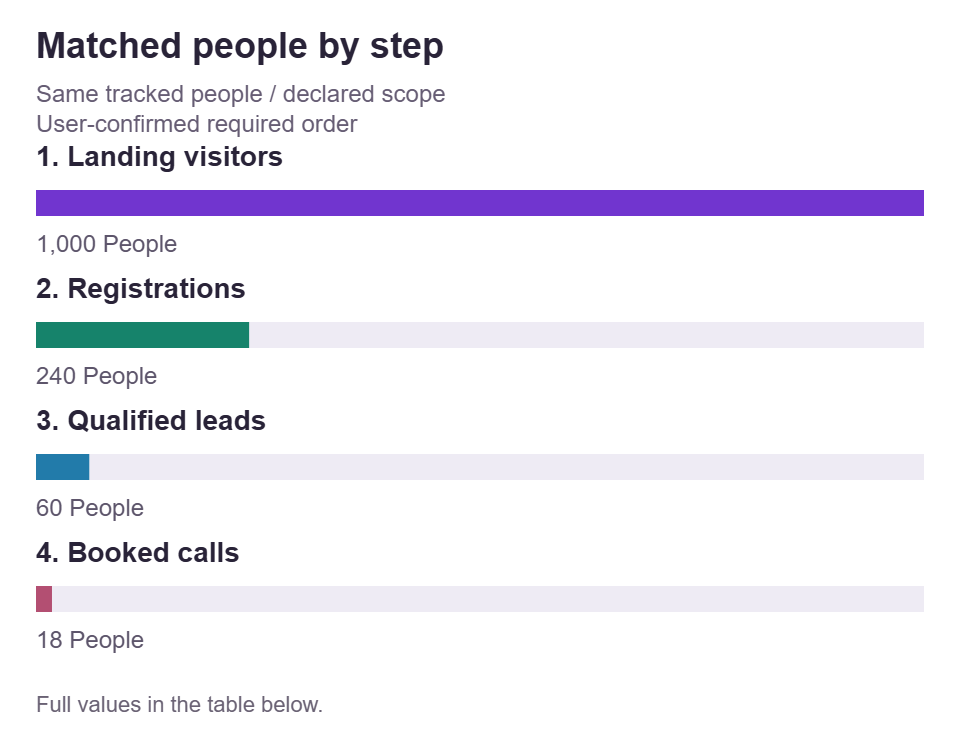
Fictional tracked cohort: 60 qualified leads become 18 booked calls. A separate 25% registration-to-qualification step can be reviewed without claiming every view was a unique prospect.
Use the counts you can actually explain
Review the path, one step at a time
Choose the interpretation before reading a percentage. The same arithmetic can describe different things when the counting unit changes.
Your stage counts
Stage ratios can compare different counting units. Matched people is only for the same deduplicated group following the required order. Changing a label does not convert the data.
Every unit must be People and later known counts cannot exceed earlier ones. This is your declaration, not a tracking verification.
Import stages from CSV
Paste requires Replace stages. Opening a file applies valid rows after asking before unsaved replacement. The template has fictional rows only, not the interpretation or scope. Review these settings separately.
Your stage review
Bars show the supplied counts. Mixed units are not a measured sequence of unique people.
| Transition and inputs | Stage ratio | Status |
|---|
Review definitions, the reporting window and eligibility before treating one step as a problem. This tool does not collect analytics or prove attribution.
The supplied counts are processed in this browser without a social login or upload. There is no autosave. Projects, copied reviews, CSV and PDF attachments include all stages, scope, units and scenario assumptions. Check private labels before sharing. Review CSV is not the input template; project JSON reopens the full draft.
How the review is built
A clear denominator before a bigger promise
Name the path
Keep each count beside its actual counting unit and reporting scope.
Read the right rate
Compare adjacent totals, or use a declared matched-people sequence.
Test one assumption
Change a selected rate while holding other cohort rates fixed.
Choose a question your supplied counts can answer
A useful social media funnel review begins with a decision, not a diagram. Perhaps your team wants to understand whether visitors complete a registration, whether registered people meet a qualification rule, or whether qualified people book a call. Those questions need different evidence from a comparison of views and clicks. This analyzer organizes three to six supplied stages and calculates the relationships that your chosen interpretation permits. It cannot establish that a person saw a post before reaching your website. Write down the handoff you want to inspect, the action that matters, and the records you actually possess before entering attractive headline totals.
Under Interpretation, choose Stage ratios when the rows are unrelated totals, differently counted activities, or observations whose membership is unknown. Choose Matched people only for the same deduplicated group followed through the required order within your declared window. That second choice needs evidence outside the calculator: a later person must belong to the preceding stage, not simply resemble its audience. A shared date range, a descending sequence, and a familiar platform name are insufficient. The conversion rate versus stage ratio guide explains the eligible denominator and identity questions that determine which interpretation you can defend.
Platform supplies context for Instagram, TikTok, YouTube, Facebook, LinkedIn, Threads, X, Snapchat, or Reddit. It does not alter the arithmetic, fetch a native metric, or make the counts comparable. Use Account label to identify the review and Reporting scope to describe its window, population, and inclusion rule. For example, distinguish a month of account activity from people who entered a particular signup journey during that month and completed it by a stated cutoff. Keep the underlying definitions with your evidence. The labels make a report understandable, but neither those labels nor a confirmation checkbox verifies the tracking that produced your numbers.
Build a short stage record with explicit units
For each row, enter Stage name, Count, and Unit. Name the observation precisely enough that another reviewer can identify its completion rule. A label such as Qualified leads needs a separate definition of qualification; the word alone does not create one. Count accepts whole numbers from zero through one trillion, while an empty count means unknown. Unit distinguishes people, views, impressions, visits, clicks, messages, leads, bookings, and orders. These choices describe your records rather than converting them. A booking event and a person who booked are different quantities, even when both happen to total eighteen in a small example.
Use Add stage to expand the sequence, keeping between three and six rows. Move stage up and Move stage down change the declared order, while Remove stage deletes a row when the minimum allows it. Think about that order before calculating: qualification after registration describes a different required path from registration after qualification. Reordering or removing a stage clears Scenario stage so an old assumption cannot quietly attach to a different handoff. Switching Interpretation also does not deduplicate counts, change Unit to people, or confirm your tracking. If you need to prepare a valid people cohort, do that work in the authorized records that contain the necessary evidence.
CSV template provides four fictional rows with the exact headers stage_id, stage_name, unit, and count. Prepare only those columns; the review download is a different file. Paste CSV holds text until you choose Replace stages, whereas Open CSV can replace the rows after validation and any requested unsaved-work confirmation. These actions keep the current project context rather than importing a platform connection or an interpretation from the CSV. Blank counts remain unknown, and plain whole-number counts must not contain separators, signs, or exponent notation. Clear paste removes uncommitted text. Resolve that pending paste before Analyze funnel or Save project so the recorded stages match your intention.
Check the fictional workshop example by hand
Load example supplies the account Fictional workshop team and the scope Same tracked signup cohort. Its four stages are Landing visitors 1000, Registrations 240, Qualified leads 60, and Booked calls 18, all counted as people. The example selects Matched people and supplies the required confirmation because its invented premise is one ordered, deduplicated group. This is a teaching record, not an account result or an industry benchmark. Its numbers let you inspect the formulas without supplying private business information. The CSV template contains those four stage rows only; opening that template does not carry the example’s mode, confirmation, account, or scope with it.
For each adjacent pair with a known positive starting count, divide the later count by the earlier count and multiply by one hundred. The workshop therefore has 240 divided by 1000, or 24 percent; 60 divided by 240, or 25 percent; and 18 divided by 60, or 30 percent. Because these are declared nested people stages, the corresponding differences are 760, 180, and 42 people. Overall conversion is 18 divided by 1000, or 1.8 percent. The first handoff has both the lowest stage rate and the largest stage loss in this particular record. Other sequences can give those distinctions to different handoffs.
The example’s Scenario stage is the transition into Qualified leads, with New stage rate (%) set to 30. Replacing its original 25 percent while holding the first count and the other supplied transition rates fixed gives 1000 multiplied by 0.24, 0.30, and 0.30: 21.6 modeled booked calls. Against the supplied final count of 18, the difference is 3.6 and the relative difference is 20 percent. The fractional output is deliberate model arithmetic, not a promise of partial customers or guaranteed extra bookings. Keep the fictional premise visible when demonstrating it, and replace every relevant input before discussing a real review.
Read mixed activity totals as ratios rather than losses
Stage ratios answers how large one supplied total is relative to the adjacent supplied total. It does not answer what proportion of the same people progressed. Suppose a separate activity worksheet contains 800 visits, 1040 clicks, and 130 leads. Its adjacent ratios are 130 percent and 12.5 percent. The first result is allowed because repeated click events can outnumber visits, and the records might also cover different populations. There is no mathematical need to cap that ratio at one hundred. There is also no basis for reporting negative drop-off, an overall people conversion, or an improvement opportunity measured in lost individuals from those totals.
Even ratios below one hundred can be misleading when called conversion. A total of clicks divided by a total of views does not identify which viewers clicked, whether one visitor clicked repeatedly, or whether the click record includes another route. The analyzer preserves units so those questions stay visible. Matching units are not enough either: two rows labeled people can still describe different groups with no demonstrated overlap. Similarly, an average number of clicks, views, or leads cannot be combined into a unique people journey. Averages summarize their own observations; they do not supply the missing membership, ordering, or eligibility needed for cohort analysis.
Keep the useful operational question without overstating the evidence. A large change in a consistently defined activity ratio might justify checking the destination link, reviewing an offer, or reconciling collection windows. It cannot establish that social visitors abandoned a particular form. The Instagram salon funnel guide separates account aggregates from a linked booking cohort, while the YouTube tutorial funnel guide starts its people analysis at an independently supported resource journey. In either case, platform activity can remain context without being forced into the first stage of a person-level sequence.
Preserve unknown counts and zero denominators
An empty Count means the measurement is unavailable, not that nobody completed the step. If a registration total is missing, both adjacent transitions involving it lack a calculable rate. Filling the cell with zero would manufacture a complete failure at one handoff and an unusable denominator at the next. Leave the gap visible until you have the appropriate record. Known first and final counts can still support overall conversion in a valid declared people cohort with a positive first count, even when an intermediate count is unknown. That endpoint result does not reveal either missing stage rate or explain where the unobserved progression occurred.
Zero has a narrower, meaningful role. From a positive starting count to a known zero, the stage rate is zero percent. From a zero starting count, division is unavailable rather than zero percent, regardless of the later value. In Matched people, a later known positive count after an earlier known zero also contradicts the required nested sequence. The validation compares known counts across unknown gaps, so hiding the intervening value cannot repair that conflict. Investigate whether the counts use different windows, include bypass routes, or measure events instead of people. Do not change a truthful zero to a blank merely to make an invalid sequence pass.
The scenario has stricter completeness needs than the ordinary transition review. Every stage count must be known, and every transition’s input count must be positive; only the final count may be zero. Otherwise a fixed downstream rate cannot be recovered from your supplied record. The tool gives a reason instead of inserting an assumed rate. For example, a known final zero can coexist with a valid scenario when all preceding counts are positive, but the relative change remains unavailable because the baseline final count is zero. Distinguish this missing relative comparison from the modeled final count and absolute difference that the assumptions may still support.
Use review priorities without inventing a winner
In Matched people, the lowest available stage rate identifies the smallest observed progression proportion. The largest available stage loss identifies the greatest difference in people between adjacent known counts. These are separate review lenses, not competing names for one score. A large starting group can lose many people despite a higher progression rate, while a small late-stage group can have the lowest rate with relatively few people involved. Read the counts and stage definitions alongside both summaries. If rates or differences tie, the earlier transition is selected, which makes the review repeatable without claiming that the earlier handoff is more important to the business.
A review priority is not a causal diagnosis. People may be ineligible for the next step, decide the offer is unsuitable, or still be inside an unfinished decision window. Some exclusions can be intentional and useful. Before redesigning a form, inspect whether its starting population actually had the opportunity to complete it. Before treating a qualification loss as a problem, check whether qualification protects the service from unsuitable demand. The funnel drop-off analysis guide develops a practical review sequence. The analyzer supplies arithmetic prompts, not significance tests, attribution proof, a universal benchmark, or a ranking of which change will create the most value.
Prepare a short action note outside the calculator that names the selected handoff, the observed count relationship, and the next evidence check. For a registration review, that could mean checking whether a mobile form accepts the required fields and whether late submissions are included consistently. For a booking review, it might mean checking available appointment inventory before editing the invitation. Assign a person to verify the issue and set a collection cutoff for the next review. Do not add losses from multiple stages as a measure of separate opportunities, or present several fixed-rate scenarios as independent gains that can all be collected together.
Explore one fixed-rate assumption at a time
Scenario stage selects a nonfirst stage, meaning the transition into that stage is the one replaced. New stage rate (%) accepts a value from zero through one hundred with up to two decimal places. The scenario requires Matched people, the explicit tracked-group confirmation, people units throughout, nonincreasing counts, complete observations, and positive input denominators. Those checks establish internal eligibility for the arithmetic, not independent proof of the cohort. If your only evidence is a profile total followed by a website total, changing their unit labels and checking the confirmation does not make the scenario defensible. Keep Stage ratios for that record and collect better downstream evidence separately.
The calculation keeps the original first count and every other supplied adjacent rate fixed, substitutes the selected percentage, and multiplies through to the final stage. It does not use a growth model, infer demand, or estimate how a real change would affect later behavior. Improving a signup experience could change the composition of signups and their later qualification rate, which this fixed-rate assumption deliberately does not model. Report the selected transition, old rate, new rate, and unchanged rates together. A modeled result without those assumptions looks like a forecast even though the calculator has no evidence for a forecast or a causal estimate.
A lower New stage rate (%) is allowed and can reduce the modeled final total. That makes the control useful for sensitivity discussions as well as improvement discussions. Keep fractions through the calculation and distinguish display rounding from whole people actually observed. When the baseline final count is positive, relative difference is the absolute modeled difference divided by that baseline, multiplied by one hundred. It is not a percentage-point change in the selected stage rate. In the workshop example, five percentage points at the qualification handoff correspond to a 20 percent relative difference in the modeled final count under the stated fixed-rate assumptions only.
Keep a reproducible handoff separate from account execution
After entering or replacing stages, choose Analyze funnel to create the current review. Editing the project clears result-dependent output, so run it again before Copy results, Download CSV, or Download PDF. Save project downloads the editable JSON without requiring an analysis, and Open project restores that record after validation. There is no persistent browser history for this tool. Save a deliberate version before closing or replacing important work. The review CSV records inputs, results, and method; it is not the four-column input template. Preserve the JSON when the goal is a lossless return to the same account context, interpretation, stages, and scenario settings.
Review the full report before sharing it. A useful handoff includes Account label, Reporting scope, units, all stage counts, unavailable transitions, and the interpretation that governed the calculations. The PDF also carries complete project JSON and review CSV attachments, so private labels can remain accessible beyond the visible summary. Local calculation does not make a downloaded file private after you send it. Use neutral references where appropriate, retain the source definitions separately, and tell the recipient which facts were observed and which values were modeled. A polished chart cannot replace the evidence needed to verify the ordered people sequence or its observation cutoff.
An approved account routine is a separate operational task. SMTasker supports nine social platforms through connected Android devices with a Windows or Mac client. Built-in Skye helps prepare supported workspace changes; MCP connects compatible assistants with chosen permissions. Neither supplies this calculator with a CRM cohort or attribution trail. Keep customer matching, booking records, and measurement checks in the systems that actually hold them. Bring the review back to one practical commitment: the handoff to inspect, the responsible owner, the evidence to collect, and the next comparable review window. That is more actionable than treating a modeled decimal as promised demand.
Make the path fit the platform
Platform and measurement guides
Each guide uses its own example, counting decisions and next-step review. Start with the source of your traffic or a specific measurement question.
Instagram Conversion Funnel
Compare a salon’s supplied profile activity totals, then review a separate matched people journey from booking page to confirmed client.
Read the guideTikTok Conversion Funnel
Follow a sewing-pattern launch from mixed TikTok activity totals to a separate 960-person signup cohort, without treating views as unique visitors.
Read the guideYouTube Conversion Funnel
Follow a fictional tutorial resource cohort through signup, verification, and attendance without treating video views as unique website visitors.
Read the guideFacebook Conversion Funnel
Review a local ceramics class with 640 tracked landing visitors, 160 registrants, 120 confirmations and 96 attendees, keeping event interest separate.
Read the guideLinkedIn Conversion Funnel
Examine an operations advisory offer with 420 tracked people, 168 inquiries, 84 qualified contacts and 21 booked calls, separate from LinkedIn totals.
Read the guideThreads Conversion Funnel
Review supplied Threads link signals, then examine a separately tracked resource-to-consultation cohort without inventing viewer identities.
Read the guideX Product Activation Funnel
Separate X outbound-click totals from website arrivals and work through a verified landing-to-trial activation cohort with exact scenario arithmetic.
Read the guideSnapchat Registration Funnel
Distinguish Snap Views, destination interactions, and landing visits before reviewing a tracked registration-to-attendance sequence for a pop-up event.
Read the guideReddit Referral Funnel
Review Reddit referral totals without joining anonymous readers, then analyze a verified newsletter-to-workshop people sequence with consistent definitions.
Read the guideConversion Rate vs Stage Ratio
Check eligibility, unique people, repeated events, unknown counts, and ordered membership before interpreting a percentage as conversion.
Read the guideFunnel Drop-off Analysis
Review a 1200-person repair-workshop cohort where the largest loss and lowest rate differ, then inspect fractional, lower-target and zero-baseline scenarios.
Read the guideQuestions about social media funnel analysis
Can this tool connect to my social analytics or booking system?
No. It calculates from manually supplied counts or its strict local CSV format. It does not retrieve analytics, match people, collect bookings, or attribute off-site outcomes to a platform.
Why can Stage ratios show more than 100 percent?
The rows can use different units or count repeated events. A later total can exceed the earlier total. That ratio is not a measured people conversion or a drop-off calculation.
What makes a record eligible for Matched people?
You must have evidence for the same deduplicated people completing the required sequence within the declared window, select people units, and confirm that premise. Known counts must not increase. The controls do not independently verify your tracking.
Should I enter zero when a stage count is missing?
No. Leave an unknown count empty. Zero means a known count of none. A zero denominator makes its transition rate unavailable, rather than automatically producing zero percent.
Does the scenario predict extra leads or bookings?
No. It replaces one stage rate while holding the first count and all other supplied rates fixed. It requires a complete eligible people cohort with positive transition inputs and preserves fractional model results.
Put the approved routine into practice
Organize the account work after the review
Explore SMTasker for supported Android social workflows, with Skye and MCP options. Customer tracking and funnel measurement stay separate.