Most social media managers approach Meta’s Threads with an outdated playbook. They take the broadcast mindset perfected on platforms like X or LinkedIn—publishing polished corporate statements, link drops, and self-serving promotional announcements—and wonder why their posts languish in obscurity with three likes and zero replies. The reality is simple: Threads is not a broadcast network. It was engineered from its foundation as a conversation engine, and its recommendation algorithm evaluates content through an entirely different lens.
If you manage multiple brand accounts or run organic social growth for clients, cracking the Threads algorithm is one of the highest-leverage opportunities available today. While traditional feeds continue to suppress organic reach and demand pay-to-play ad spend, Threads still provides massive algorithmic distribution for accounts that understand its underlying mechanics. Meta’s multi-layered machine learning models are designed to surface compelling, authentic community dialogue rather than static declarations.
According to longitudinal research on social media adoption, user behaviors across digital ecosystems are fragmenting rapidly toward niche, text-first, and community-driven interactions. To capitalize on this shift, marketers must transition from broadcasting announcements to engineering active discussions. This guide breaks down the core signals that govern the Threads recommendation system, reveals how reply velocity unlocks explosive distribution, and provides a tactical framework to spark viral conversational loops across your profiles.

Conversation Density and Nested Reply Depth
To succeed on Threads, you have to understand what the recommendation engine is actually optimizing for. On image-first platforms, the primary signals are dwell time, saves, and shares. On traditional microblogging platforms, retweets or reposts historically served as the primary viral multiplier. On Threads, however, simple reposts carry surprisingly little weight. Instead, the algorithm evaluates two interrelated metrics above all others: conversation density and nested reply depth.
Conversation density measures the ratio of substantive replies to total post impressions. A post that receives 500 impressions and generates 45 active comments exhibits significantly higher conversational density than a post with 10,000 impressions and only 10 passive reactions. Threads interprets high conversation density as an unmistakable signal that the content has touched on a compelling, unresolved, or emotionally engaging topic that demands community participation.
Nested reply depth takes this evaluation a step further by analyzing how deep the conversational tree branches. When someone leaves a comment on your post, that is a level-one reply. When you reply back to them, or another user jumps in to challenge, clarify, or expand on that thought, you create level-two, level-three, and level-four nested replies. The Threads algorithm tracks this multi-turn dialogue closely. A post with 20 original comments that branch into 80 nested back-and-forth exchanges will dramatically outperform a post with 100 isolated, one-off comments containing nothing more than thumbs-up emojis.
Industry analyses detailing best practices for community engagement on Threads highlight that genuine back-and-forth exchanges demonstrate authenticity to Meta’s automated scoring systems. The algorithm recognizes that two users arguing respectfully about a workflow or exchanging advice represents genuine human connection—the explicit product goal of Threads. Consequently, content exhibiting deep nested reply chains is systematically plucked from the chronological Following feed and pushed directly onto the high-traffic For You discovery surface.
Mastering the Reply Velocity Window
Understanding what the algorithm values is only half the battle; timing is what triggers exponential distribution. The foundational concept here is reply velocity: the rate at which unique users leave comments on your post within the opening minutes of publication.
When you publish a post on Threads, Meta’s recommendation engine does not instantly broadcast it to millions of feeds. Instead, the post enters an initial evaluation phase. It is served to a localized test cohort—typically a fraction of your active followers and a small cluster of non-followers whose historical interest graphs align with your topic. During this initial window, which lasts roughly 15 to 30 minutes, the algorithm monitors interaction speeds in real time.
If your post achieves high reply velocity—generating 15 to 30 substantive replies within the first quarter-hour—the scoring algorithm calculates a steep velocity curve. It assumes the topic is timely, polarizing, or exceptionally valuable, and immediately expands distribution to a secondary, larger audience tier. If that tier maintains the velocity threshold, the post breaks out of your follower graph entirely and lands on the global For You feed.
Operationalizing the Creator-in-the-Room Rule
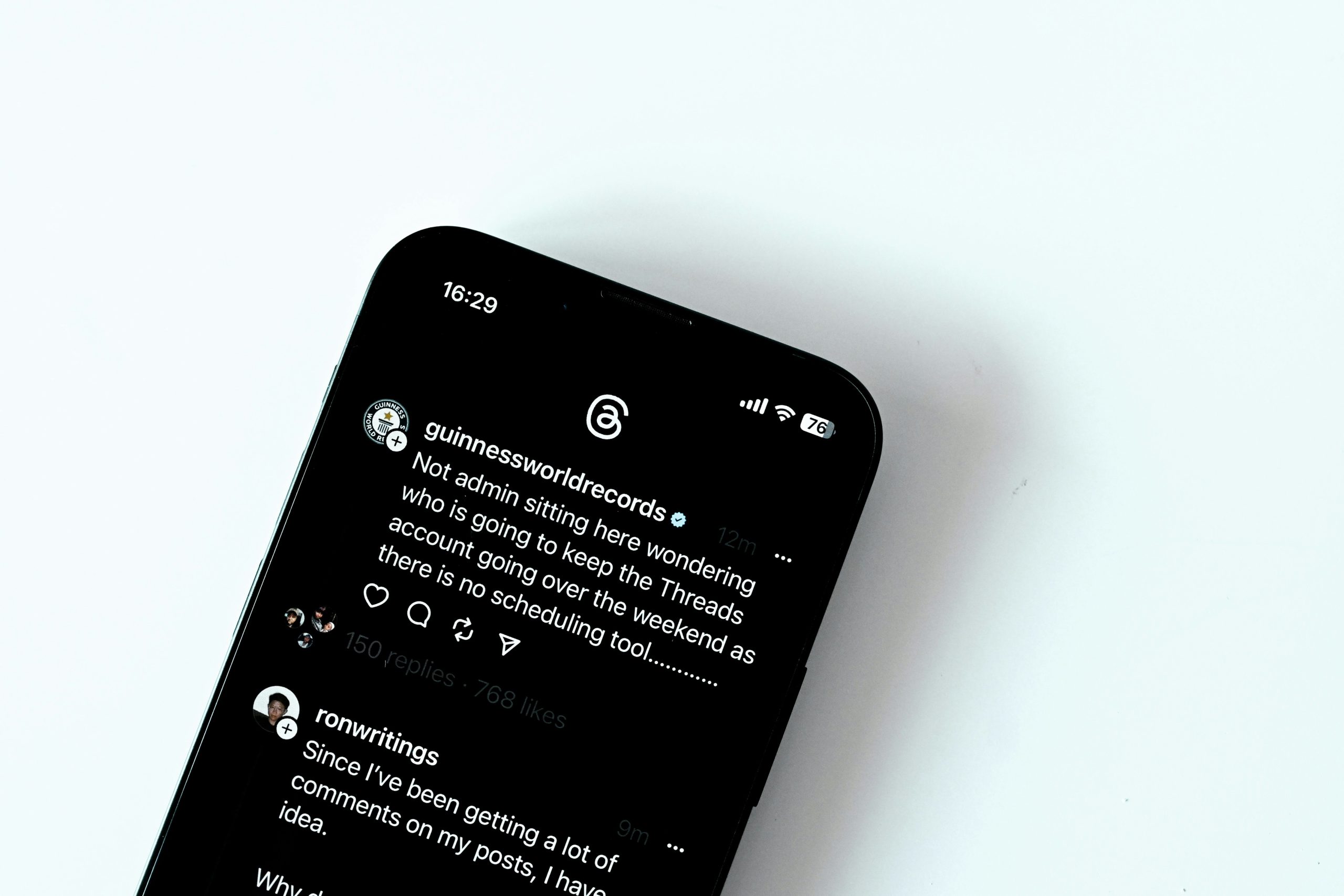
For social media managers overseeing multiple client profiles, the biggest mistake is treating Threads like a “schedule-and-forget” network. If you schedule a post for 10:00 AM and do not open the app until 2:00 PM, you effectively sabotage your own reach. You must implement the Creator-in-the-Room rule: whoever manages the account must be actively present during the first 20 minutes post-launch.
- Acknowledge and Provoke: Never reply with a dead-end statement like “Thanks for sharing!” Always answer a comment with a counter-question or a request for clarification to prompt another nested reply.
- Connect Commenters to Each Other: If User A expresses an opinion and User B shares an opposing view in a separate comment, tag them into a single reply thread: “@UserB has an interesting take on this—how do you handle that constraint in your workflow?” This immediately spawns a multi-user nested thread.
- Double Your Velocity Math: Every time you respond thoughtfully to a commenter within the opening 15 minutes, you mathematically double the post’s total comment volume and signal rapid engagement to the recommendation engine.
Preparing this interactive flow ahead of time is critical. High-performing social media teams frequently use a dedicated threads post builder to draft, structure, and format debate hooks with intentional visual breaks, ensuring the core premise is immediately readable on mobile screens before the publishing sprint begins.
Writing Open-Ended Debate Prompts That Ignite Comments
You cannot achieve high reply velocity with bland, corporate declarations. People do not comment on social feeds to agree with obvious statements; they comment to defend their identity, showcase their expertise, debate differing methodologies, or seek validation from peers. To spark 50+ comments in under 15 minutes, you must master the art of writing open-ended debate prompts.
A successful debate prompt balances three components: low barrier to entry, strong professional or cultural stakes, and an unresolved tension. If a prompt requires writing a five-paragraph essay, people scroll past. If it can be answered with a simple “yes” or “no,” it generates zero nested depth. The prompt must demand a personal perspective that can be delivered in one or two punchy sentences.
Four Battle-Tested Conversational Hook Frameworks
Below are four specific hook templates designed to generate immediate comment volume, along with realistic scenarios across B2B, agency, and direct-to-consumer sectors:
- The Polarizing Process Hook: Challenges conventional industry best practices and invites practitioners to defend their preferred workflow.
Example (B2B SaaS / Agency): “Most marketing teams spend 6 hours every Friday compiling slide decks their clients skim for 45 seconds. We replaced our weekly reports with a 3-minute video and a live dashboard link. What is the one standard agency deliverable you think is complete theater?” - The Unpopular Stance with Context Hook: Takes a definitive, mildly contrarian position on a trending topic, followed by an immediate invitation to disagree.
Example (E-Commerce / Retail): “Free returns are slowly bankrupting direct-to-consumer apparel brands, and customers are starting to abuse return policies at unprecedented rates. Charging a flat $5 return fee didn’t hurt our retention—it improved our operating margin by 8%. At what point does ‘customer-first’ become bad business?” - The Crowdsourced Audit Hook: Offers real-time feedback or peer critique in exchange for public submissions, generating instant comment volume.
Example (Freelance / Design): “Drop your current homepage value proposition or brand bio below. I have 30 minutes before my next client call and will rewrite each one to eliminate corporate jargon. Be prepared for honest feedback.” - The Fill-in-the-Blank Benchmark Hook: Leverages professional curiosity and benchmarking instincts to drive rapid responses.
Example (Social Media Management): “If a prospective client demands 7 original short-form videos per week across 4 platforms with a total monthly budget under $1,500, your immediate response is ________. Wrong answers only.”

Instagram Feed Recommendations and Trending Cards
One of Threads’ most distinctive competitive advantages is its architectural integration with Instagram. Threads is not an isolated island; it operates as an upstream conversational feeder for Meta’s broader family of apps. When a Threads post reaches a critical threshold of conversation density and reply velocity, it enters the cross-pollination loop.
Meta actively embeds algorithmic “For You on Threads” carousel cards directly into the main mobile feeds of active Instagram users. This recommendation surface does not merely display posts from accounts a user already follows on Instagram; it surfaces high-velocity discussions from creators across the entire network. If your post touches on personal finance, tech stacks, or creative production and maintains strong nested engagement, Meta’s cross-app recommender system identifies it as high-value content and serves it to Instagram users who follow similar topical keywords.
To maximize this cross-platform distribution, you must align your posting strategy with established frameworks for multi-channel content promotion, recognizing that text posts on Threads frequently act as discovery funnels for your visual channels. A single debate prompt that generates 150 comments on Threads can easily yield an additional 50,000 to 100,000 passive impressions inside the Instagram feed carousel, funneling fresh followers back to your primary brand assets.
- Choose Exact Topical Relevance: Tagging a post with a generic or deceptive keyword will trigger user disinterest, lowering your dwell time and killing algorithmic distribution.
- Leverage Active Trending Clusters: Check the Search tab before publishing. If an active topic tag closely aligns with your debate prompt (for example, “Content Strategy” or “B2B Marketing”), incorporating that exact tag anchors your post inside that topic’s real-time discussion feed.
- Avoid Multi-Tag Clutter: Threads permits only one topic tag per post by design. Respecting this constraint keeps the interface clean and allows the machine learning classifier to accurately map your content’s thematic relevance.
Operational Workflows for Multi-Account Teams
For agency professionals, social media managers, and multi-brand operators, implementing this playbook across 5, 10, or 20 distinct client accounts presents significant logistical challenges. Context-switching between disparate brand voices while attempting to monitor reply velocity windows can quickly exhaust a team. Scaling these tactics requires an operational system that separates preparation from active community management.
The solution is the Batch-and-Babysit workflow. In this model, content creation and live engagement are bifurcated into separate, protected calendar blocks:
- Batch Creation Phase: During dedicated strategy sessions, draft 10 to 15 debate prompts per brand account. Focus exclusively on crafting polarizing questions, benchmarking prompts, and contrarian perspectives. Test each hook against the nested reply criteria: Does this prompt compel someone to share an opinion in under 30 seconds?
- Targeted Publishing Schedule: Space publications across distinct, non-overlapping windows. Do not publish posts across all client accounts simultaneously. Instead, stagger releases across peak engagement periods (e.g., Brand A at 8:30 AM, Brand B at 11:15 AM, Brand C at 2:00 PM).
- The 20-Minute Engagement Sprint: For each release, dedicate a 20-minute operational block where the community manager monitors incoming notifications, replies directly to initial commenters, introduces new questions, and drives nested discussion depth.
Managing this cadence manually across multiple dashboards is unsustainable. Progressive agencies rely on purpose-built solutions like threads automation to coordinate post queues, align cross-platform release times, and manage multi-account workflows efficiently. This allows human operators to focus 100% of their operational energy on live, authentic community moderation rather than administrative scheduling tasks.
Three Metrics Every Threads Manager Should Track
To accurately evaluate whether your conversational hooks are triggering algorithmic distribution, abandon vanity metrics like raw likes and follower counts. Focus on these three operational indicators:
- Nested Reply Ratio (NRR): Calculated as total comment count divided by unique top-level comments. An NRR of 2.5 or higher indicates that your audience is actively conversing with you and one another, signaling healthy algorithmic distribution.
- First-15 Velocity (F15V): The absolute number of replies logged within the first 15 minutes of publication. Establish account-specific benchmarks (e.g., aiming for 15 replies on smaller profiles and 50+ on mature accounts) to determine whether a hook achieved initial escape velocity.
- Non-Follower Discovery Percentage (NFDP): In your platform analytics, measure the proportion of total post impressions generated by accounts that do not follow your profile. High-velocity posts routinely achieve an NFDP above 75%, confirming that Meta’s For You algorithm is actively amplifying your content to cold audiences.
Master the Conversation, Own the Distribution
The Threads algorithm represents a refreshing departure from passive broadcast feeds. By rewarding conversation density, nested reply depth, and early reply velocity, Meta has created a platform where thoughtful engagement consistently outpaces superficial promotional content. Brands and agencies that adapt to this reality will unlock compounding organic reach, while those clinging to static broadcasts will find themselves speaking into an empty room.
Start treating your posts not as final pronouncements, but as the opening sentence of an unfinished debate. Plan your publishing windows around active moderation, craft prompts that challenge industry norms, and fuel the comment section within the critical first 15 minutes. When you provide the spark, the Threads algorithm will handle the fire.