
A useful listing starts with the right audience
A good product can remain almost invisible when every discovery path depends on the same social feed. A potential customer might miss your launch post, search for a category instead of your brand, or ask another founder which tool solves a particular problem. Software directories create another route into that conversation. They collect products around a need, category, platform, or launch date, giving someone who has never encountered your company a place to understand what you do and decide whether to visit.
This guide brings together 76 directories and launch platforms that we encountered while researching places to introduce SMTasker. Each had a free submission route tied to a backlink or badge when checked. They cover AI applications, SaaS, developer tools, small independent products, and broader business websites. This is a research shortlist, not a ranking of guaranteed traffic sources. Some have lengthy queues, participation requirements, or restrictions that make them unsuitable for a particular product. Their current submission pages should always be the final reference.
For a social media business, directories can complement the work already happening on Instagram, LinkedIn, TikTok, Threads, or other channels. Social content explains your approach over time; a directory profile gives an interested visitor a compact product summary, pricing model, screenshots, and a website link. Neither channel replaces the other. A useful launch plan connects them: publish a demonstration, make the listing accurate, answer questions, and give visitors a clear next step on your own site.
What directories can realistically help with
The first benefit is discovery by context. Someone browsing marketing automation tools is closer to your subject than a random person scrolling past a general announcement. The second is a durable reference: a product page can remain available after a launch week finishes. The third is learning. Comparing neighboring listings reveals which features buyers expect, which descriptions are confusing, and how competitors explain their setup requirements. Community comments can also expose questions that deserve a better answer in your documentation.
A listing may send referral traffic and make your product easier to find, but publication is not evidence of sales, search rankings, or inclusion in an AI answer. Treat a directory’s traffic totals, audience counts, and Domain Rating as its stated metrics unless you verify them independently. Domain Rating is a third-party measure, not a Google quality score. A small, relevant directory can produce more useful conversations than a larger general catalog. Measure the visitors who actually arrive and what they do after arrival.
Backlinks deserve the same practical perspective. A normal editorial reference can help readers move between useful resources. A large collection of exchanges created mainly to manipulate rankings is a different proposition: Google’s spam policies specifically discuss excessive link exchanges. Its outbound-link guidance also explains how to identify paid placements and other link relationships. Read those policies before treating a badge campaign as an SEO strategy. The dependable reason to pursue a listing is that the audience and profile can help a real prospective user.
Choose the niche before preparing the submission
Start with the job your product performs. AI directories suit software with a concrete AI capability that you can demonstrate; adding the word AI to an ordinary feature is not enough. Developer directories favor useful technical detail, platform support, documentation, and integration requirements. SaaS catalogs fit subscription software with a clear buyer and recurring use case. Independent-maker launch boards can suit focused apps, extensions, templates, and small services. Broader business directories may include agencies and professional services, but their categories still need to match your offer.
For social media tools, consider several honest entry points: content production, publishing, analytics, collaboration, marketing automation, or customer conversations. Select the categories supported by the product today. If your software requires a connected device, a desktop client, a paid AI provider, or human approval, say so. These details help the right person recognize a fit and prevent a promising click from turning into disappointment. Clear limitations often make a listing more useful than another paragraph of ambitious growth language.
Prepare a small public submission kit before opening forms: the canonical website address, a short tagline, two description lengths, a clean logo, product screenshots, pricing, trial conditions, and a business contact email. Keep account credentials in a separate private record. Use screenshots with sample data and remove customer information before uploading anything. Check for an existing listing first, especially if a teammate has already submitted the product. Managing an existing profile is usually more useful than creating a duplicate.

Understand the real cost of a free listing
Free can still mean work and an ongoing commitment. A directory may require its exact badge, a visible homepage placement, a footer link, a minimum domain metric, several community interactions, or an available launch slot. A plain text link inside a blog article will satisfy some forms and fail others. Where the rules say homepage, do not assume a resources page qualifies. Where they only say website, inspect the verification step or ask the directory before promising a placement you cannot maintain.
Keep a record of the submission date, account, selected plan, backlink location, verification result, review estimate, and final public URL. Separate drafts, successfully submitted requests, scheduled launches, and published profiles. These are different stages. Recheck important listings after a redesign because moving or removing a required badge can pause a profile or change its link treatment. Queues and pricing change, so review an old note before relying on it for a new campaign.
Turn a listing into a measured launch workflow
Choose a manageable first group instead of submitting everywhere at once. Pair each live listing with a relevant social post: a short demonstration, a specific customer problem, or a candid explanation of a product decision. Ask for feedback without promising reciprocal votes or posting repetitive promotional comments. With SMTasker, teams can organize supported publishing and engagement routines alongside that launch work; they still need to choose appropriate messages, review settings, and follow each platform’s rules. Directory participation should remain thoughtful and relevant.
After launch, compare referral visits, engaged sessions, trial starts, and useful inquiries over a consistent period. Add campaign parameters only where the directory permits them and preserve a clean canonical product address. A modest stream of qualified visitors can justify maintaining a profile; an impressive vote count without relevant visits may not. The directory notes below focus on positioning, practical submission requirements, and tradeoffs so you can make that decision with more context. Screenshots show the sites as encountered during our November 2026 research.
1. Fazier
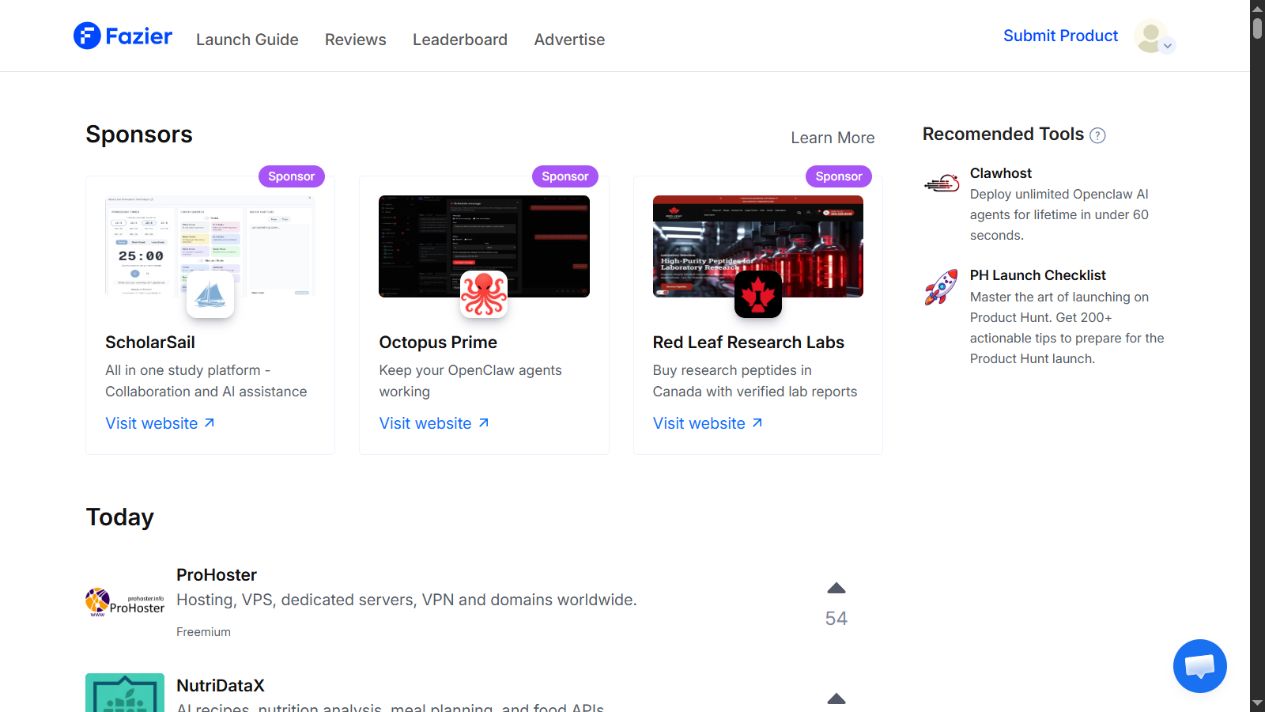
Fazier combines daily product discovery with a community launch format. Its front page separates today’s products, yesterday’s launches, and leading products from earlier periods, so a listing sits within an active stream rather than only an alphabetical catalog. The range is broad: SaaS, utilities, creative applications, and other independent products appear together. It is a sensible research stop when your product has a clear, easily demonstrated benefit that another maker can understand quickly.
The free Basic route we checked required more than a product description. It included a badge, an English-language website, a positive domain rating, and three useful comments on other products. Those comments should contribute something specific, such as a question about a workflow or feedback based on a real demonstration. Budget time for participation before planning a launch date.
Prepare a concise explanation of the problem solved and a screenshot that remains understandable at thumbnail size. For a social media product, describe the actual publishing or account-management workflow rather than promising followers. Fazier’s community exposure can be valuable, but neither votes nor acceptance establish commercial results.
2. DANG! AI Tools Directory
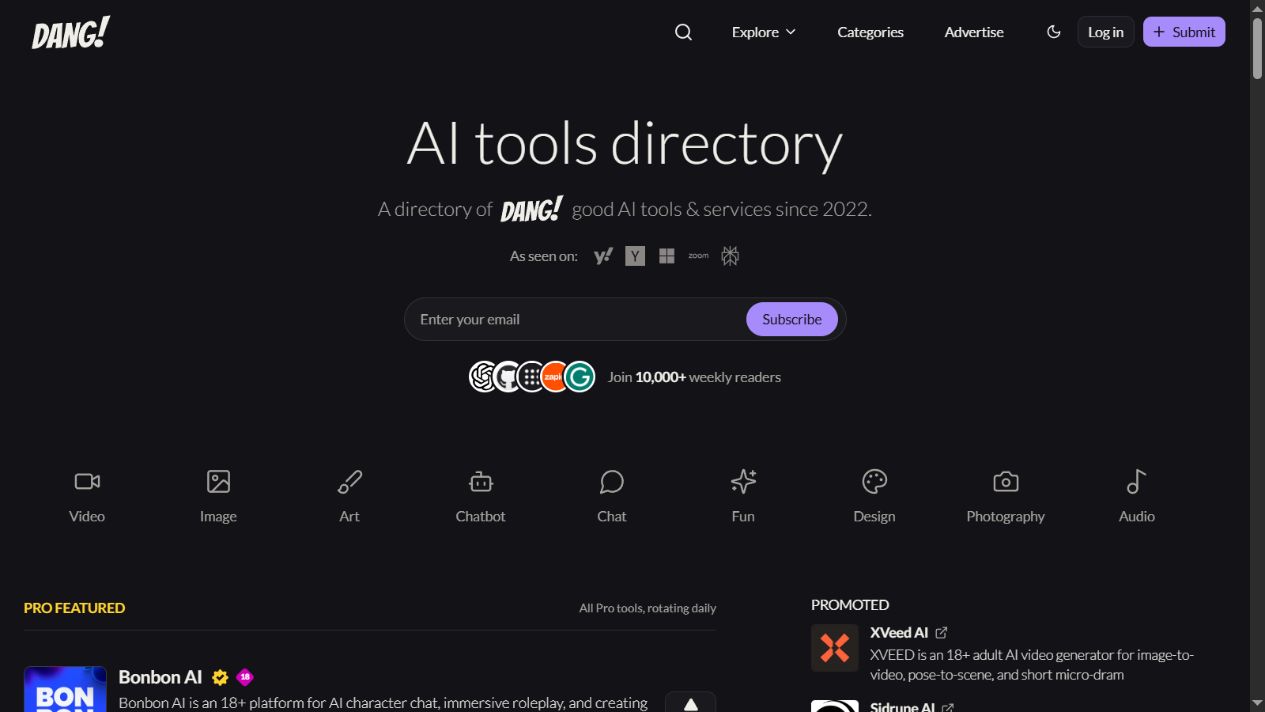
DANG is an AI tools directory organized around categories such as writing, productivity, assistants, marketing, image creation, and social applications. Its homepage distinguishes promoted and featured placements from the wider collection. That structure makes it useful for discovering how an AI product is positioned among tools with similar jobs, while reminding a submitter that paid visibility and ordinary discovery are different experiences.
The free route we reviewed required a custom domain and a crawlable followed backlink, supplied as a badge or text link. The link needed to remain available to retain the listing. The exact accepted location was not clearly established in the earlier form, so a blog reference should be tested through the current verification flow rather than assumed sufficient. Keep the submitted product URL separate from any backlink-page field.
DANG fits products with a demonstrable AI capability. A social media application might explain how its assistant prepares settings or helps interpret activity, including any separate AI-provider charges. Inspect the surrounding categories and advertising before deciding whether the presentation suits your brand. A broad AI audience is not automatically your ideal buying audience.
Explore DANG! AI Tools Directory →Back to the directory index ↑
3. Findly.tools
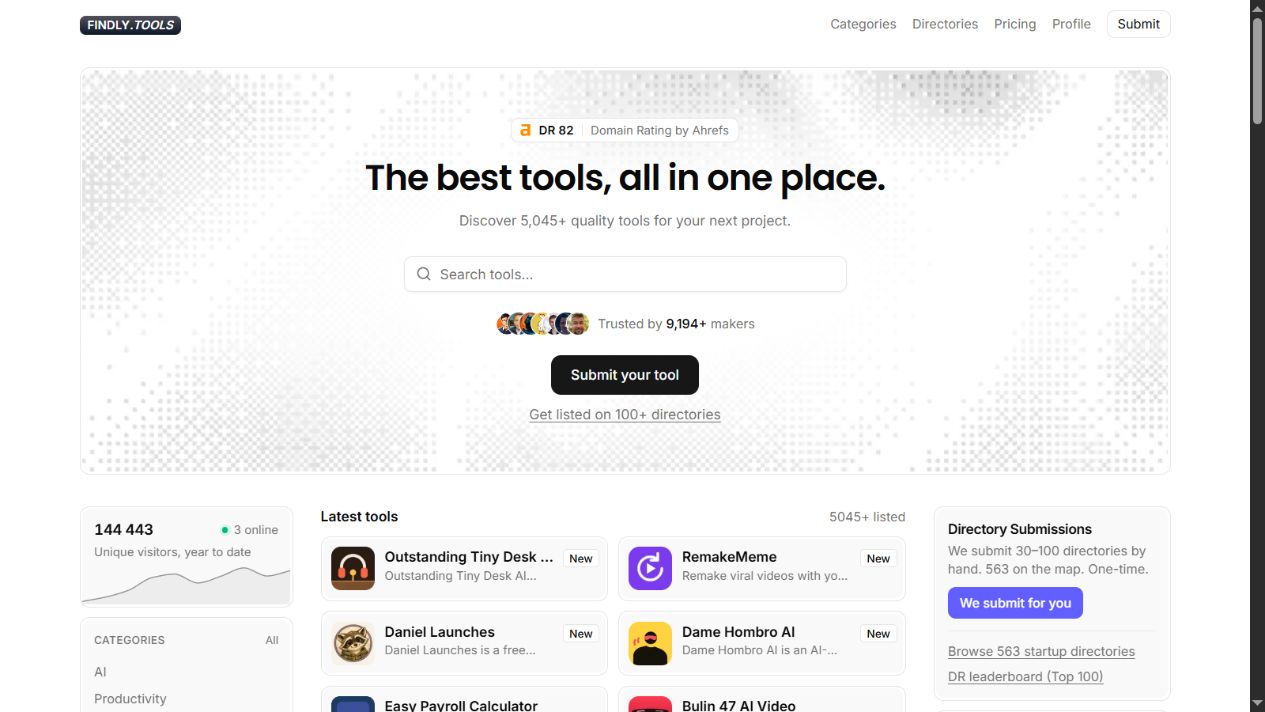
Findly.tools brings software discovery into one catalog with categories including AI, productivity, marketing, SEO, automation, development, design, and analytics. Its homepage also shows recent tools and deals, giving buyers several ways to browse beyond a single launch ranking. That breadth can suit a product that crosses categories, provided its description explains one primary use case instead of trying to appear relevant to every visitor.
The submission process we examined allowed a draft with descriptions, audiences, pricing information, and platform details. Publication on the free route was gated by a badge in the website footer. An account and a completed draft therefore do not mean a product is publicly listed. Save the draft identifier and return to the listing step after installing the required reference; check what the verifier accepts before treating a text link as a substitute for the badge.
For social media software, the marketing and automation categories are useful places to compare descriptions. Explain whether the product is web based, desktop assisted, or device dependent, and label a time-limited trial accurately. A tidy profile with realistic setup details gives a buyer more to work with than a long list of unsupported benefits.
4. Turbo0
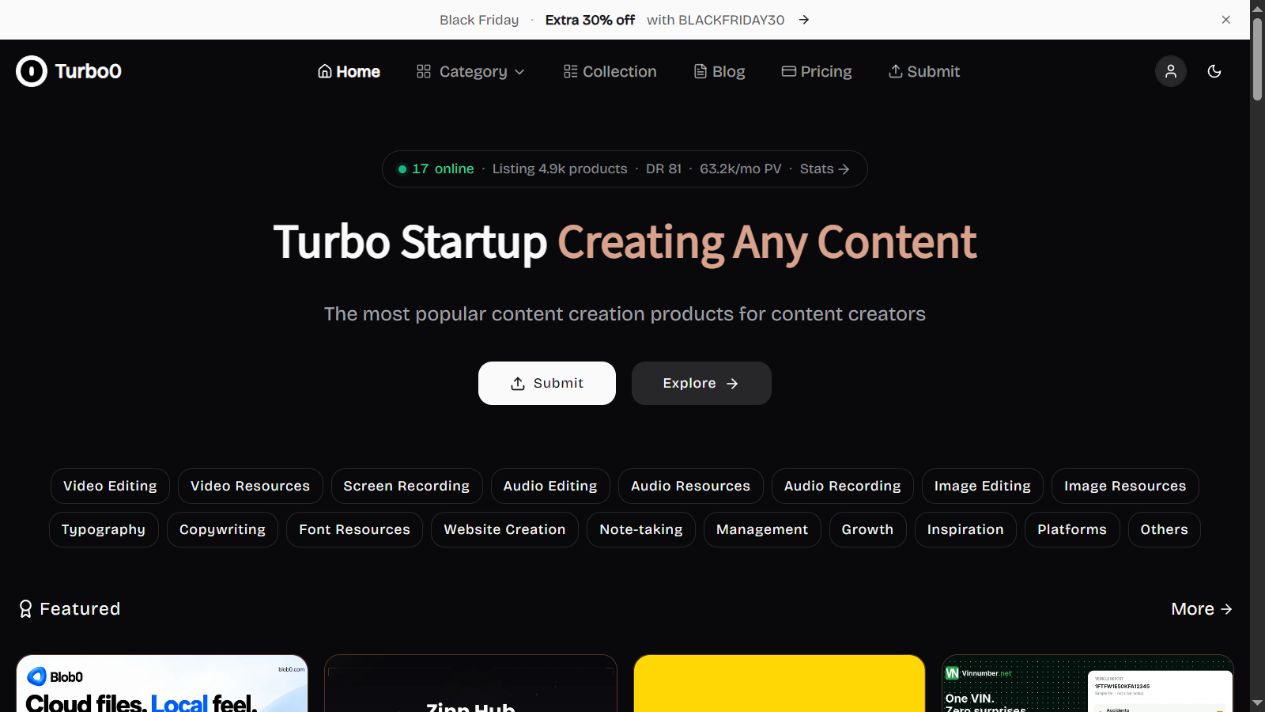
Turbo0 focuses its discovery experience on content-creation products. Its categories include video and audio editing, image resources, screen recording, typography, copywriting, website creation, management, and growth. This gives it a particularly relevant angle for tools used by creators and social media teams, even though the catalog also contains broader utilities. Product cards display practical labels such as platform and pricing, which can help a visitor decide what to investigate.
The free submission route checked for a domain rating above ten and a backlink or badge. The draft flow included an introduction and cover image before a verification step, so it is worth preparing those assets before beginning. A successful domain-rating check is only one prerequisite; the badge can still be reported missing and leave publication incomplete. The current verifier inspects the product homepage and looks for the badge or the exact Turbo0 item link; it does not offer a separate backlink-page field.
Use a cover that shows the product doing a recognizable task rather than presenting a vague promotional slogan. If your application coordinates content or manages publishing, describe how it fits alongside creation tools. Recheck the review estimate and accepted backlink location in the current form. Turbo0’s audience positioning is relevant, but listing there does not guarantee campaign reach or creator adoption.
5. ToolPilot AI
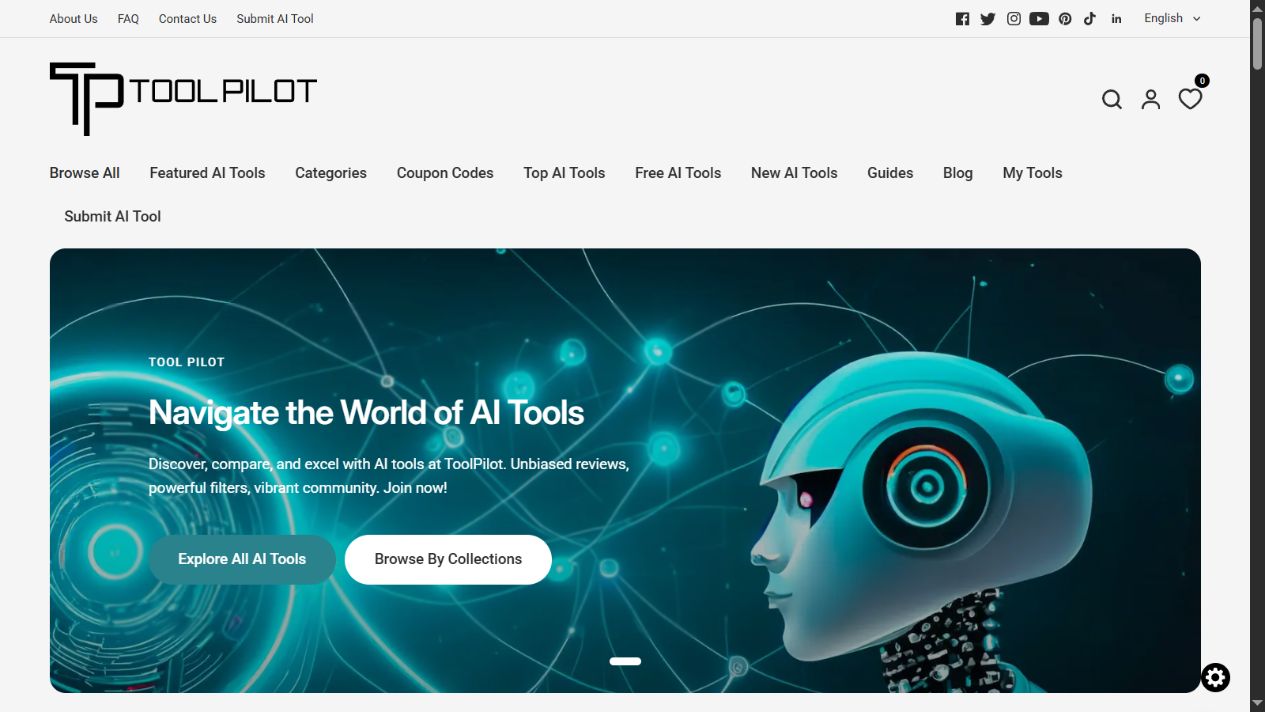
ToolPilot presents AI software through categories, collections, filters, user reviews, and product pages. Its homepage includes featured tools as well as links to free tools, new tools, guides, and coupon codes. This format can suit products whose value needs a little explanation, because a prospective customer can compare positioning and pricing rather than relying exclusively on a short launch-day tagline.
The free submission form we checked requested the URL of a page containing the backlink, which is useful when you want to test an editorial resource page. It did not explicitly require the homepage in that field. It also asked for a square JPG logo with a background at 500 by 500 pixels. A smaller transparent logo may need a careful format conversion and resize before the form will accept it. The stated free review window could extend to sixty days.
For a social media product with an AI assistant, explain both the assistant’s role and the underlying operational requirements. Do not imply that an AI feature eliminates the need to review settings. ToolPilot is worth assessing for its comparison-oriented presentation, while keeping the distinction between submitting a tool and receiving editorial approval clear.

6. ShowMeBest.AI
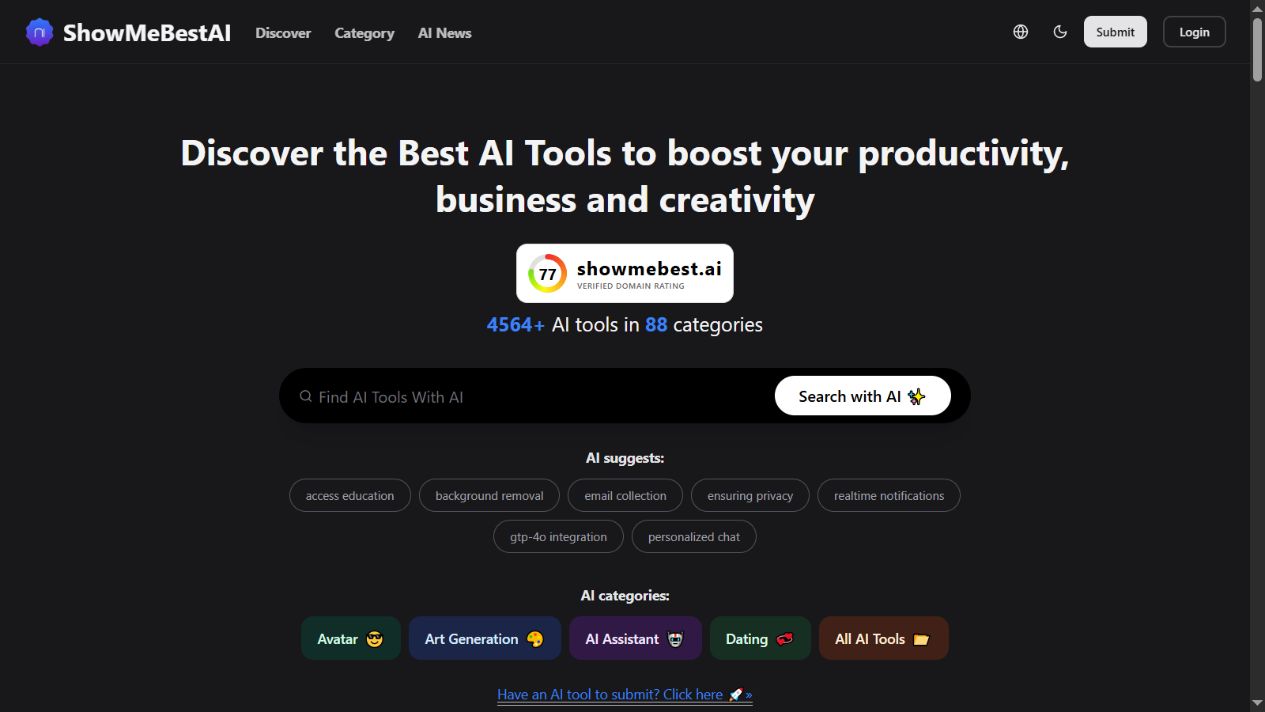
ShowMeBest.AI organizes AI tools around productivity, business, and creative work. Its homepage combines category browsing, search suggestions, AI news, and featured entries. It can be a useful place to research how different tools describe the same need, especially when your application spans content production, marketing, or an assistant-based workflow. The visible catalog is broader than social media alone, so relevance depends on selecting an accurate category.
The free submission route we reviewed explicitly requested a badge or link in the website footer. That is an important distinction: an article mentioning the directory does not automatically satisfy a footer requirement. The review timing displayed on the actual submission page ranged from seventy-two hours to several weeks, illustrating why a third-party directory list should not be treated as the final promise of publication speed.
Prepare a short description that explains what the AI actually changes for a user. A content tool might emphasize editing or ideation; an automation tool should identify the routine it supports. Consider the surrounding featured placements when evaluating brand fit, and record the final public page only after approval rather than counting the initial form as a live listing.
7. Smol Launch
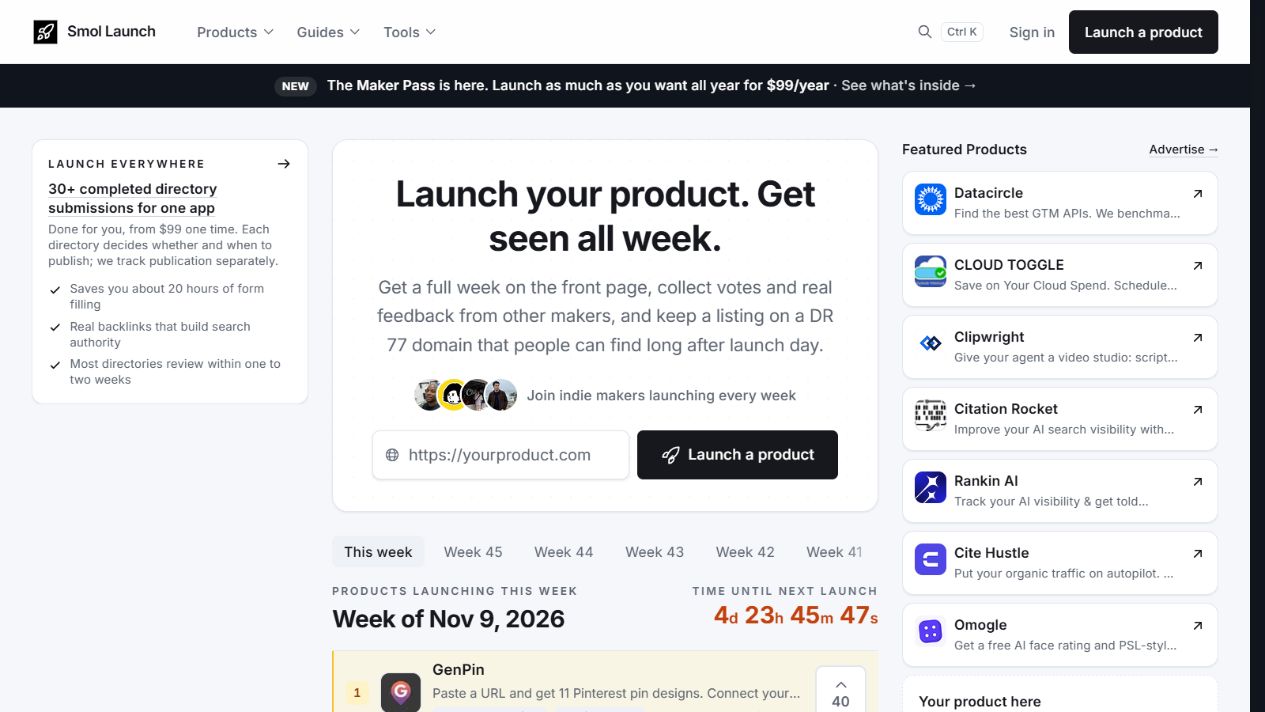
Smol Launch is structured around weekly product launches, with product pages, guides, and a board for the current week. Its visible mix includes design tools, content applications, developer products, and other small software businesses. The weekly rhythm makes it useful for a coordinated launch: a founder can prepare a demonstration and a small set of social posts around a specific period instead of treating submission as an isolated administrative task.
The free flow we checked required a homepage badge and five votes during the current week, alongside a limited number of weekly places. A product draft can exist before those conditions are completed. A blog article is therefore useful as a resource for readers but does not replace the stated homepage badge. Community votes should reflect a real assessment of the products, and any additional public participation needs to be considered separately.
Use the product page to explain one audience and one strong use case. If the launch is aimed at agencies, show an agency workflow rather than a generic feature collage. Watch the available launch week and distinguish an approved submission from a scheduled or already published product.
8. Submit AI Tools
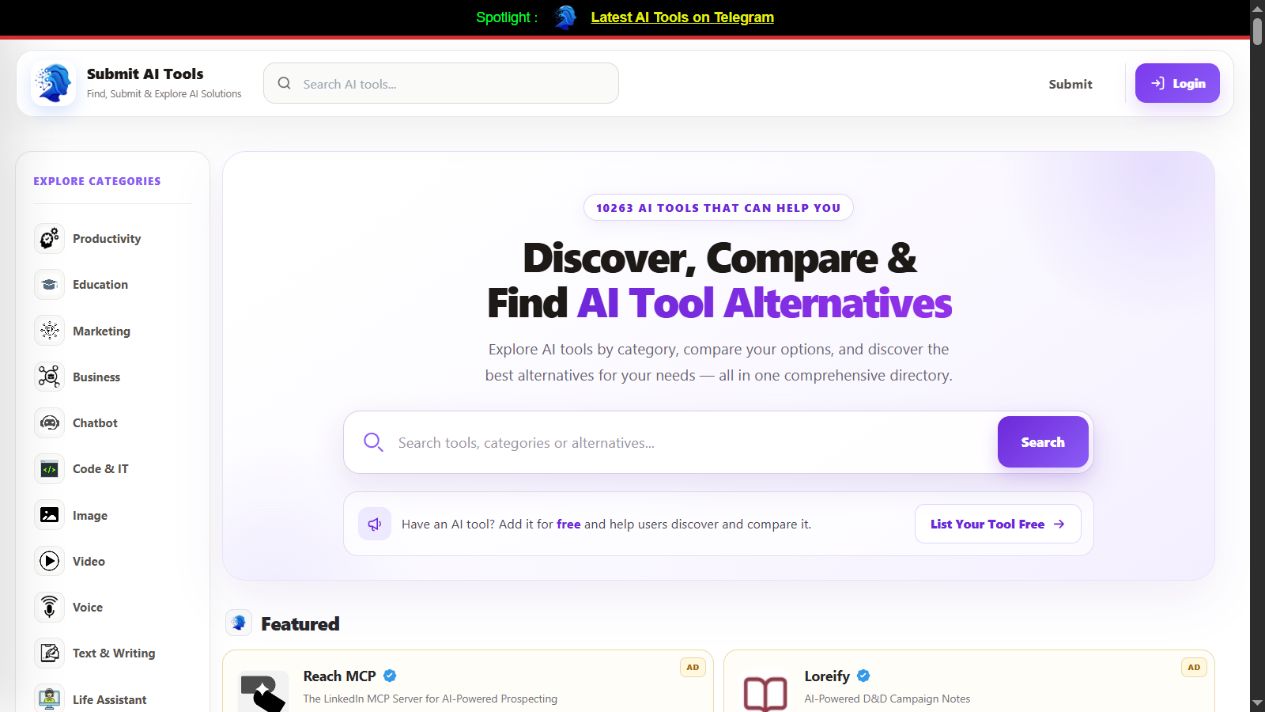
Submit AI Tools is a category-based AI directory with search, comparisons, alternatives, deals, and profession-oriented discovery. Its navigation covers marketing, business, productivity, image, video, writing, coding, and several other AI use cases. That organization gives a product multiple relevant research contexts, but the best submission still begins with the task a user is trying to complete, not with the largest possible collection of category labels.
The free route required authentication and a verified backlink that remains in place. The submission page indicated a review period of five business days when we checked it. Human verification may also appear in the process. These steps should be completed through the normal interface, and a successful login should not be confused with successful product submission. Preserve any confirmation and the eventual public profile URL in your launch record.
A social media application can be relevant when it has a genuine AI or marketing workflow to describe. Include the pricing model, supported platforms, and any account or device requirement. The directory’s alternatives angle also makes a precise differentiator useful: explain a concrete operational distinction instead of claiming to be universally better than other tools.
9. ToolFame
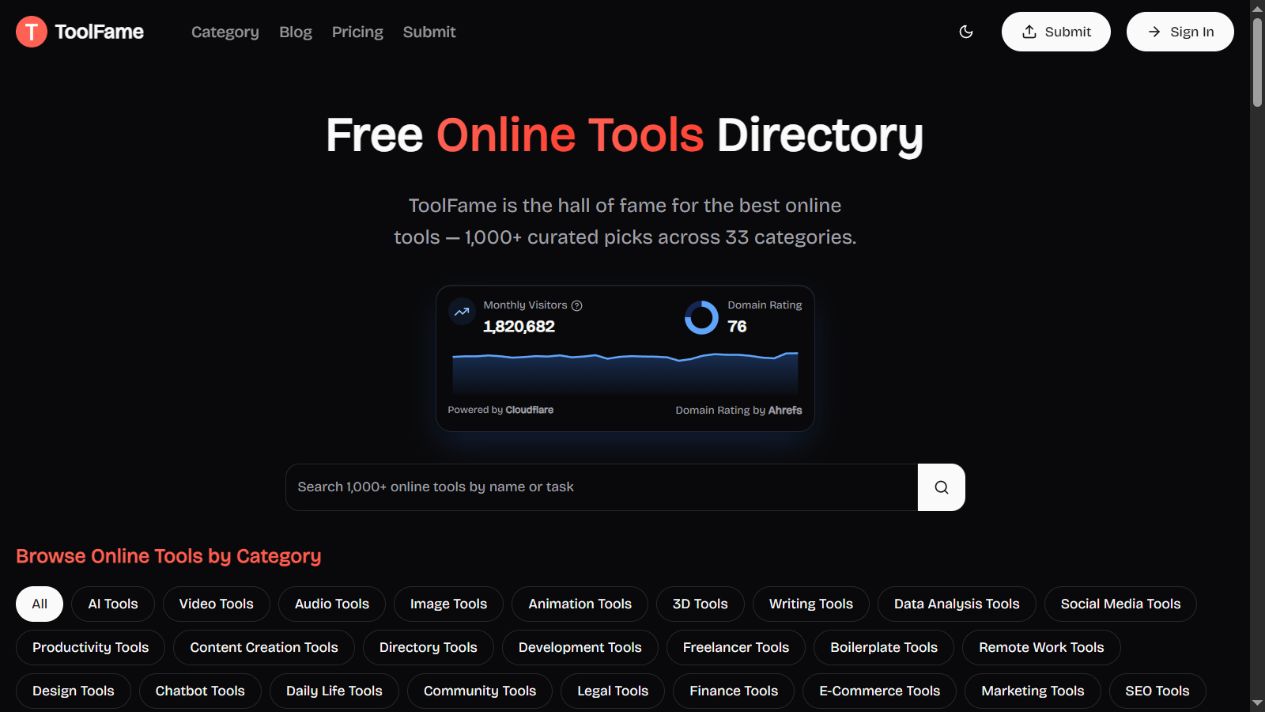
ToolFame presents a broad online-tools catalog rather than restricting discovery to one kind of AI application. Its homepage includes social media, content creation, development, productivity, marketing, SEO, and many other categories. This makes it suitable for researching products that sit between workflows, such as software used to create assets and then organize marketing activity. It also means a visitor’s intent can vary widely across the site.
The free route we examined required a minimum domain rating of ten and a badge that is verified and retained. Its advertised review window extended as far as one hundred eighty days, so this is better treated as a long-term distribution task than an urgent launch dependency. A completed form may enter a queue rather than produce an immediate public page. Check current terms and verification behavior before promising a date to your team.
Choose a category that reflects the buyer’s main reason to use your product. For social media software, a clear workflow explanation and a realistic trial label are more informative than repeating the directory’s traffic statistics. Keep the badge obligation in your website-maintenance notes so a later redesign does not accidentally affect the listing.
10. AI Agents Directory

AI Agents Directory focuses on agents, skills, and AI solutions, with discovery paths for marketing, customer service, development, and other use cases. Its homepage separates featured items from newly added entries and provides several ways to explore the agent ecosystem. It is most relevant when your product includes an assistant that performs a defined job, rather than only adding a chat box to an otherwise unrelated service.
The submission flow we reviewed asked for details such as source model, pricing, category, description, and a public logo. The free step required an explicit commitment to display a linked badge, and the listing could remain pending until verification. That commitment should describe what is actually deployed. If you plan to use a blog resource page, check that the current verifier accepts its location and the exact badge before completing the promise.
Explain an agent’s boundaries as carefully as its capabilities. For example, say whether a user reviews prepared changes, what integrations are supported, and which costs are separate. An accurate agent profile helps both technical evaluators and business buyers decide whether the tool belongs in their workflow.

11. LaunchIgniter
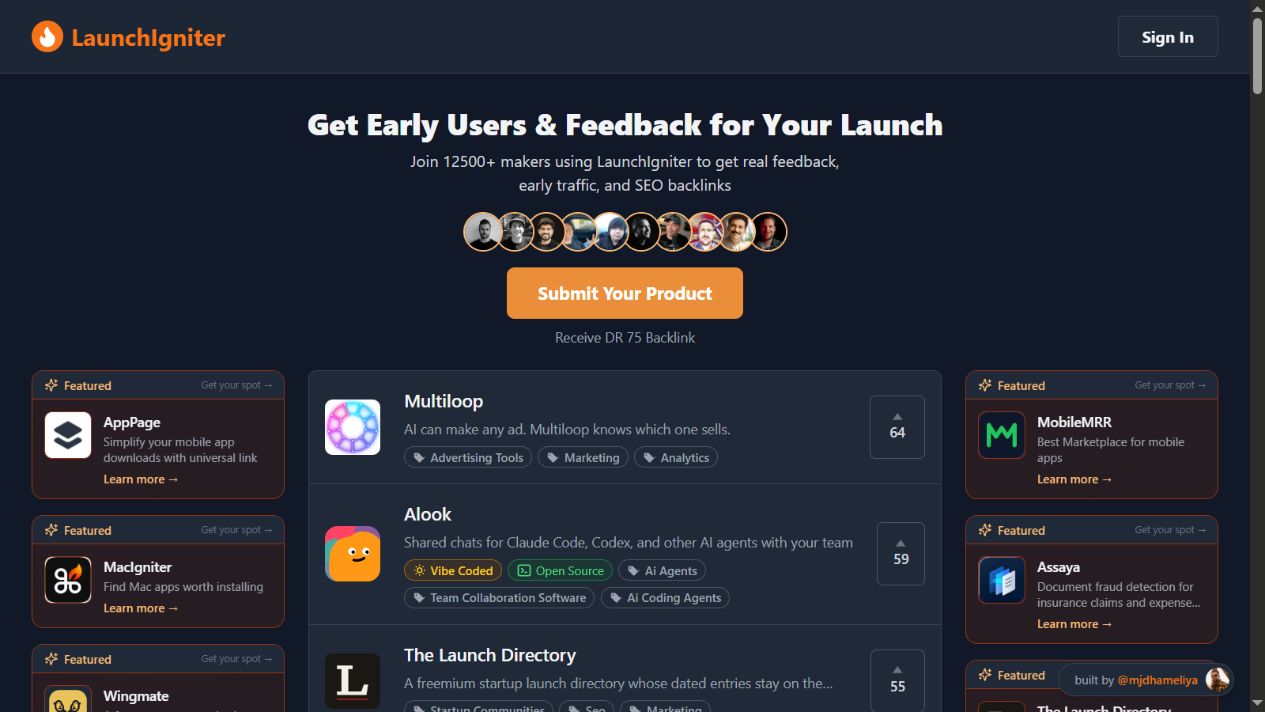
LaunchIgniter combines product launches with a maker-oriented community and ongoing posts. The homepage emphasizes early users and feedback, showing featured products alongside recent launches and discussions. Its mix of applications and business tools makes it a possible fit for a SaaS product with a focused explanation and a founder who can answer practical questions. The community context is worth considering alongside the directory page itself.
The free route we checked required badge verification and manual review, with no guaranteed publication date. Followed-link treatment was linked to finishing among the top three rather than being a universal free-plan benefit. Paid visibility options were presented separately. This is a useful reminder to read the actual free-plan conditions instead of assuming that a headline about backlinks applies equally to every submission.
Prepare a launch message built around a real problem, and make the website ready for visitors who have never heard of the product. A social media team could support the launch with a short demo and an explanation of a repeatable workflow. Evaluate any feedback and referral activity separately from the ranking position; each tells a different part of the story.
12. Neeed Directory
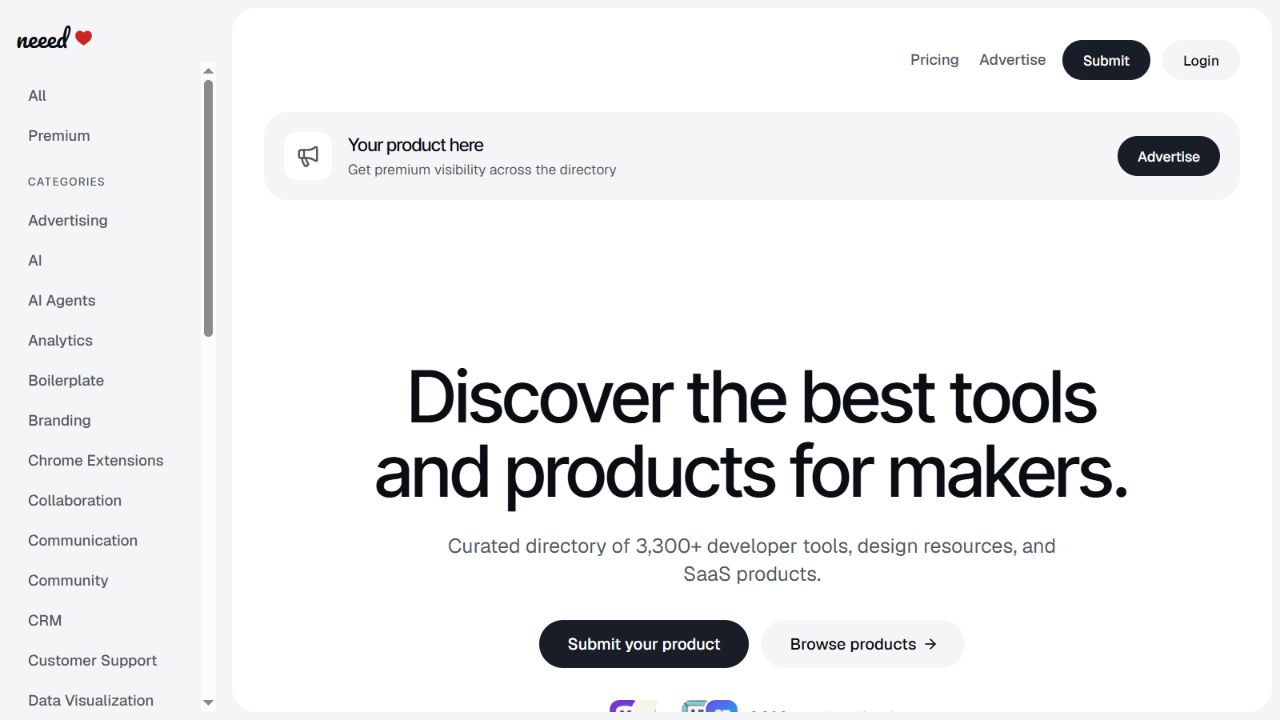
Neeed Directory is a broad discovery resource for makers, covering developer tools, design resources, SaaS, marketing, social media, and other work categories. Its homepage separates featured placements from recently launched products and offers a detailed category sidebar. That can be useful when your product solves a specific operational problem and you want it to appear near comparable tools rather than only in a time-limited launch competition.
The submission route we checked described a free option with the directory’s badge and automatic verification, alongside a paid option without the badge. Some wording about followed links was not completely clear in the earlier flow, so verify the current plan details before treating a particular link attribute as guaranteed. Authentication was also part of the submission path. A blog reference and a correctly installed badge may be evaluated differently by the verifier.
Select the narrowest accurate category and use a description that answers who the tool is for, what it does, and what is required to start. For social media applications, avoid crowding the listing with every supported action. A coherent primary use case makes the profile easier for a buyer to understand.
13. Aura++
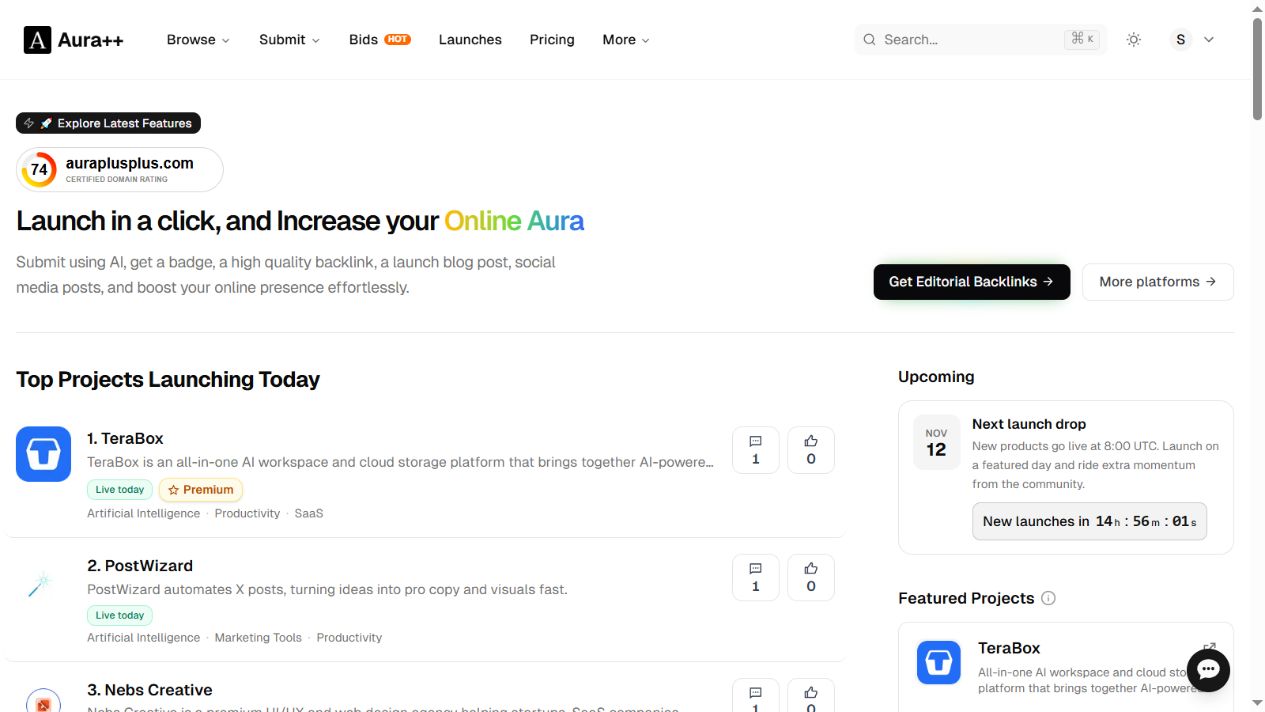
Aura++ combines launch discovery with a broader product-promotion platform. Its homepage shows projects launching today across categories such as productivity, marketing, design, and SaaS. It also promotes AI-assisted submission and additional distribution services. Treat these as distinct offerings: a free project listing is not automatically the same package as a launch article, social posts, or other promotional work described elsewhere on the site.
The free route we reviewed required badge verification, and the available free launch date could be far in the future. An imported product draft still needed checking: website import can misinterpret pricing, capabilities, or platform support. Review every field before saving and again before the final submission. A saved draft is useful progress but is not a live listing or a confirmed launch booking.
Aura++ is worth exploring for a product with a clear maker or small-business audience. Connect the launch to a genuine demonstration and a practical social announcement, while keeping expectations realistic about timing. Record the chosen plan, verification result, and confirmed date instead of relying on the homepage’s general promises about online visibility.
14. Dofollow.Tools
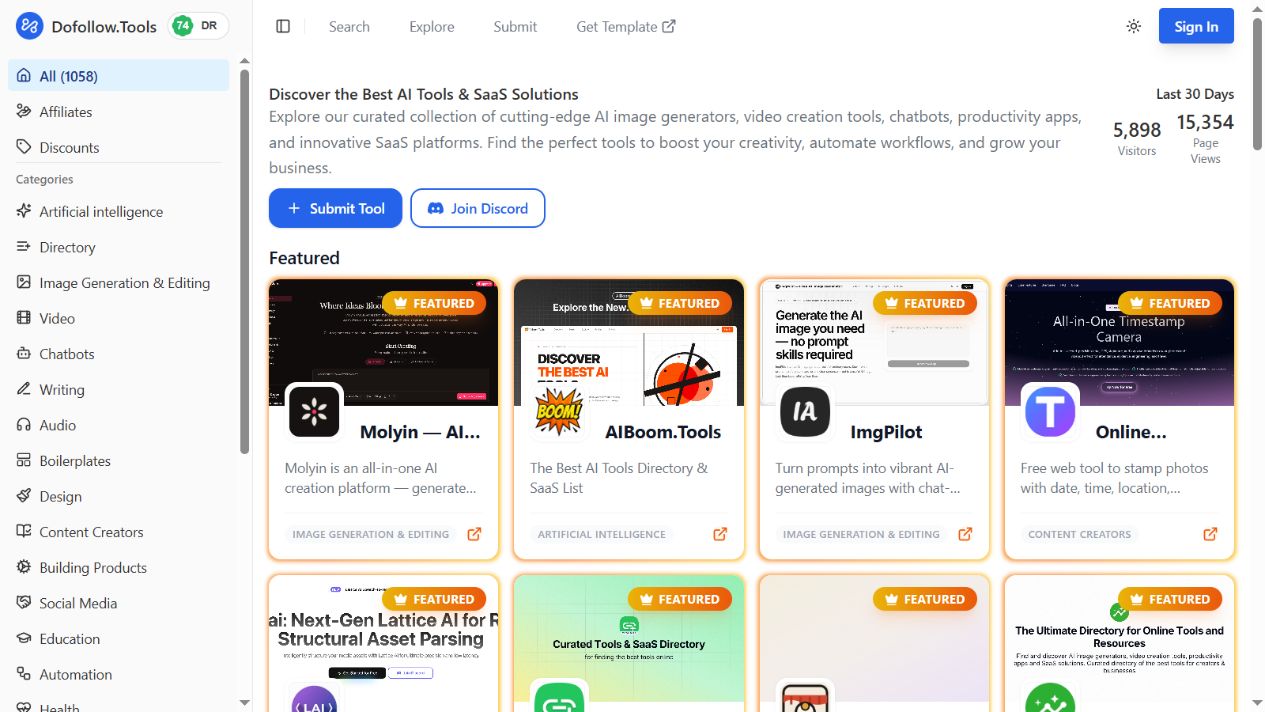
Dofollow.Tools offers category-based browsing across AI, SaaS, developer tools, automation, design, marketing, social media, and more. The homepage includes featured entries and recent tools, while additional navigation covers affiliates and discounts. This makes it a useful comparison surface for products that have an identifiable software workflow and need a concise description of the buyer benefit. Its name emphasizes backlinks, but audience fit should still guide the decision to submit.
The free listing route we examined required a followed badge link that stays on the website, with recurring checks after publication. It also limited free entries per day and described a review queue. Those are ongoing operational conditions rather than a one-time formality. Check whether the current submission flow can verify a resource article and whether it expects the supplied badge markup instead of an ordinary text reference.
For marketing software, a useful profile explains the activity supported and the setup needed to run it. Keep a record of any badge requirement when updating your site. A followed link is a technical relationship between pages; it is not a promise of customers, search placement, or measurable revenue.
15. DeepLaunch
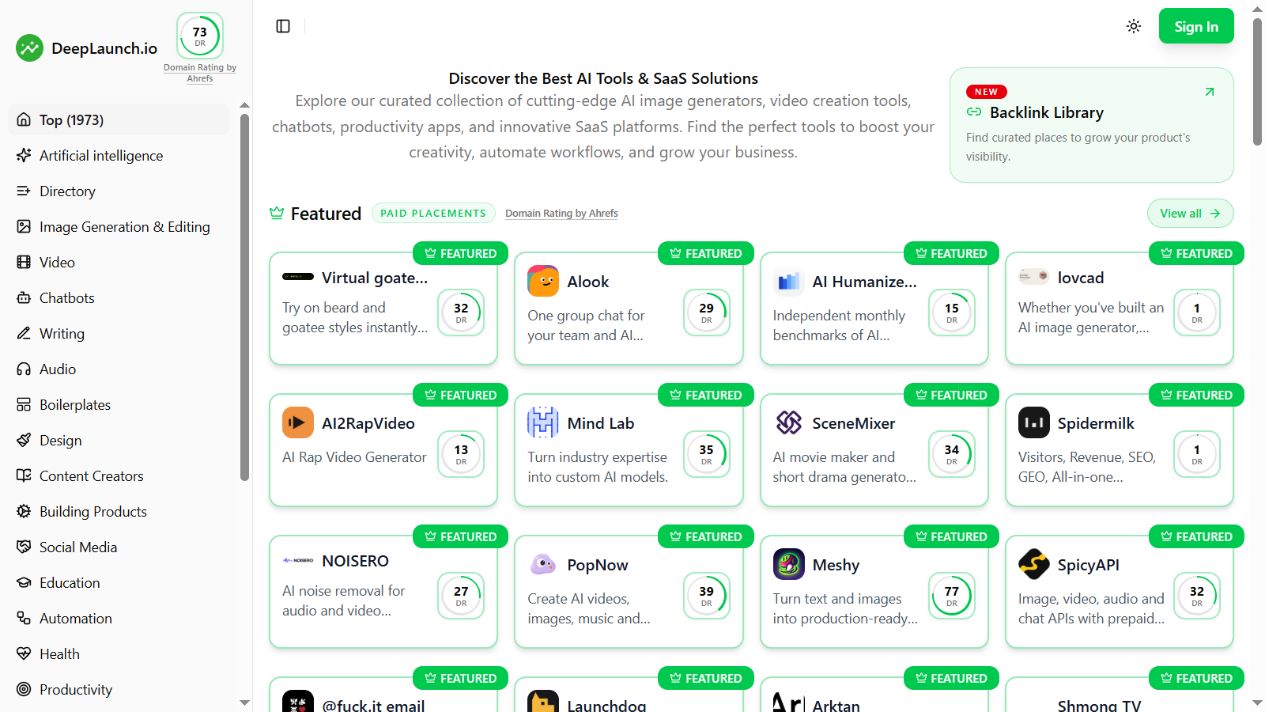
DeepLaunch is a tools-and-resources directory with a broad software category system, including content creation, social media, automation, analytics, development, and AI. Its homepage distinguishes paid featured placements and also points visitors toward a backlink research library. For a founder, the useful starting point is still the catalog itself: inspect the categories and product descriptions to determine whether someone browsing there could reasonably need your tool.
The free submission option we checked required a followed badge and recurring verification, with a limited number of free places each day. The flow also involved selecting a launch date. This means that adding a link is only part of the task; the date, available capacity, and ongoing visibility of the badge matter too. Reconfirm these conditions in the current form before scheduling supporting marketing work.
A product profile should describe a repeatable job and the audience that performs it. For a social media team, that might be preparing a publishing routine or reviewing campaign activity. Do not borrow the site’s claims about reach as your own forecast. Judge the listing by relevant visits and useful conversations after it becomes public.
16. ScrollLaunch
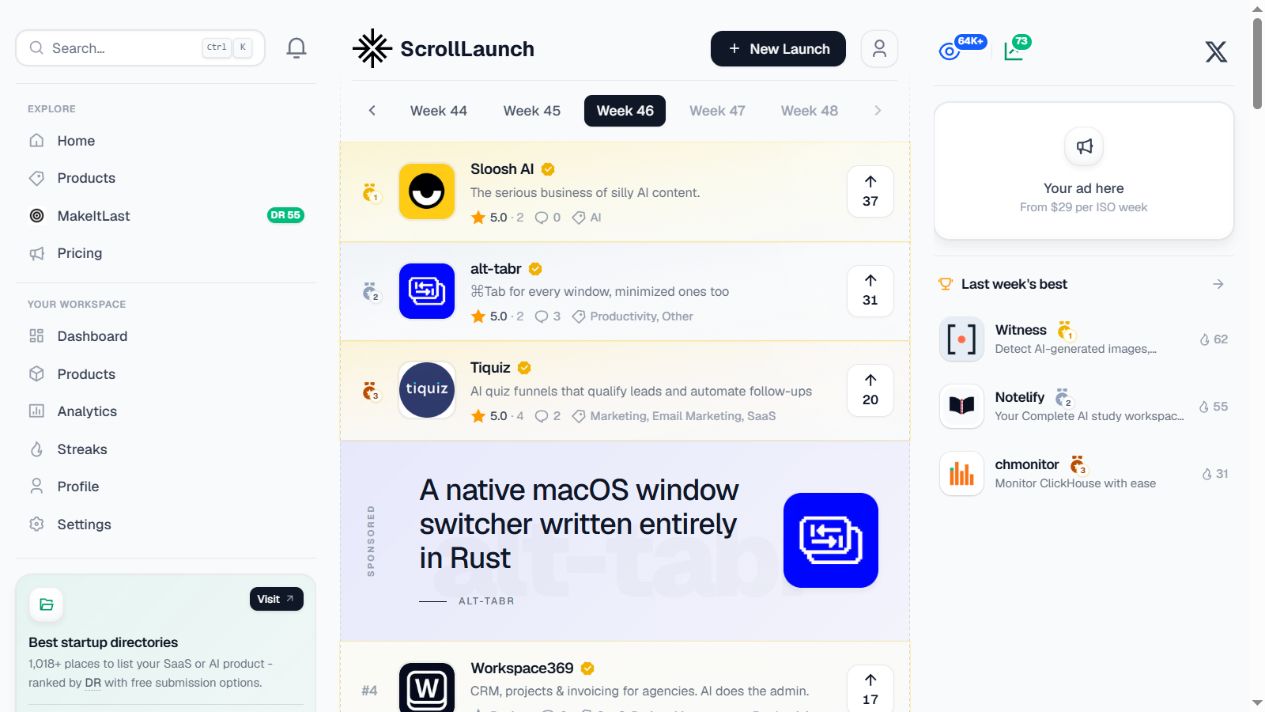
ScrollLaunch is a weekly launch platform with product pages, past-week archives, maker profiles, and category discovery. The homepage explains its current-week leaderboard and distinguishes premium placement from other entries. Its permanent product pages can provide a reference after launch week, while the weekly board creates a specific moment around which to plan outreach. Products for creators, marketers, and small software teams can fit if their use case is clear.
The free path we reviewed allowed an imported draft but required a website badge before publication. The account flow also included a newsletter subscription. Check imported fields carefully: an automated summary can misunderstand pricing or imply features that the product does not offer. Keep the product’s canonical website address accurate, and treat badge verification as a separate step from saving the draft.
A useful social launch can connect a product demonstration, the directory page, and an explanatory post on your own channels. Do not interpret the site’s claims about AI search discovery as a guarantee of citations. Record the confirmed launch week and public profile, then measure relevant referral visits after publication.
17. Launchpadly
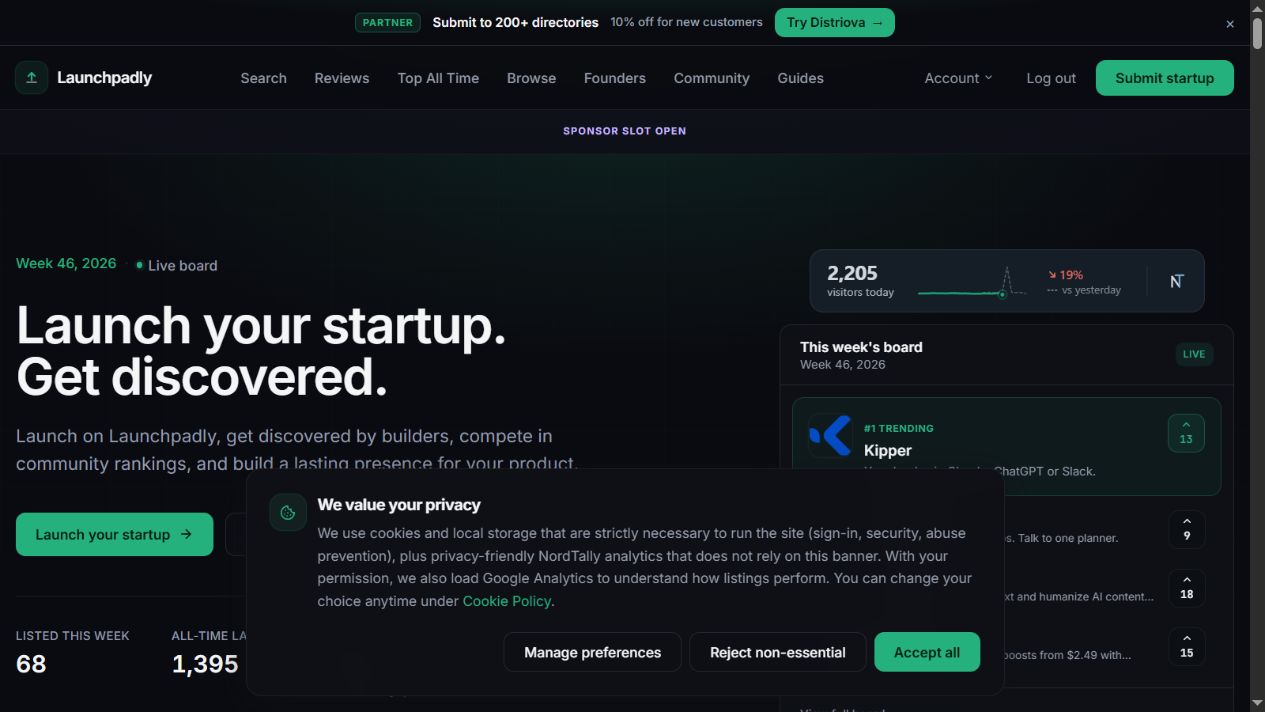
Launchpadly offers weekly startup discovery with a launch board, founder profiles, reviews, community material, and an archive of earlier products. Its homepage separates paid featured visibility from community rankings, which is useful context when comparing positions on the page. The range of products includes SaaS, AI applications, and other tools made by small teams. A founder who can explain the product and answer questions has more to contribute than a logo alone.
The free submission path checked during our research required a verified badge before review. Authentication and product preparation came before that final eligibility step. If you use a resource article as the backlink page, test the current verification flow rather than assuming that any mention on the same domain will pass. Keep review status, launch scheduling, and publication as separate entries in your tracking sheet.
Prepare a short explanation of the customer problem, a representative screenshot, and an honest pricing label. For a social media workflow, show what a team actually configures or reviews. The community and weekly timing can support a launch conversation, but a high position on a board is not a substitute for evaluating whether the visitors become useful prospects.
18. SaaSFame
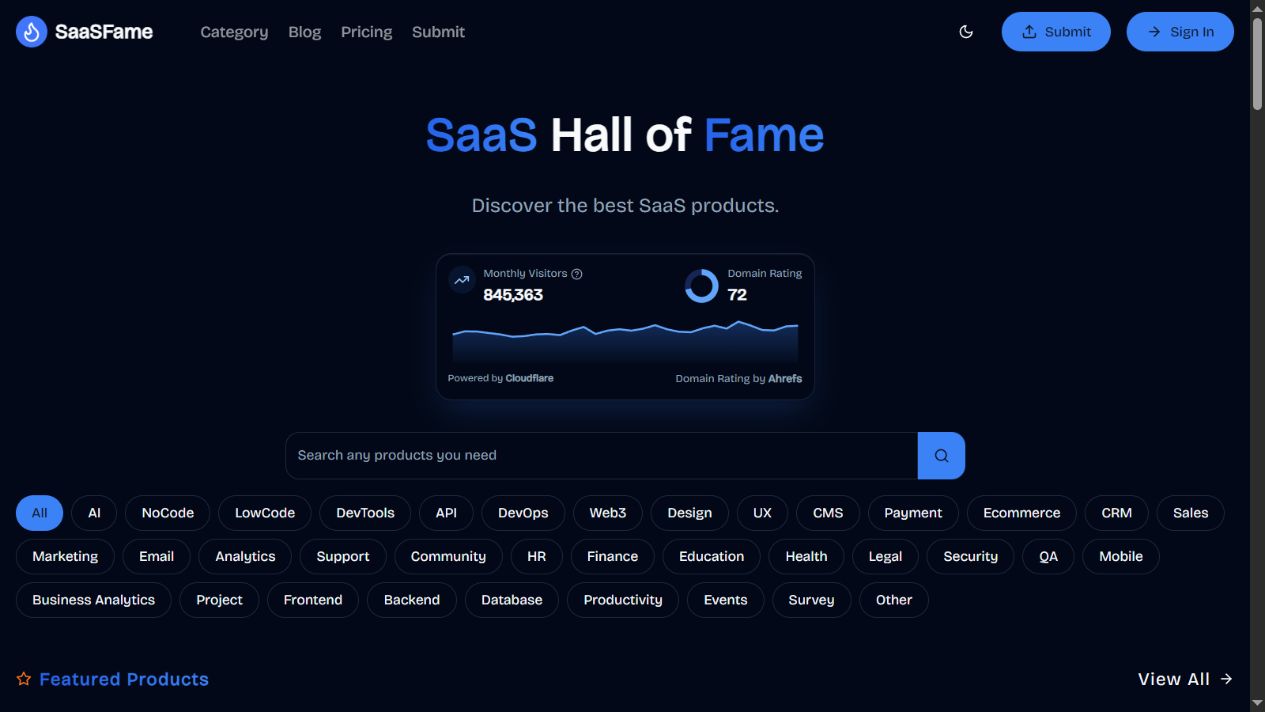
SaaSFame is a software catalog with a wide category system, from marketing and analytics to development, support, finance, and productivity. Its homepage shows featured products and practical labels such as platform and pricing. That makes it a possible research destination for recurring-use software with a clear buyer, rather than only for an application launched this week. Compare the categories before deciding where the product belongs.
The free plan we reviewed required a domain rating of at least ten and a badge that is verified and kept on the website. The stated review window could reach one hundred eighty days. This is a substantial timing constraint if your team is expecting immediate coverage. A submitted request can remain in a review queue for a long period, so avoid building a time-sensitive campaign around an unconfirmed publication date.
Use the description to explain the recurring job your software performs and any setup dependencies. A social media application should identify the supported work and the intended user, such as a solo operator or agency. Keep the badge requirement visible in maintenance notes, and evaluate the resulting profile on referral quality rather than catalog size alone.
19. AI Directories

AI Directories combines an AI-tool discovery offering with a separate service that submits products to other directories. The homepage emphasizes the submission service, so take care to distinguish buying a distribution package from adding a single tool to its own catalog. The AI tools and marketplace navigation provide the more relevant starting points when you are researching an individual product listing.
The free tool-submission option we checked required a backlink on the homepage or in the footer and a domain rating above ten. Its stated review period was seventy-two hours. An editorial article can help readers discover the platform, but it does not by itself satisfy a homepage-or-footer rule. Revisit the tool-submission pricing tab and the current verification step before proceeding; service pricing elsewhere on the site refers to a different offer.
This can be relevant for an AI product with a specific business use case and a clear website. For social media software, explain the assistant’s practical role without implying unrestricted autonomy. Evaluate any paid submission service separately, considering its destinations, reporting, and what happens when third-party directories reject or delay a product.
20. The Launch Directory
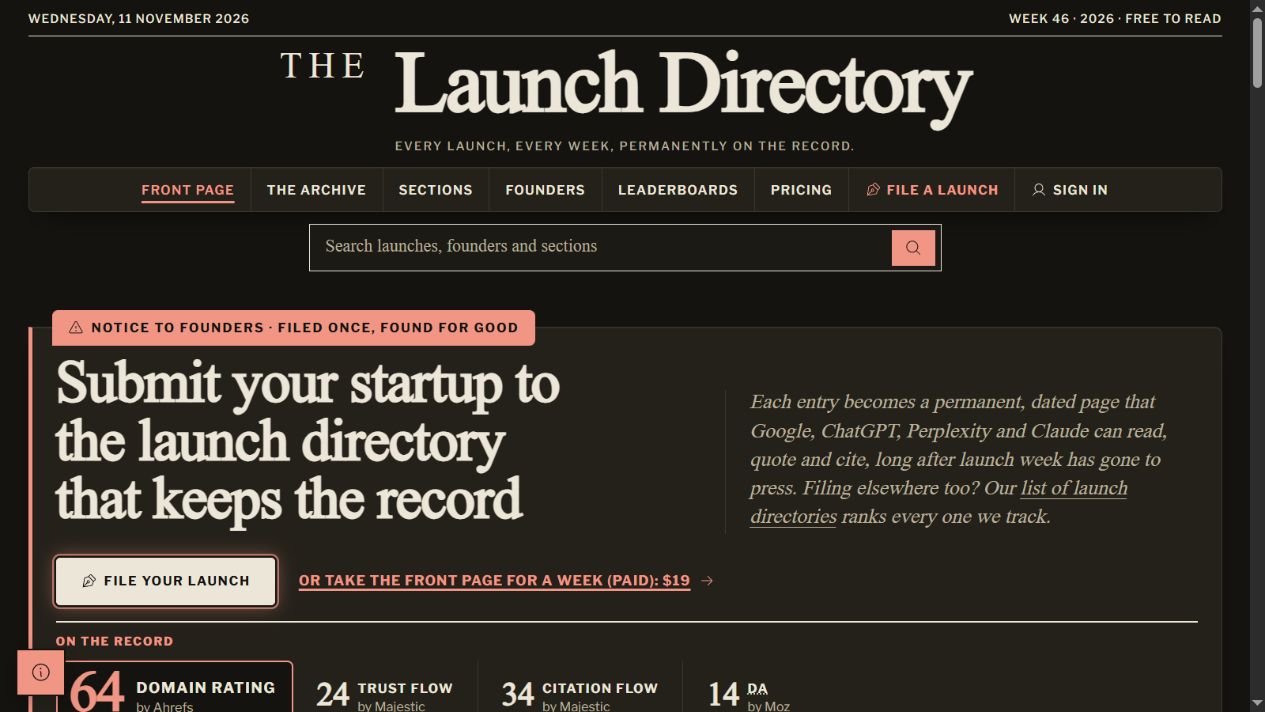
The Launch Directory presents startup discovery in an editorial, dated-record format. Its homepage is organized into weekly editions, sections, founders, and an archive, giving the experience a different feel from a conventional grid of software cards. A permanent product record can be useful when someone wants a compact explanation of a company after the original launch conversation has passed. The site includes both software and broader startup offerings.
The free submission route we reviewed required automatic badge verification and a completed founder profile. It described a review queue and a nofollow link by default, with paid alternatives offered separately. These details matter because a badge obligation does not necessarily mean the free profile returns a followed link. Confirm the current relationship and accepted badge location before choosing the route for SEO reasons.
Write the entry as a clear record: who the product serves, what changed or launched, and where a visitor can learn more. For social media products, a concrete operational example works better than a generic growth claim. The archive may support long-term reference, but discoverability and conversions still depend on relevance and the quality of the destination website.
21. ToolDirs
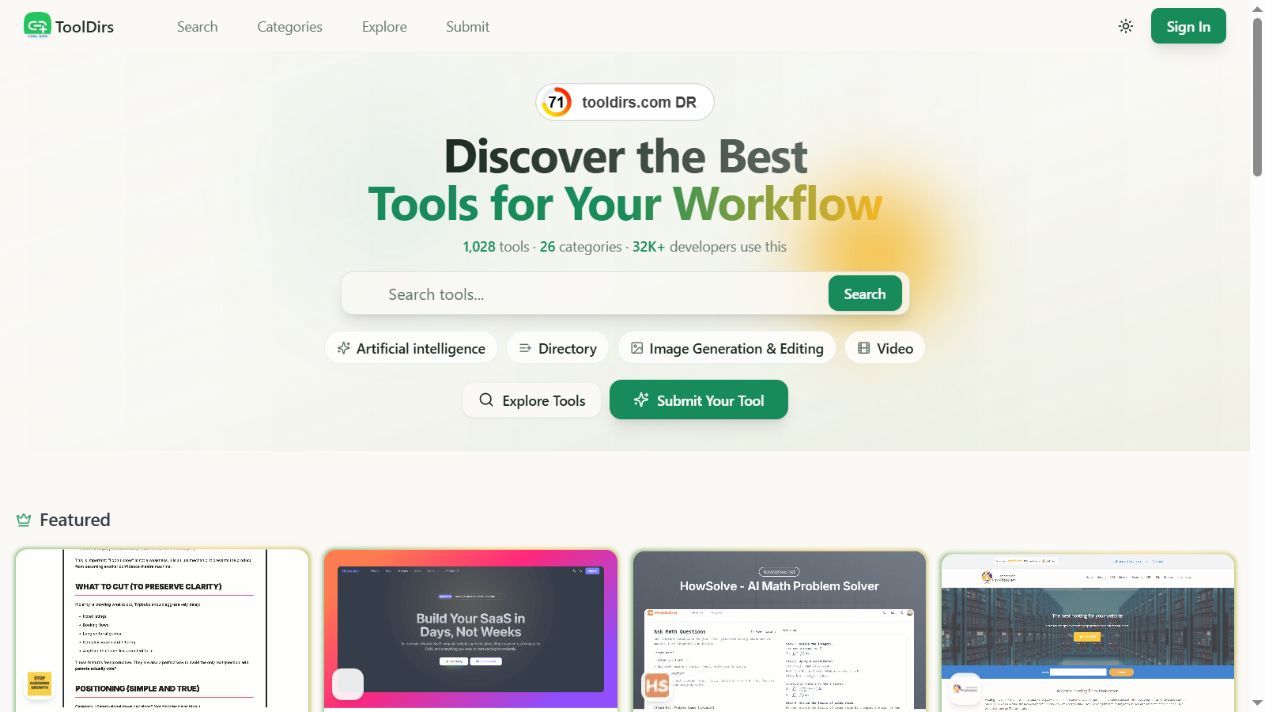
ToolDirs is a curated tools and SaaS directory with search, category browsing, featured products, and recent additions. Its categories span AI, design, development, marketing, education, and other software workflows. The homepage gives each tool a short description, making the clarity of a submission particularly important. A visitor should be able to understand the job performed before opening the full product site.
The free plan we checked explicitly required a followed backlink in the website footer and indicated a two-day review period. A text reference within a blog post is a different placement and should not be represented as meeting that footer condition. Paid options were separate. Reconfirm the current instructions and keep the exact badge or link markup available if the directory supplies one.
A useful submission avoids stacking unrelated benefits. Describe one buyer, the task they perform, and the way the product helps. Social media teams can use the marketing or automation context to explain a concrete publishing routine. After approval, verify that the product name, website URL, pricing model, and public profile are correct. Those details matter more to a prospective customer than an unverified promise of backlink value.
22. Uno Directory
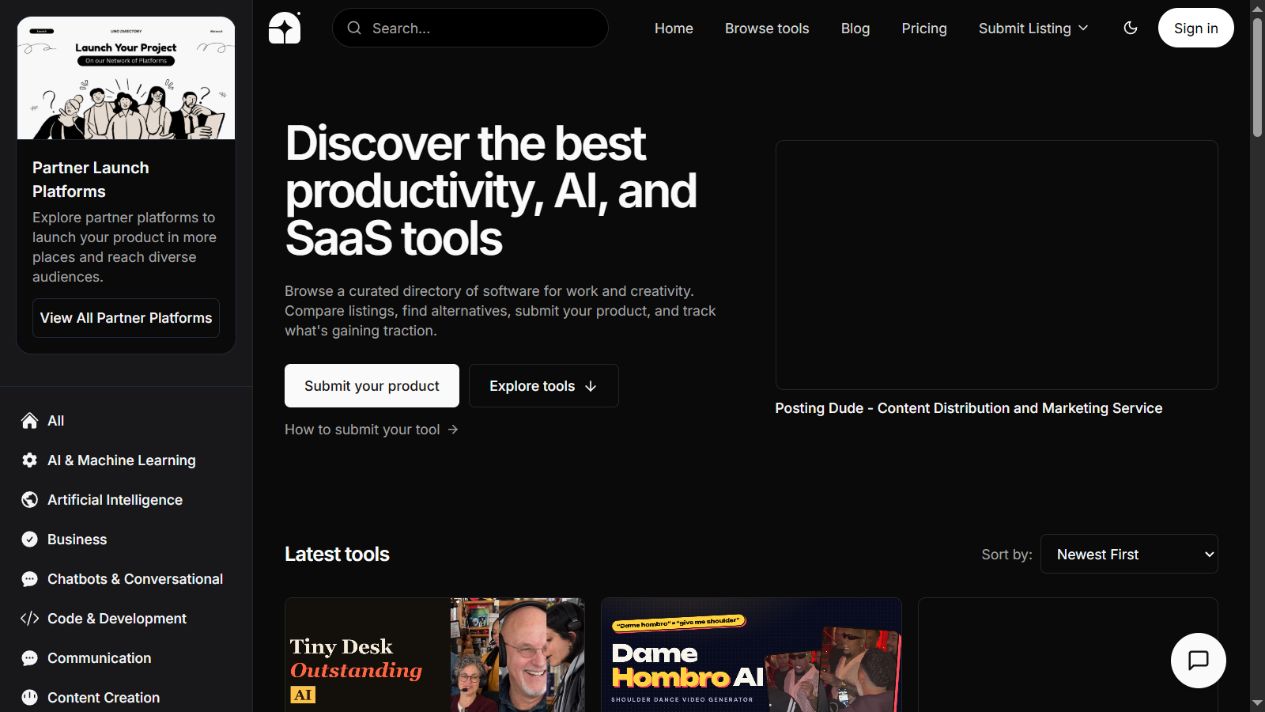
Uno Directory covers AI, SaaS, productivity, business, development, marketing, and creative tools. Its homepage provides category browsing, sorting, recent entries, and links to partner launch platforms. That makes it useful for exploring a broader software landscape and comparing how a product appears among adjacent solutions. The partner-platform section is a separate discovery aid, not a guarantee that one submission distributes a product everywhere.
The free submission guide we checked explicitly asked for a visible badge on the homepage. It also described automatic verification. A standalone blog guide does not replace that placement, even when it links to Uno clearly. Before submitting, check that the chosen plan, badge markup, and website address match the live instructions. Keep the distinction between the destination product URL and any backlink verification page.
For a marketing or social media application, choose categories based on current capabilities and show a representative workflow. Describe platform requirements and any paid trial conditions accurately. Uno’s broad catalog may help people discover alternatives, but the useful outcome is a relevant visitor understanding your product, not simply adding another directory name to a report.
23. AI Toolz Dir
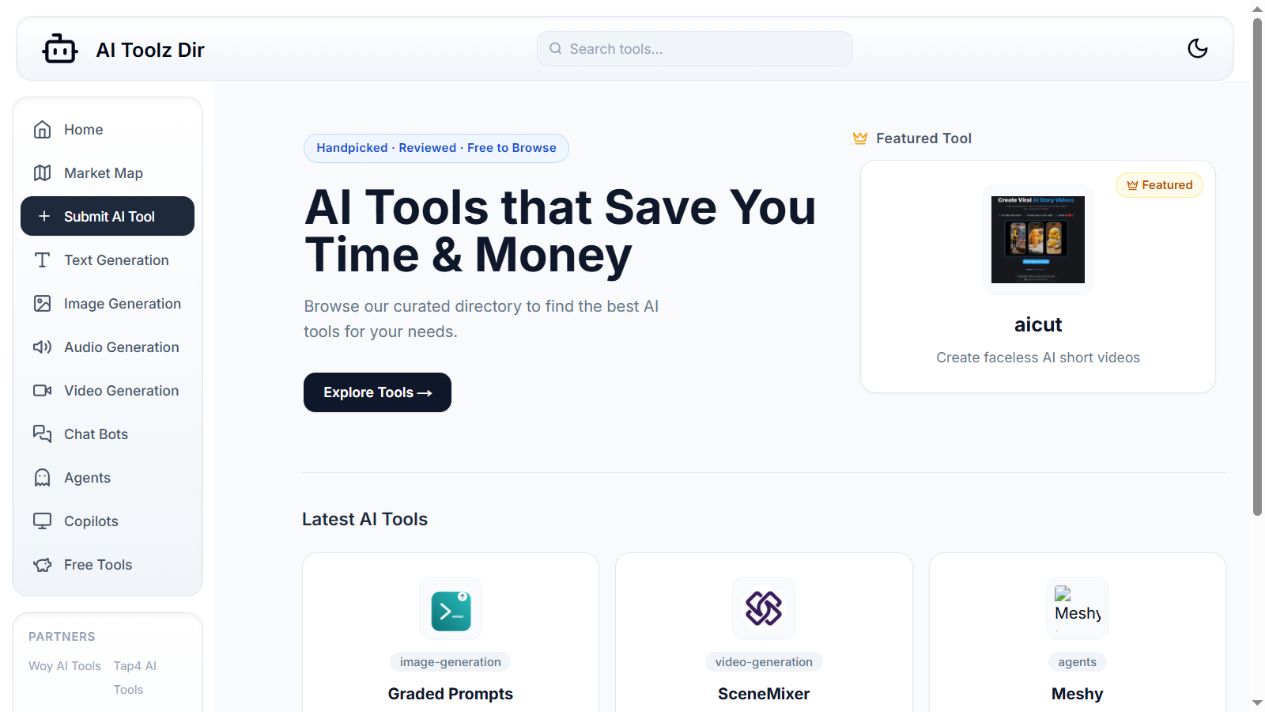
AI Toolz Dir is an AI-focused directory with navigation for text, images, audio, video, chatbots, agents, copilots, and free tools. Its homepage also includes a market-map route and recent tool descriptions. The relatively task-oriented structure can be useful for a product that performs a defined AI job and needs a straightforward introduction. A creator or marketing team can browse by the kind of output or assistance they need.
The free submission instructions we reviewed required a link to AI Toolz Dir before submitting and asked that the link remain in place. They did not clearly specify the homepage or footer in that earlier form. This makes a public resource page worth testing, while leaving the verifier’s actual decision as the proof. The page stated a forty-eight-hour review period, which should be rechecked when you submit.
Explain the product’s AI contribution with an example, and disclose whether the user must provide another account or API key. For a social media tool, distinguish content assistance from automated publishing or engagement. Accurate categorization helps the directory’s visitors understand the offer, while a maintained public reference helps avoid problems when the listing is checked again.
24. First Look
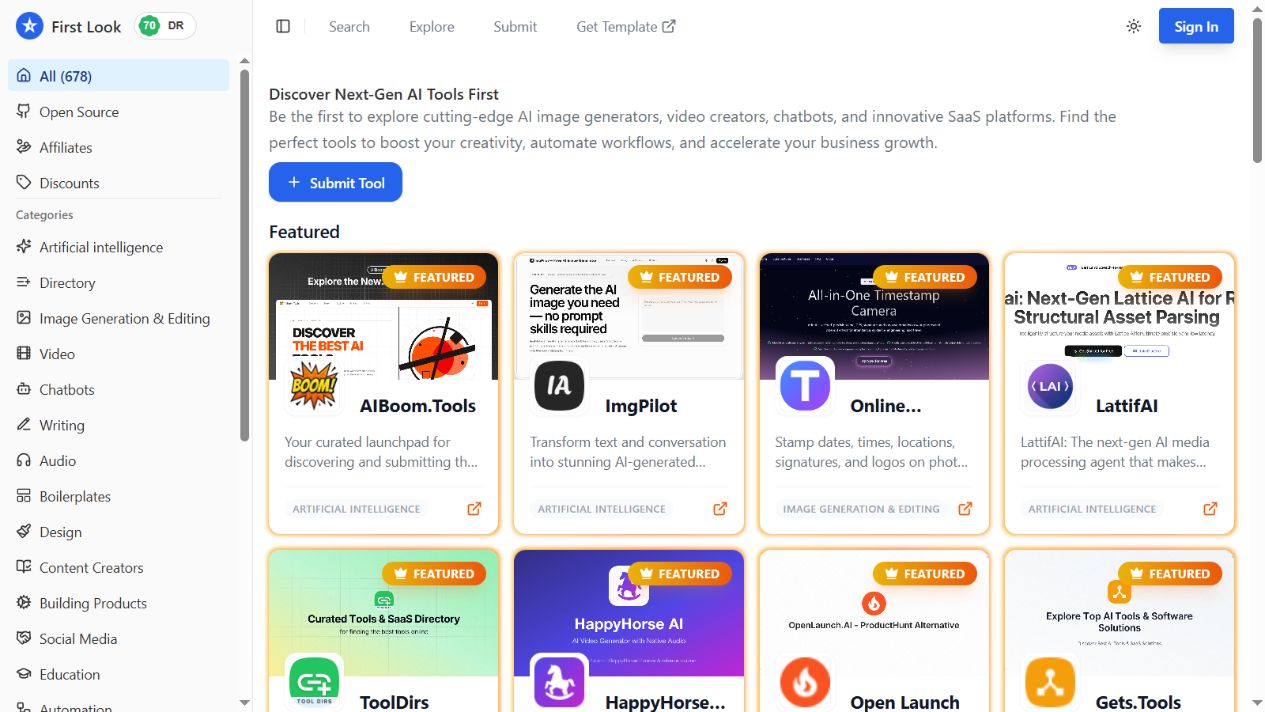
First Look focuses on emerging AI tools and SaaS, with categories including content creation, social media, automation, developer tools, design, and analytics. Its homepage combines featured entries with newer products and offers additional discovery paths such as open source, affiliates, and discounts. It is a useful place to compare how early software products present their main use case and the information a visitor sees before clicking through.
The free route we examined required a followed badge on the website, with a stated seven-day review period and weekly verification. The instructions explained that removing the badge could change the product’s outgoing link to nofollow. That is an ongoing relationship, so include it in website maintenance rather than treating it as a temporary launch asset. The exact acceptance of a separate article page still needs testing in the current flow.
Imported product details should be reviewed carefully, particularly pricing and platform support. For social media software, show the workflow and explain what requires human review. A clear profile can introduce a product effectively, but the directory’s early-discovery positioning should be assessed through actual referral quality after publication.
25. Huzzler
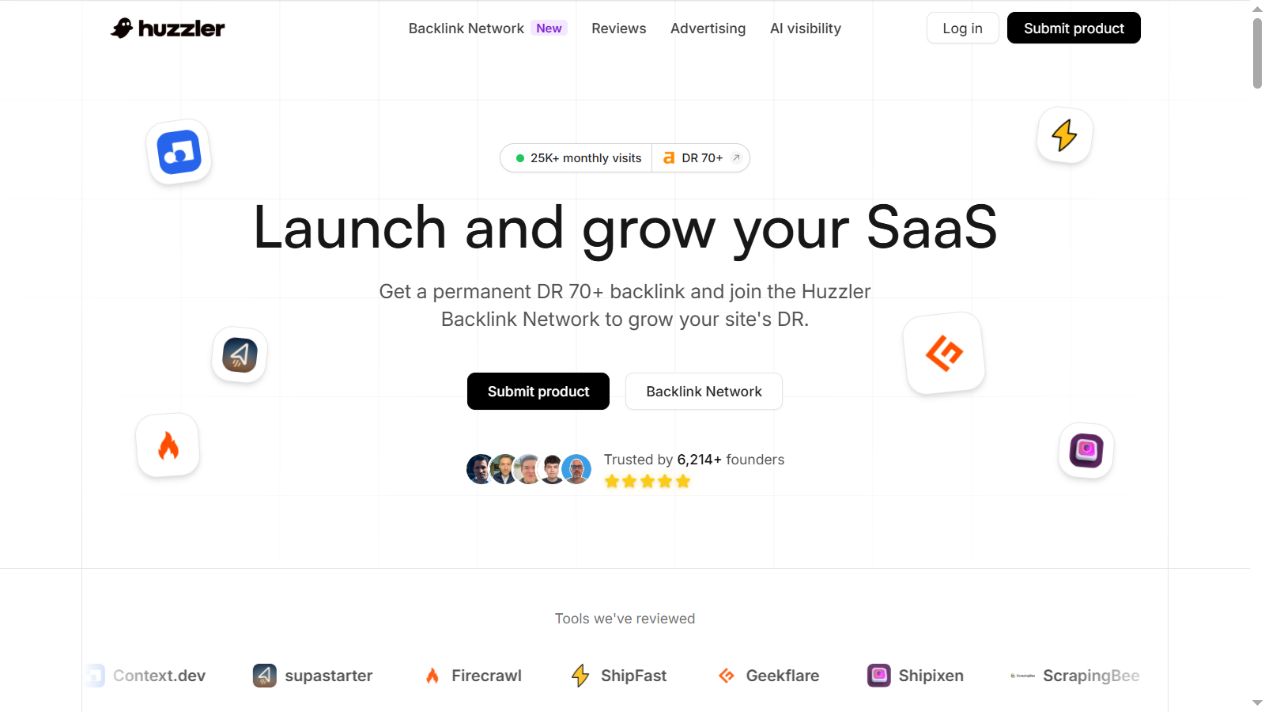
Huzzler combines a SaaS launch feed with reviews, advertising, and a backlink-network offering. Its homepage displays recent products and boosted placements across categories such as marketing, productivity, ecommerce, and AI. The product mix can be relevant to a small software business, but the launch directory and additional promotion services should be evaluated separately. Their costs, obligations, and likely audiences are not identical.
The free route we checked required a homepage badge, checked daily while the product remained in a lengthy queue. The instructions indicated that removing the badge could remove the product from that queue. The free product page also carried a noindex condition when reviewed. That substantially changes the value proposition if your main goal is search visibility; a public page and an indexed page are not the same thing.
Check the current rules before committing website space or launch effort. A social media product should still prepare a useful explanation and screenshot, but avoid assuming that every launch page will support organic search discovery. Judge whether the audience, referral potential, and maintenance obligation justify the work independently of the headline backlink claims.
26. SaaSCity
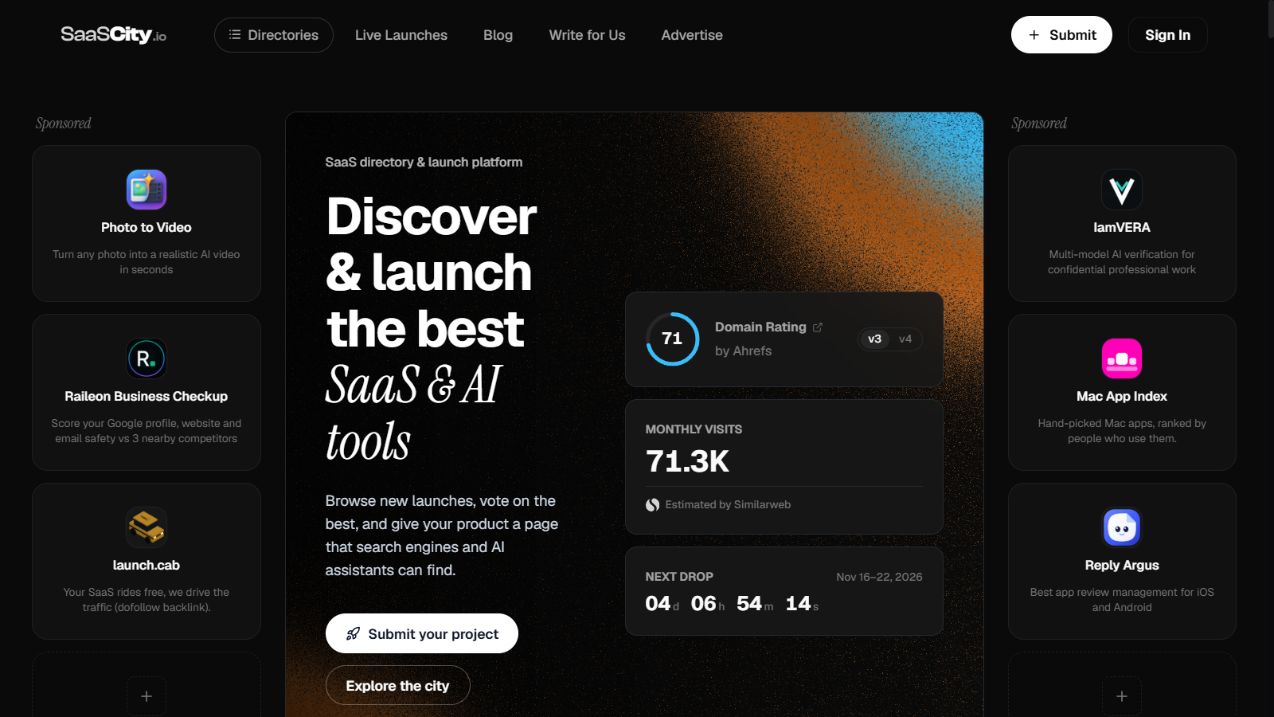
SaaSCity combines a software directory with weekly launch discovery. Its homepage shows new products, voting, category context, and separately labeled sponsorships. It is oriented toward SaaS and AI tools, including applications for productivity, business operations, and marketing. This can be useful when your product benefits from both a permanent description and a scheduled launch moment, provided the profile explains the real customer use case.
The pricing pages we checked prominently displayed paid options, while the FAQ described a Free Badge option inside the submission wizard. The free link was nofollow in that explanation. A founder therefore needs to inspect the actual wizard rather than conclude that the first pricing cards tell the whole story. Verify the badge condition and where it must appear before treating a blog reference as sufficient.
Prepare concise product information and make the landing page ready for a new visitor. For social media software, explain supported tasks, who reviews the setup, and any device requirements. A launch board can create a useful conversation, but votes, advertising exposure, and customer acquisition should be tracked as different outcomes rather than combined into one visibility score.
27. TheSaaSDir
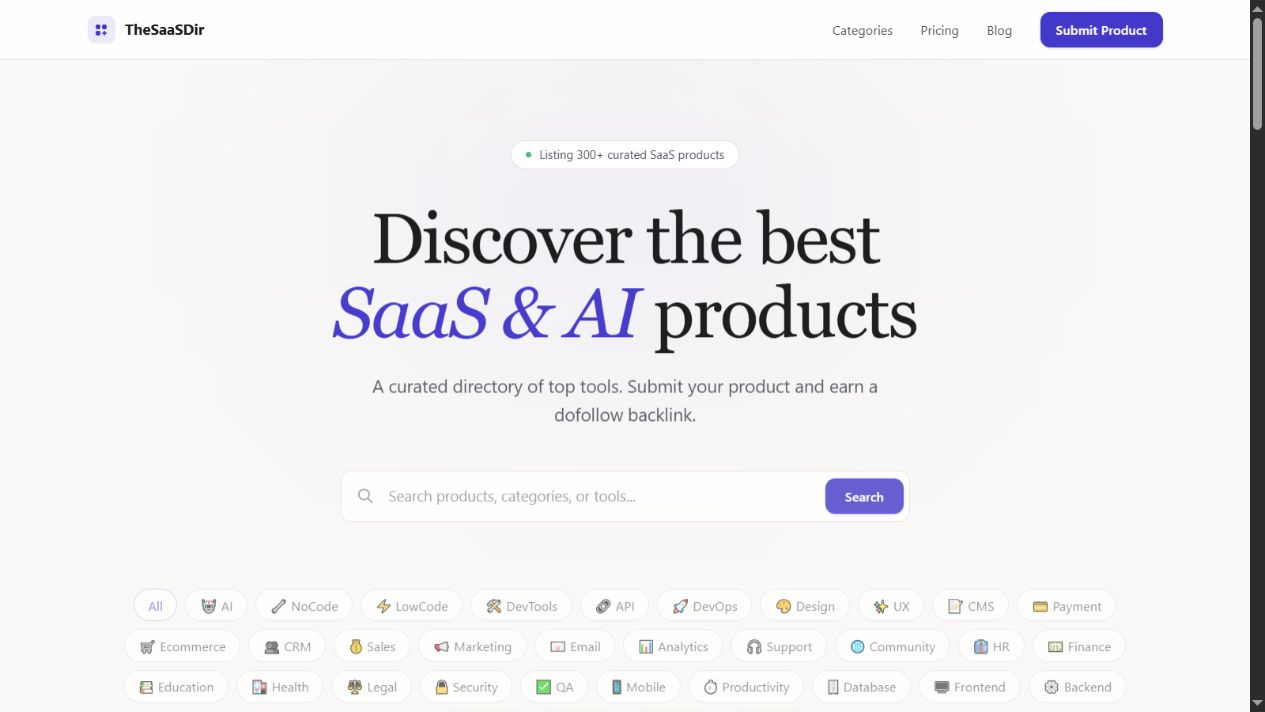
TheSaaSDir is a category-based SaaS and AI product directory. Its homepage spans marketing, analytics, development, support, productivity, ecommerce, and many other business software needs. Featured and recent products appear with short descriptions and tags. This structure suits a tool with a defined recurring job, especially when the submission can explain the audience and workflow without requiring a visitor to decode a complicated slogan.
The free form we checked did not require an account, but it did require badge verification and a followed link. The placement instructions referred to the website and gave the footer as an example; they did not explicitly confirm that an independent article page would work. That makes the current verification result important. Keep the supplied badge details, any verification response, and the final submission confirmation in your records.
For a social media product, use an accurate category and explain the operation it supports, such as preparing schedules or reviewing activity. Do not confuse a free trial with a permanently free plan. After approval, inspect the published entry for imported inaccuracies and verify that its website link points to the intended public page.
28. ufind.best
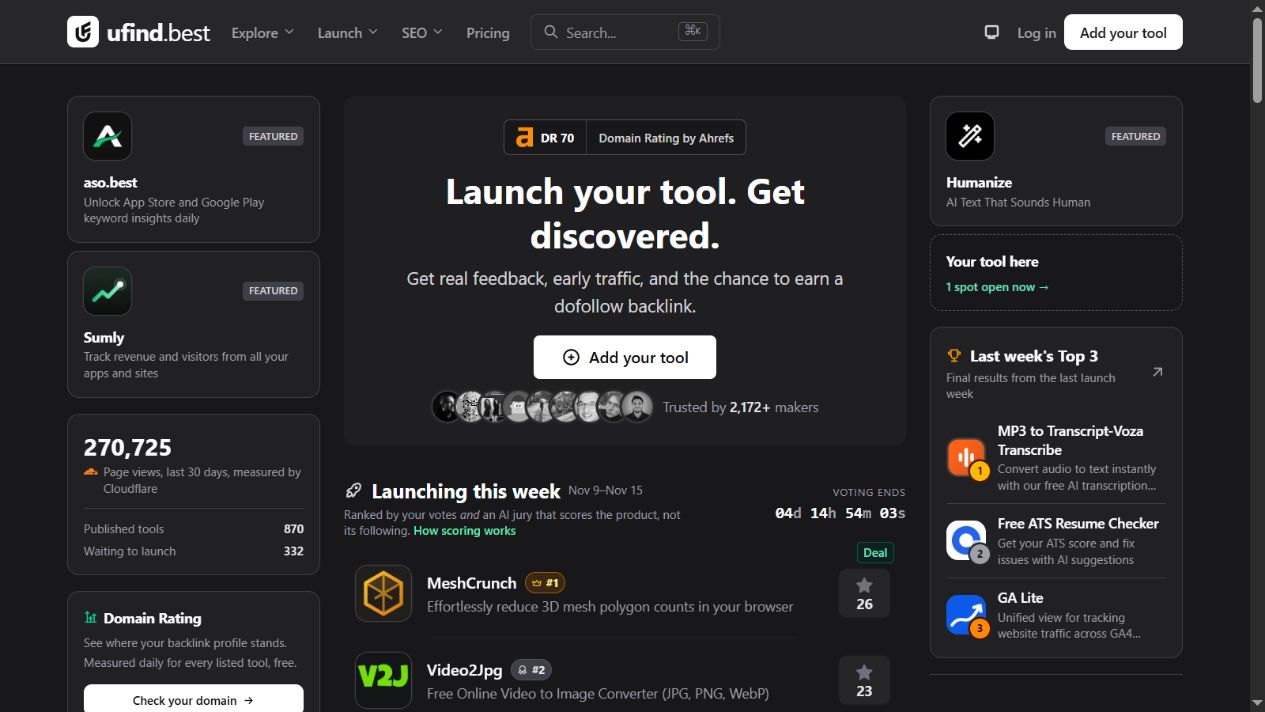
ufind.best offers software discovery through categories, weekly launches, product rankings, and domain-related tools. Its homepage includes productivity, marketing, content creation, business, design, and AI products. The weekly format can suit a small product launch with a concise demonstration, while the broader catalog provides a reference outside the launch period. Examine how ranking works before deciding what a particular position actually means.
The free route we reviewed required a badge before reserving a launch week. It showed a substantial waiting period, and followed-link treatment was limited to the top three rather than every free product. A free profile could therefore involve both a long delay and a nofollow link. Check available weeks and the current scoring rules directly instead of scheduling announcements around an old estimate.
A useful listing starts with one problem and one audience. For a social media application, identify the workflow and supported environment rather than promising generalized growth. Evaluate the final profile on the visitors and feedback it produces. A ranking can be interesting community evidence, but it should not be substituted for measured trial activity or a clear understanding of the buyer.
29. NavFolders
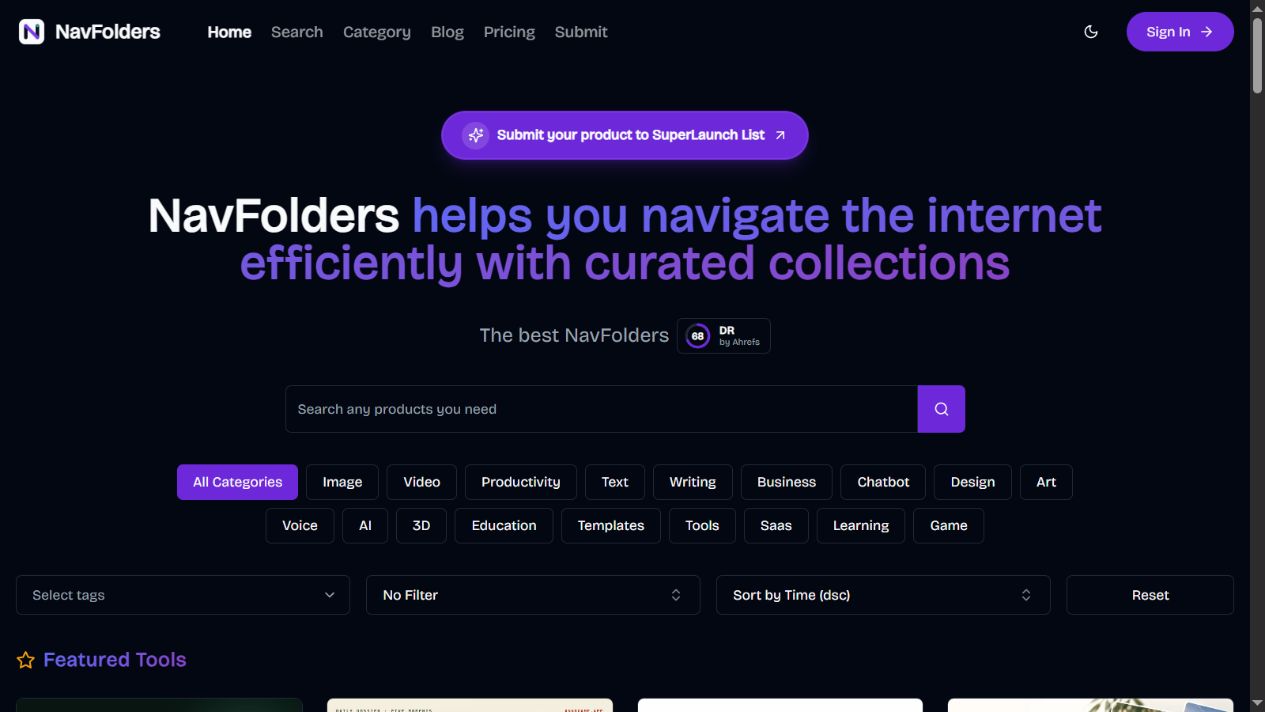
NavFolders presents tools and websites through curated collections, categories, tags, and sorting controls. Its homepage includes business, productivity, image, video, writing, AI, design, templates, and other topics. This broader scope can fit both software products and useful online resources, provided the category genuinely matches the offering. The visible filters also make precise labels useful: they help a visitor narrow a general catalog to a relevant task.
The free plan we checked explicitly requested a badge in the website footer before submission, with a stated seventy-two-hour review period. Without the badge, the product would not enter review. A link inside this article is helpful for navigation but should not be claimed as a footer placement. Recheck the exact markup and live plan instructions before completing the form.
Prepare a product description that explains what someone can accomplish and what they need to begin. A social media team could focus on content organization or repeatable publishing work rather than a broad list of actions. After publication, inspect the category, tags, screenshots, and destination URL. Those practical details determine whether the profile makes sense to a first-time visitor.
30. Indiehunt
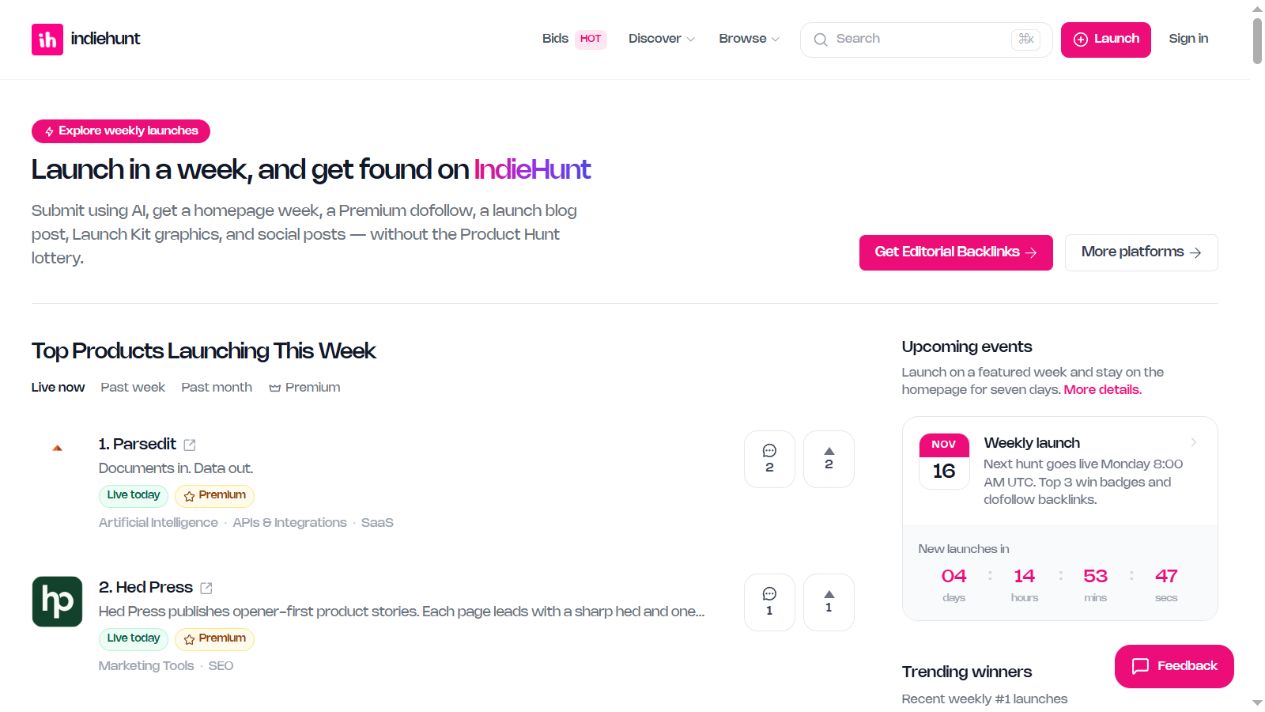
Indiehunt is a weekly launch platform for AI products and other maker-built software. Its homepage highlights current launches, earlier periods, categories, and additional promotion services. The weekly presentation provides a natural point for a founder to introduce a product and explain why it exists. At the same time, a homepage mention of launch graphics, articles, or social posts should not be assumed to describe every free listing.
The free route we checked required a badge or backlink on the website and included a week on the homepage. Ordinary free listings used nofollow links, with a possible followed-link upgrade for the top three. The required backlink location was not fully confirmed for an independent article page. Test the current verifier and record the selected plan, available week, and actual submission status.
For a social media tool, combine a short demonstration with a practical explanation of who should use it. Answer specific questions and avoid treating community participation as a vote-trading exercise. Indiehunt can be one part of a launch plan, but the useful evidence comes from relevant conversations and website activity after the product becomes public.
31. Agent Hunter
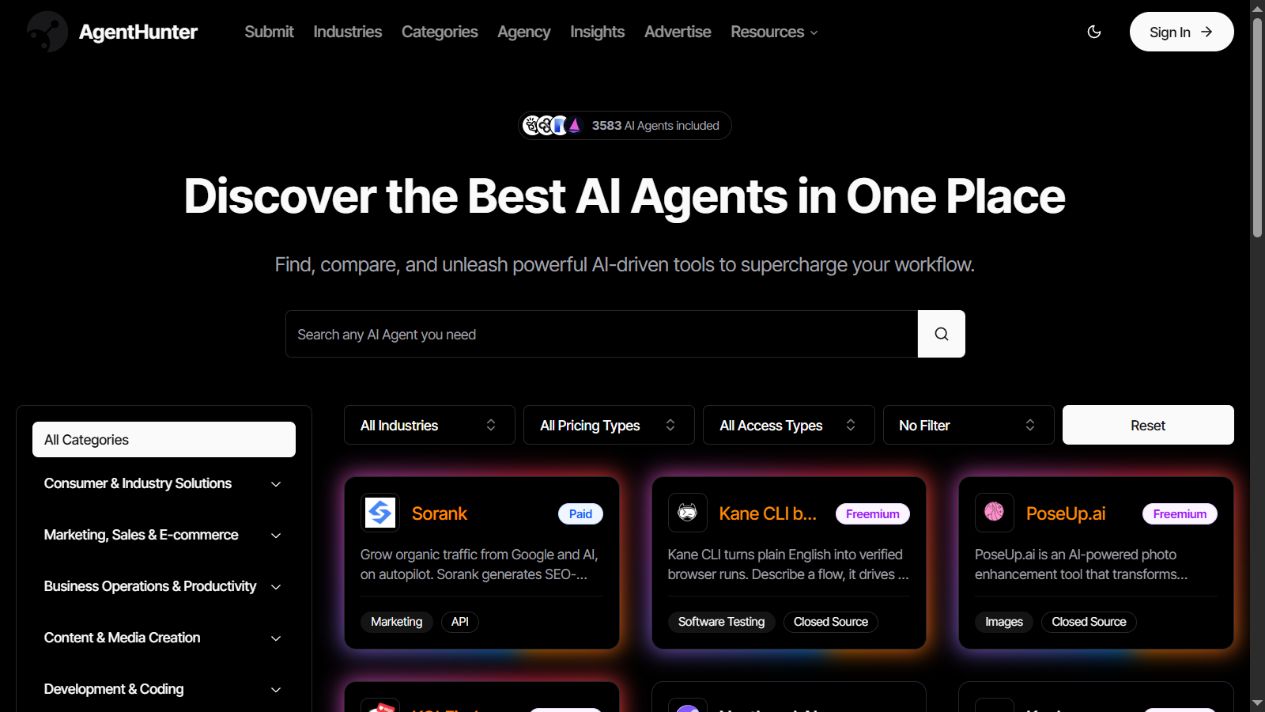
Agent Hunter focuses on discovering AI agents through categories, industries, pricing models, and access types. Its homepage lets visitors filter business operations, content creation, marketing, development, research, and other areas. That makes it useful for products that can explain a specific agent-driven job and the environment in which it operates. The industry dimension can also help a founder distinguish a specialist workflow from a general-purpose assistant.
The free option we reviewed offered a permanent profile with a nofollow link and an approximate two-week review period, while requiring a backlink to Agent Hunter. The exact accepted placement was not clear in the earlier instructions. Test a public resource page through the current flow or confirm the location before making an ongoing commitment. A backlink requirement does not necessarily mean the returned link is followed.
For a social media assistant, describe what it can inspect, prepare, or apply, and where human approval fits. Include accurate access and pricing labels, especially if an external AI account is needed. Those operational details help a buyer more than an unsupported claim that an agent can run every part of their business.
32. Aidirs
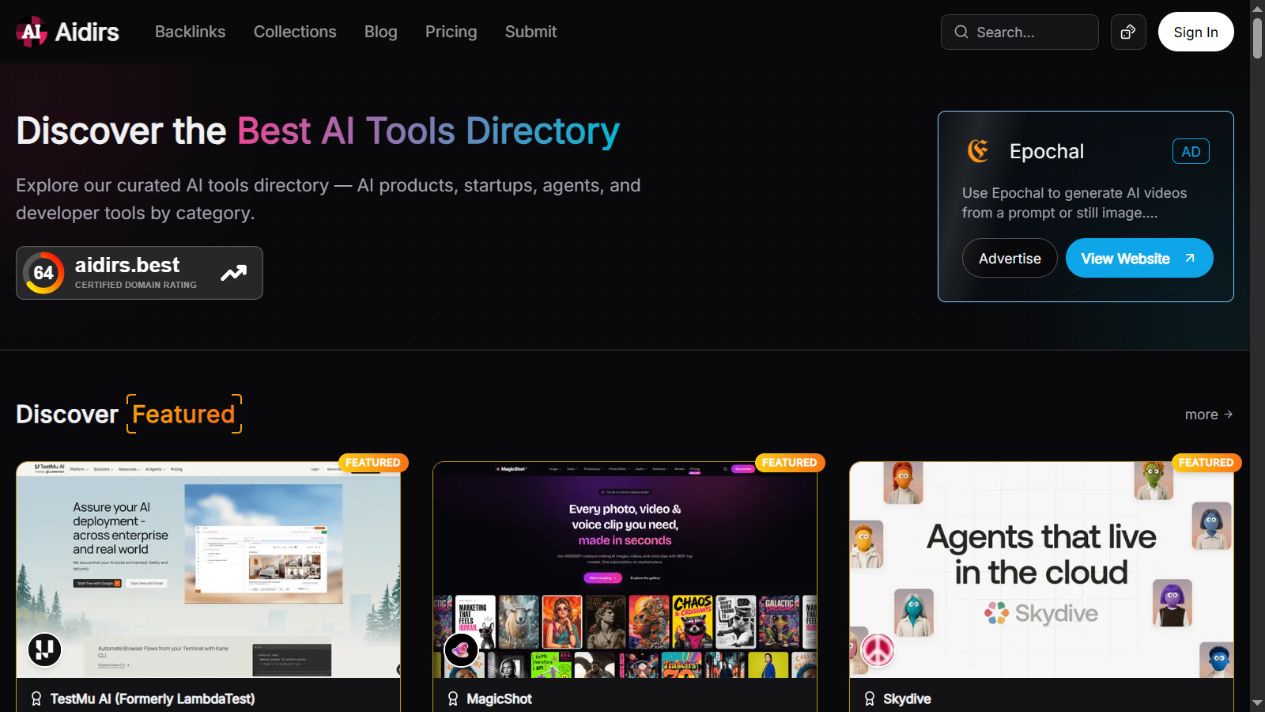
Aidirs is an AI product directory with collections, category browsing, a blog, and additional backlink-oriented services. Its homepage includes agents, developer tools, creative applications, automation, and other AI use cases. That range can be useful for a founder whose product has a clear AI capability but spans more than one task. Explore the actual category pages and neighboring tools before choosing how to position the listing.
The free route we checked required badge verification and recurring checks after publication. Other plans offered different levels of visibility and were separate from the free option. A successful submission therefore does not remove the need to maintain the badge. If the verifier only checks a particular page, a link elsewhere on the domain may not be enough; confirm the current behavior before counting the requirement as complete.
A social media product can explain its assistant, automation boundaries, and supported workflow without claiming universal growth. Choose an image that shows the product rather than only a decorative illustration. After publication, review the entry for accuracy and track relevant website activity. Treat domain or traffic metrics shown by the directory as context, not a forecast for your own listing.
33. AI Tool Trek
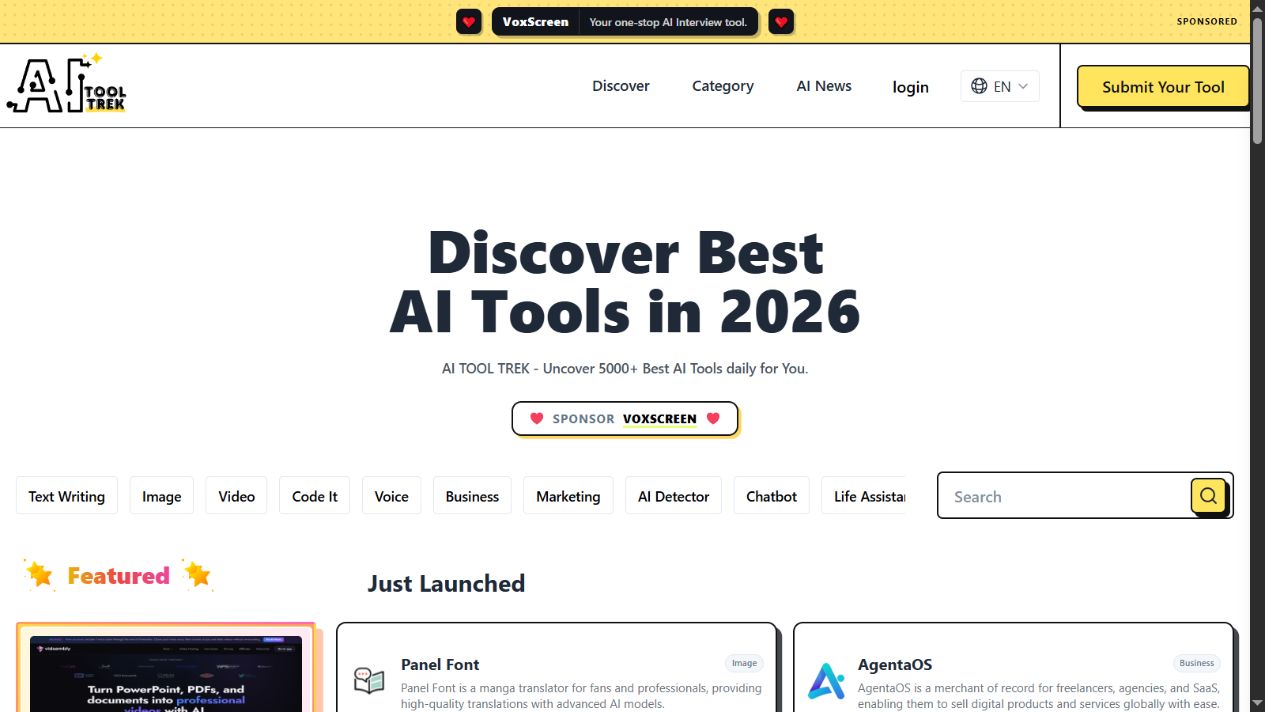
AI Tool Trek organizes AI discovery around tasks including text, image, video, coding, business, marketing, chatbots, and productivity. Its homepage includes recently launched tools and an AI-news route, giving visitors both catalog browsing and a view of newer applications. It can be relevant to an AI-enabled product that performs a clearly defined job, particularly if the description makes the audience and expected output easy to recognize.
The Free Pack instructions we checked explicitly required a homepage link. They indicated review within seventy-two hours and listing within fifteen days, with removal possible if the backlink disappeared. Those conditions make the placement and maintenance obligation important. An article reference can help readers while still failing the homepage requirement. Recheck the actual form and any supplied badge before submitting.
Prepare a practical explanation rather than a list of AI buzzwords. For social media software, distinguish assistance with settings or content from the execution of actions on supported platforms. Include the pricing model and setup requirements. When the product becomes public, verify the destination URL and category, then assess whether the directory sends visitors who understand and need the workflow.
34. DanielLaunches
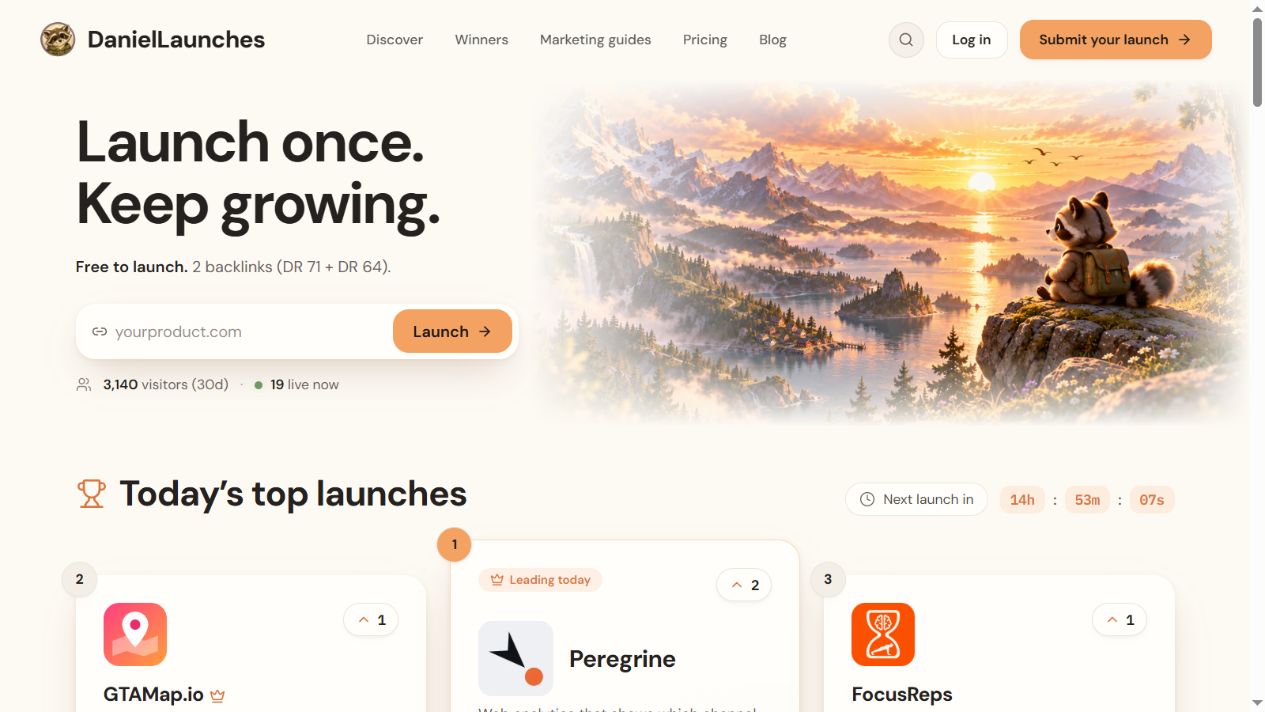
DanielLaunches is a product discovery and launch site with daily leaders, weekly highlights, categories, and maker attribution. The homepage includes analytics, productivity, marketing, social, and AI products, making it a possible fit for focused software with a clear use case. The product-and-maker format can support a more personal introduction than an anonymous catalog entry, especially when the founder has a useful story about the problem being solved.
The free route we reviewed required an active badge that remains on the website. Its rules explained that removing the badge could disable the listing and links until verification succeeds again. Treat the reference as part of the maintained profile, not a temporary launch decoration. Confirm the accepted location and exact markup in the current flow before assuming that a blog article meets the requirement.
A good description explains the product in ordinary language and shows a task being completed. A social media tool might demonstrate preparing a routine or checking account activity. Coordinate a relevant announcement with the actual launch date, then evaluate referral quality and feedback. Daily ranking movement is interesting, but it is only one part of the distribution picture.
35. Launchtory
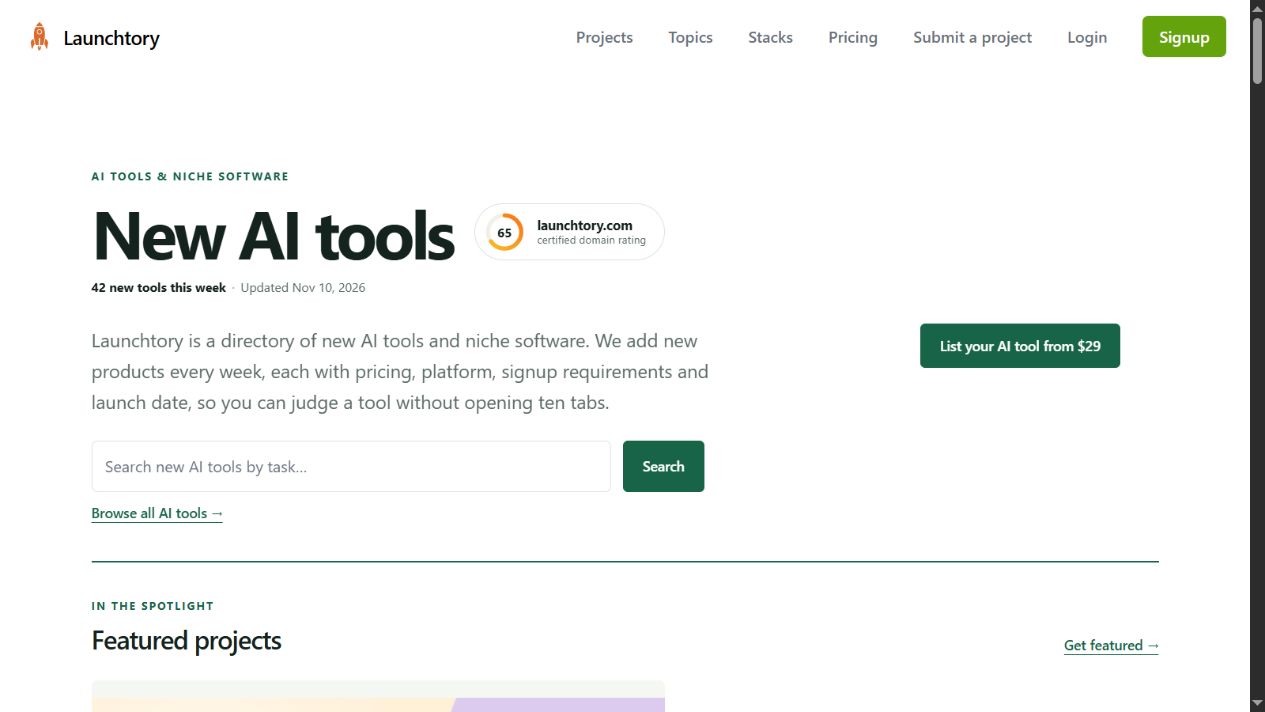
Launchtory currently presents itself as a directory of new AI tools and niche software, with projects, topics, and technology stacks. Its homepage explains that entries can include pricing, platform, signup requirements, and launch dates. That emphasis is useful for buyers who want to understand practical differences before opening several product websites. It is a good positioning exercise: can a visitor quickly tell whether the product fits their environment?
Our earlier submission research found a free route tied to verification of a link from the product website, without a guaranteed review date. The homepage now foregrounds paid listing and spotlight options, so verify that the free route is still available before investing time in it. Do not assume an older free-plan note overrides the current form or that paid sponsorship comes with a basic listing.
For a social media application, make platform support and required setup explicit. Explain what the tool actually does and identify the buyer who needs it. Launchtory’s detailed product framing can be useful as competitor research too. Judge any eventual listing on accurate presentation and relevant visitors rather than the presence of a backlink alone.
36. Launch Vault
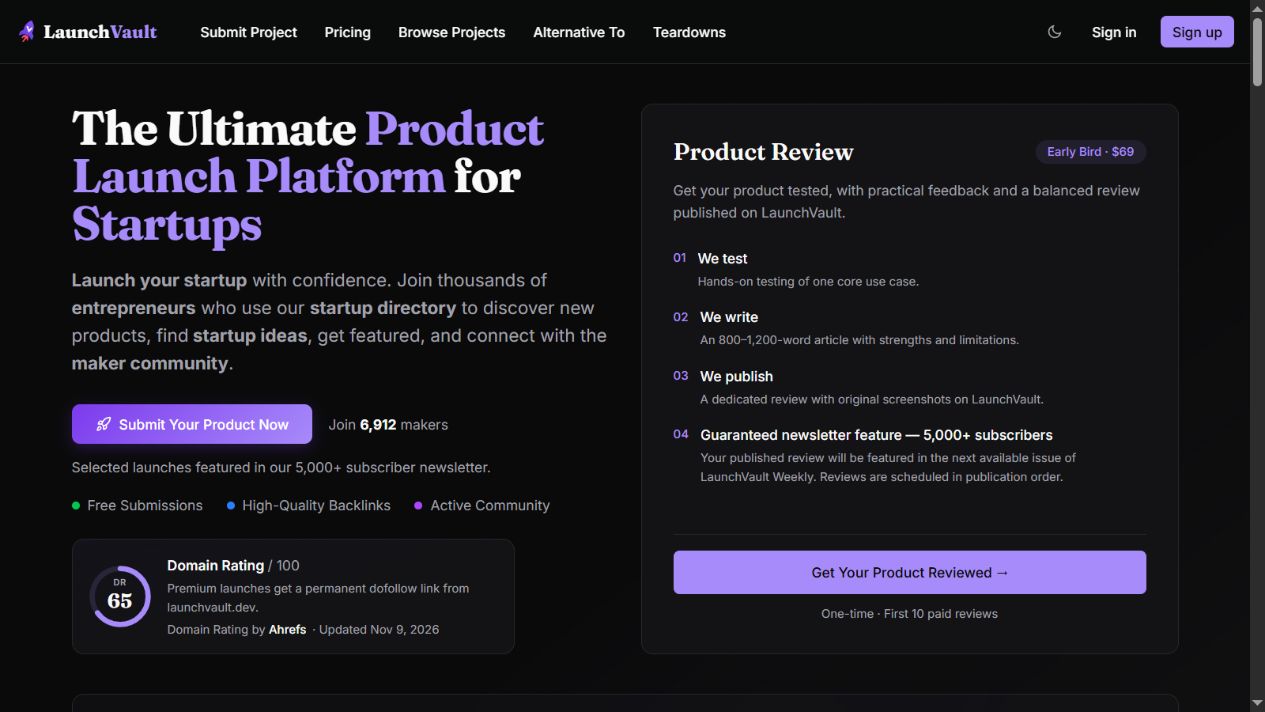
Launch Vault combines a startup launch board with product discovery, maker-oriented content, and a separate paid review offering. Its homepage includes weekly launches and information about its newsletter. This can be relevant to software that benefits from a concise launch story and a clear demonstration. Keep the different offers separate: a basic submission does not automatically include hands-on testing, a full review article, or newsletter placement.
The free route we checked limited weekly places and required badge verification before scheduling. Followed links were associated with ranking and badge conditions rather than being an unconditional benefit for every free entry. Recheck the available week and current plan wording before planning your announcement. A draft, a reserved slot, and a published product are distinct milestones.
Prepare a useful description of the core task and intended customer. For social media software, a short walkthrough communicates more than a collage of growth slogans. If considering the separate review service later, assess its deliverables and editorial approach independently. For the free listing, track the final public page and actual referral activity, then compare useful visits with the time spent preparing and maintaining the profile.
37. SaaSGrow
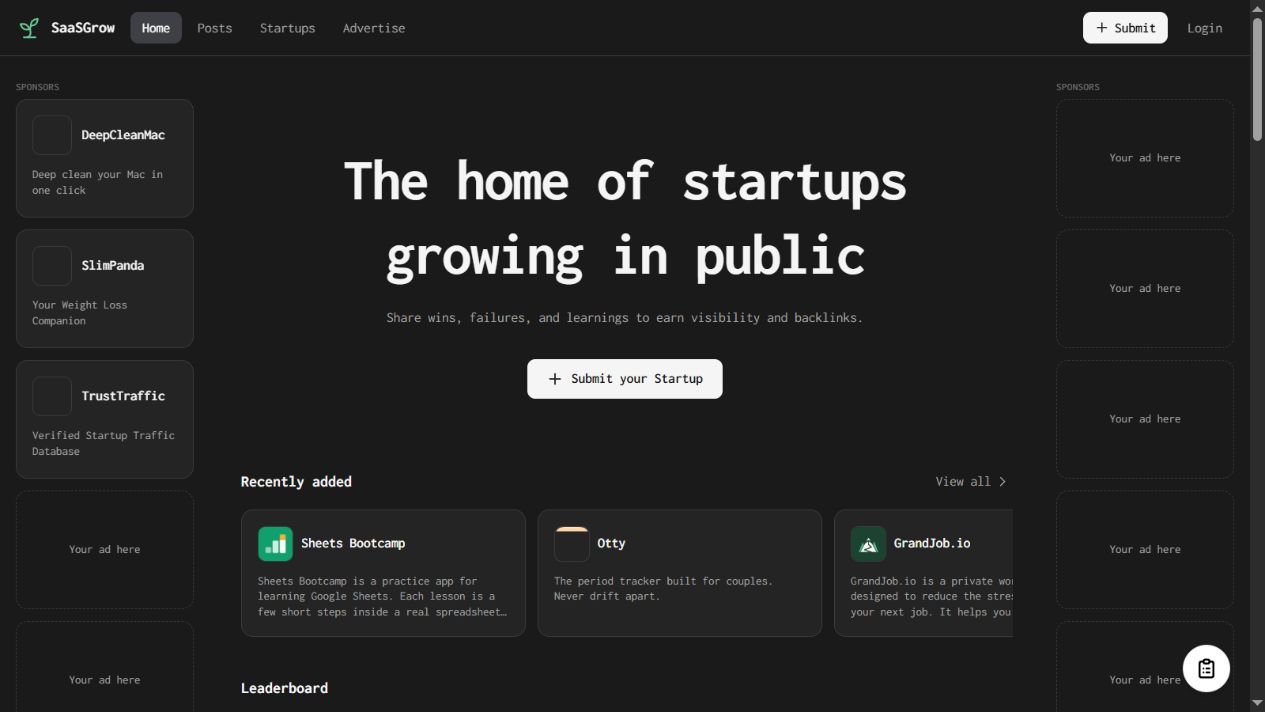
SaaSGrow is built around startups growing in public, with a directory, posts, a leaderboard, and category browsing. Its homepage explicitly invites founders to share wins, failures, and lessons. That makes the platform interesting when your team has useful operating experience to discuss, rather than only a launch announcement. The product mix includes productivity and business software alongside other focused applications.
The free route we reviewed required badge verification before approval and included a startup profile and timeline. Those features suggest an ongoing presence rather than a single launch-day card. Confirm where the badge must appear and what the verifier checks before relying on a resource article. Keep public progress updates accurate and avoid presenting a saved profile as approved until the platform confirms it.
A social media business can use this context to explain decisions about workflows, onboarding, or a new capability, using public information and real lessons. There is no need to publish customer data or private financial details to make an update useful. Evaluate whether participation produces relevant conversations and returning visitors, not only a larger number of places where the company name appears.
38. Starter Best
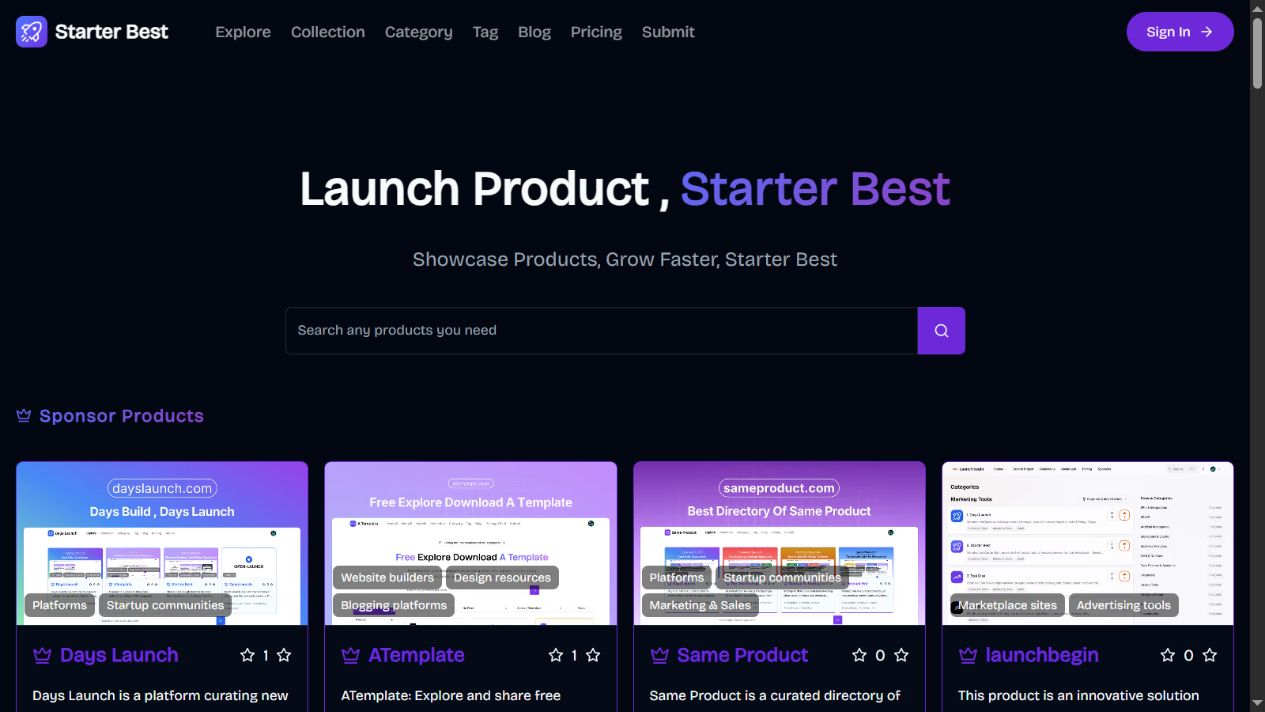
Starter Best is a product showcase with categories, collections, tags, and daily-style discovery. Its homepage includes mobile applications, websites, templates, marketing resources, and startup-community products. This broader mix can suit a focused tool that is easy to explain, while making category selection important. A visitor should see how the product helps with a task without needing to interpret a generic startup slogan.
The free option we checked required a maintained backlink and limited the number of products listed each day. The pricing page did not clearly establish a homepage or footer location in the earlier review. An editorial resource page is worth testing, but successful verification is still needed. Check the current capacity and review process before treating a free submission as immediate publication.
Prepare a short summary, accurate tags, and an image showing the interface or result. For a social media workflow, identify the practical benefit and supported environment. After publication, inspect the profile rather than assuming imported text is correct. Keep the listing as one measured distribution channel and compare relevant visits with the time required to maintain it.
39. Startup Trusted
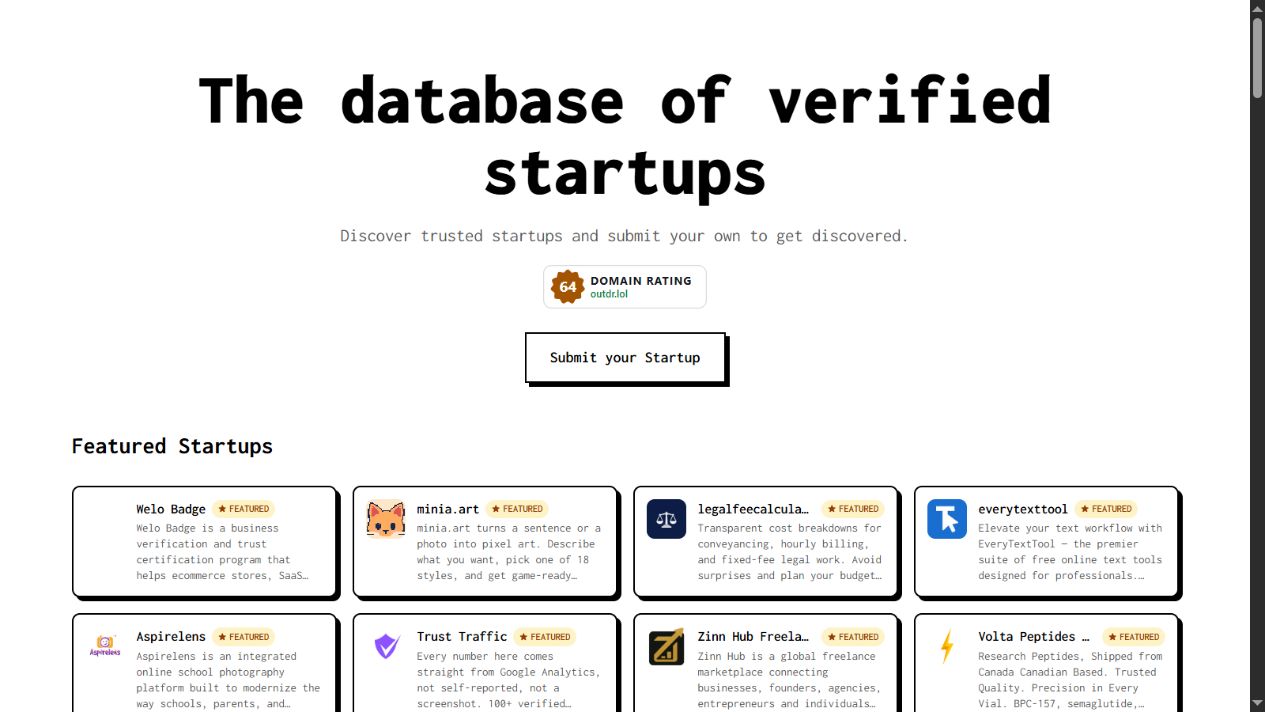
Startup Trusted is a startup database with featured entries, recent listings, and categories. Its visible product mix includes business services, software, creative tools, and specialized applications. The broad scope can be useful for a business that does not fit neatly into an AI-only directory. A clear explanation of the customer and use case is essential because visitors may arrive with very different needs.
The free route we reviewed required automatic badge verification before manual review. Paid visibility options were separate. The platform’s name and verification language should not substitute for your own product evidence; check what its screening covers before making any trust claim based on the listing. Confirm the badge location and current submission requirements directly.
For a social media product, explain the workflow, supported platforms, and practical setup requirements. Use a public business contact and screenshots containing sample data. The profile can be another place to discover the company, but it does not establish performance results or certify every product claim. Review the final page and track the visitors and inquiries it generates. Compare those results with the work required to keep the entry accurate.
40. Toolfio
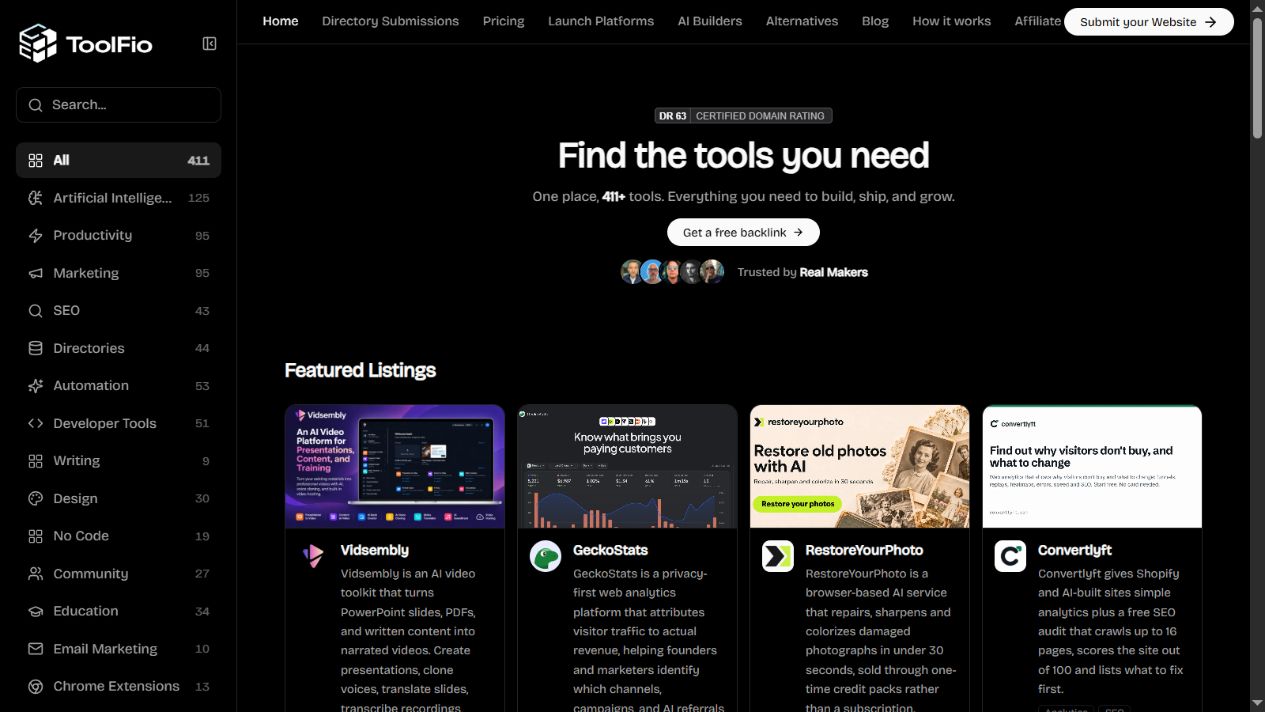
Toolfio is a broad SaaS and AI tools directory aimed at builders, with categories including social media, content creation, automation, analytics, development, and marketing. Its homepage combines featured listings with category counts and additional resources. The category structure can help a product reach visitors researching a specific workflow, provided the profile is more precise than a general claim about productivity or growth.
The free option we checked required a minimum domain rating of twenty and a permanently retained badge. Recurring checks could lead to delisting when the badge disappears. This is a meaningful eligibility condition, especially for a new domain. A public link alone does not prove the correct badge and placement have been accepted; use the verifier’s result as confirmation.
Prepare a description explaining the main task, intended buyer, pricing, and platform support. For social media software, distinguish a content tool from software executing supported routines on connected devices. Assess the directory as a discovery channel, but do not turn its backlink-focused language into a promise of improved rankings. Track relevant visits and useful prospects after publication.
41. DodoDirectory
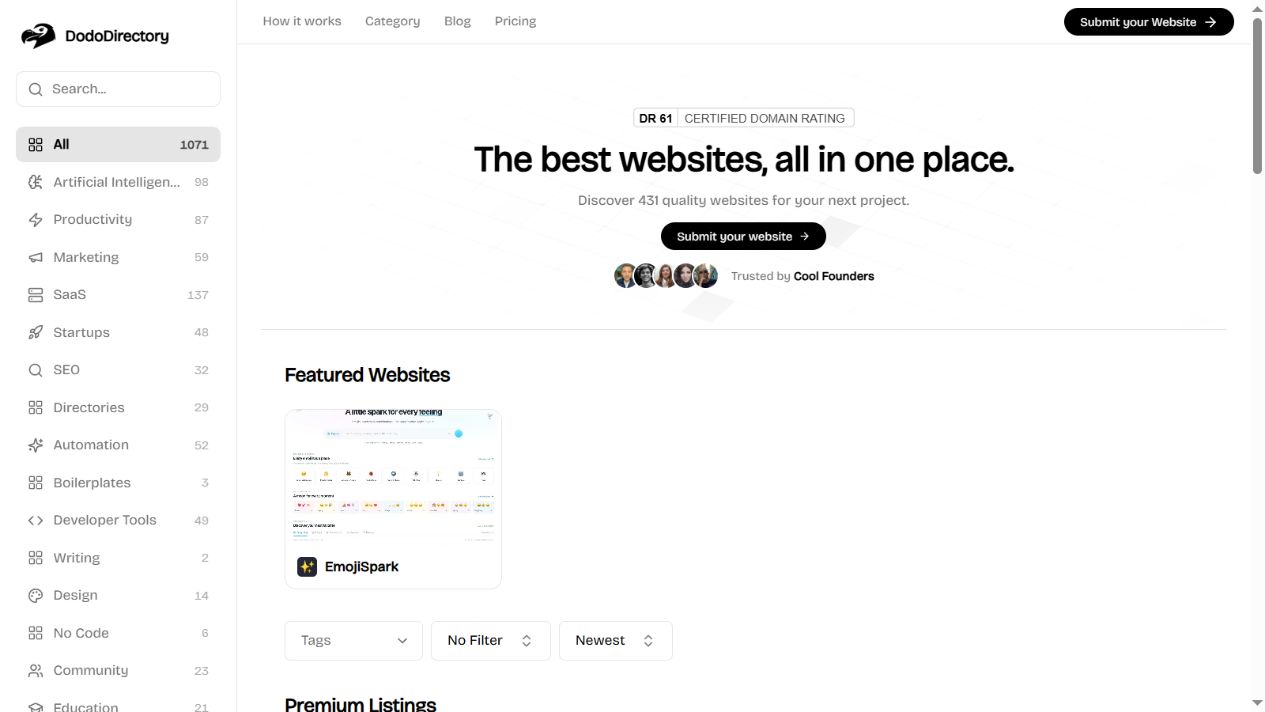
DodoDirectory covers business websites and software across a broad set of categories. Its homepage includes SaaS, startups, marketing, automation, social media, professional services, and local businesses, alongside specialized topics. That breadth makes it a possible fit for products or services outside a narrowly defined launch board. Choose the category where a prospective customer would reasonably look for your offering.
The free plan we reviewed required a permanent badge or backlink and described a two-week review period. The rules stated that removing the reference could cause immediate delisting. Keep that obligation with website maintenance notes, particularly before redesigning a footer or reorganizing resources. Verify the accepted location and markup rather than assuming any mention on the domain will pass.
Write an introduction centered on one buyer and one practical problem. A social media business might explain its account-management workflow or the kind of team it serves. Avoid unrelated categories merely because they are available. After approval, check the public description and link, then judge whether the profile attracts visitors with a real reason to explore the product. Record those outcomes alongside the original submission date.
42. SaaSBison
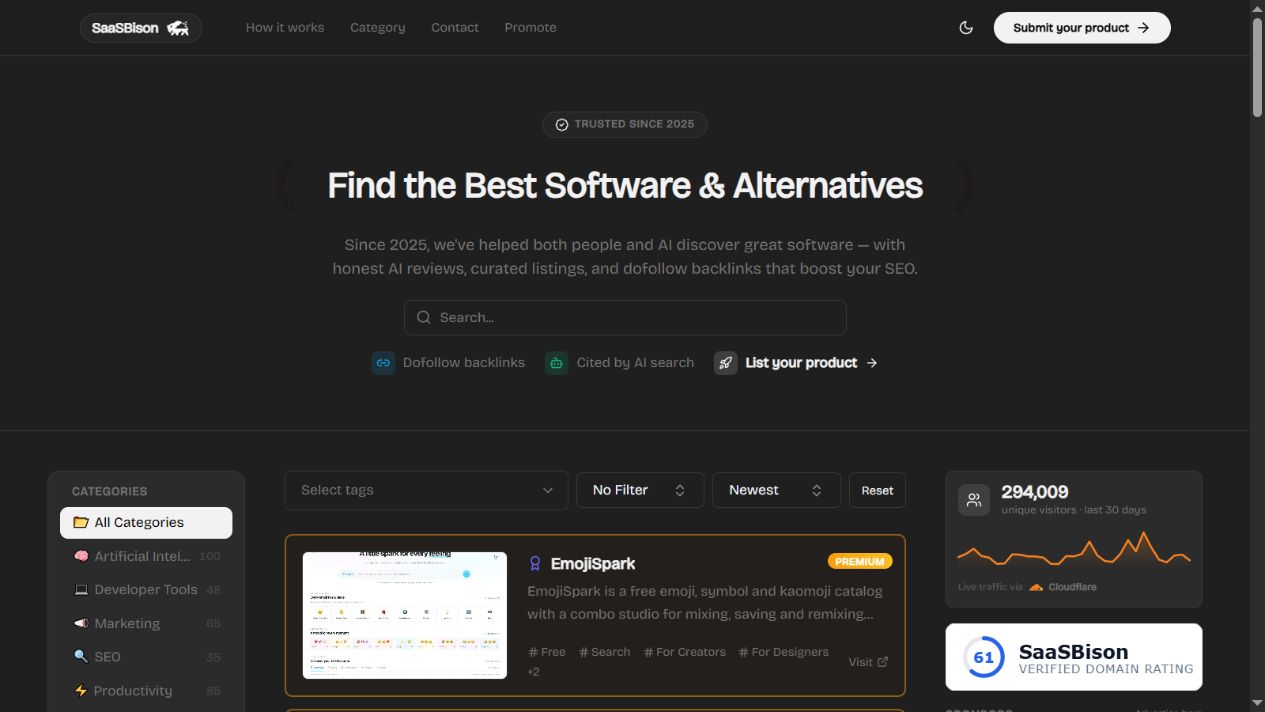
SaaSBison organizes software and alternatives through categories such as marketing, automation, analytics, content creation, social media, development, and productivity. Its homepage includes labels and product descriptions, with premium entries identified separately. The alternatives framing can help a buyer compare approaches, so a submission benefits from explaining the job performed and the circumstances in which the product is a good fit.
The Free Listing option we checked required a badge on the website and described a slow manual review. It limited the short description to approximately fifteen hundred characters. Prepare a compact version rather than pasting a full sales page. Confirm the current badge location and verification process before assuming a blog resource page qualifies.
For a social media product, explain the workflow and any desktop, device, or account dependencies. State pricing and trial conditions accurately so comparisons remain meaningful. A directory description or generated review is not the same as hands-on validation of every claim. Inspect the published result for mistakes and measure whether it sends relevant visitors who understand what the software does. Use any recurring questions to improve the profile and your documentation.
43. SubmitMySaas
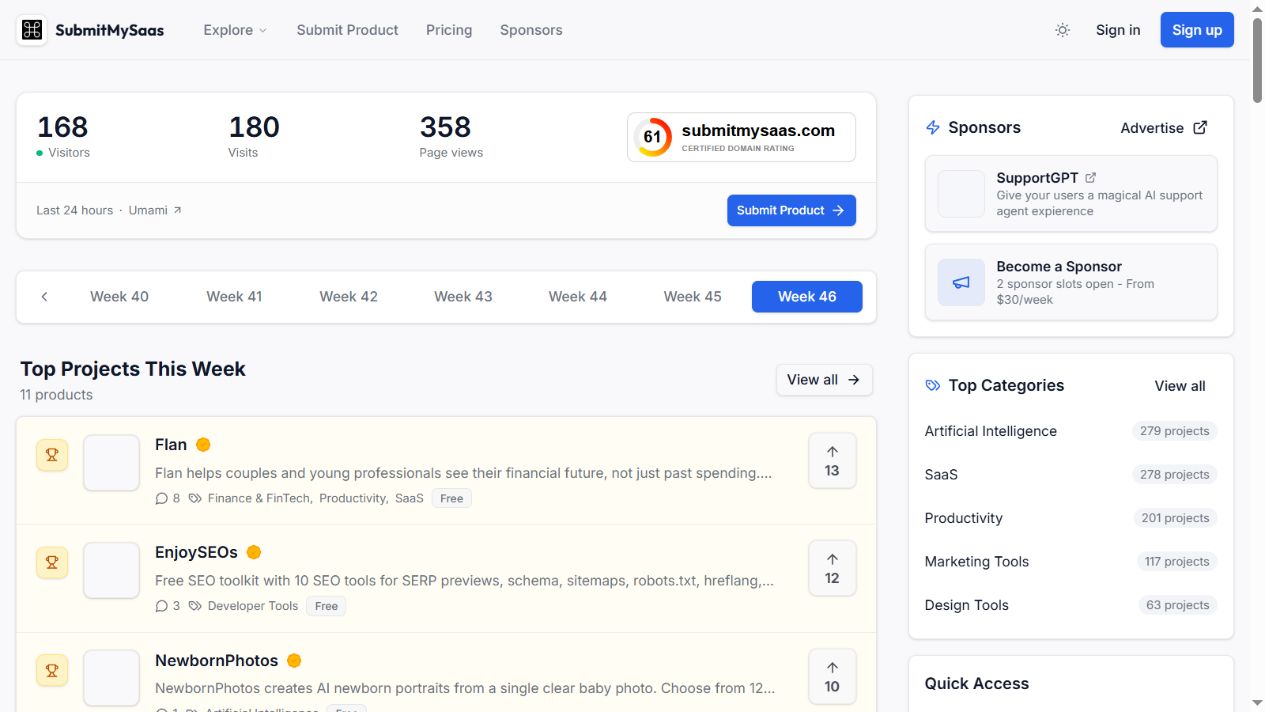
SubmitMySaas combines SaaS discovery with weekly product launches, categories, voting, and earlier launch periods. Its homepage features business, developer, productivity, and AI applications. That format can suit a small software product with a clear launch message and specific customer. The weekly context helps coordinate a demonstration and social announcements, but a confirmed slot is needed before dates are treated as fixed.
The free route we checked required verification of a homepage badge before a slot could be reserved. It limited free launches each week and explicitly did not offer a badge-free zero-cost listing, even with a nofollow link. An article reference cannot be assumed to replace that requirement. Revisit current availability and verification instructions before completing the submission.
A social media product should explain a practical recurring task and the setup a customer needs. Use a relevant screenshot and truthful trial label. Separate the free launch from premium promotion or sponsorship, and record the public profile after publication. The useful outcome is a new visitor understanding the product, not simply collecting a launch-board badge. Follow up on relevant questions while the launch is active.
44. LaunchKiwi
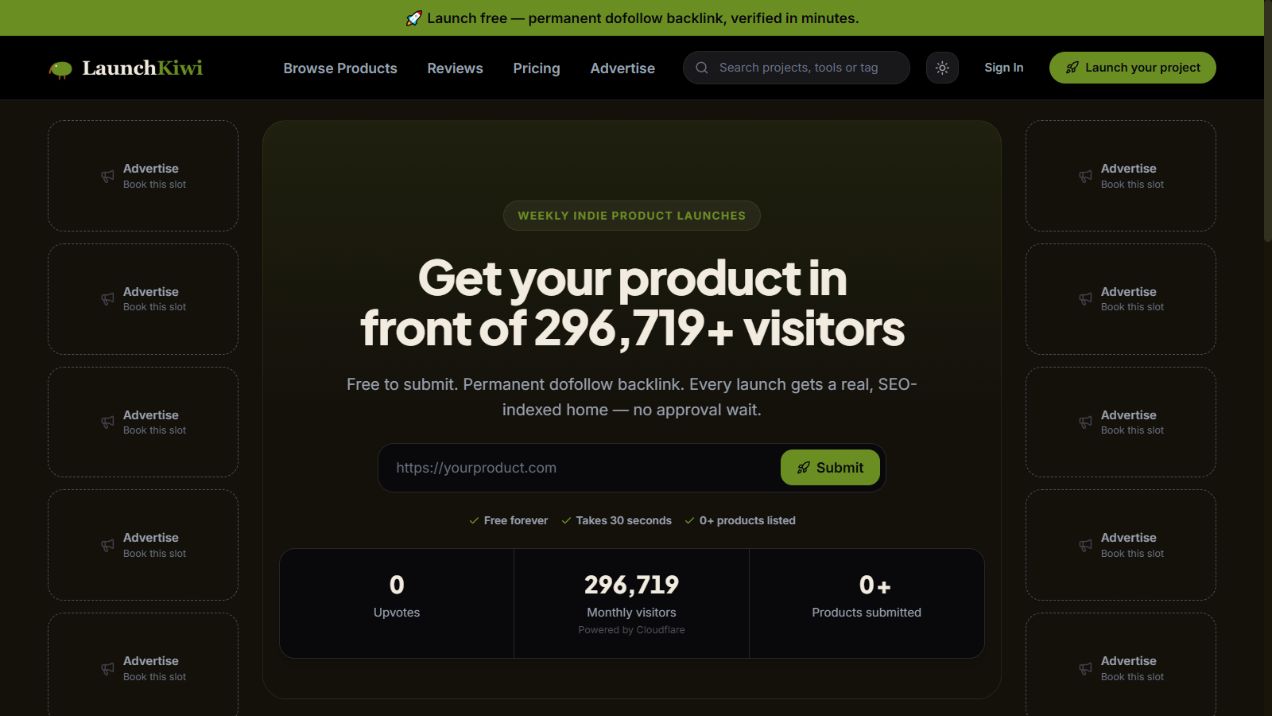
LaunchKiwi is a weekly discovery platform for independent projects and startup launches. Its homepage offers current, past-week, and past-month views, alongside reviews, a newsletter, and paid advertising. The positioning is suitable for small software aimed at early adopters, designers, developers, or other makers. A clear explanation of what the product does is more useful than relying on the platform’s overall audience headline.
The free plan we checked required badge verification, with featured and premium options offered separately. Some homepage language emphasizes fast publication, so inspect the actual free submission step before assuming speed applies without conditions. Confirm what the verifier accepts and whether an editorial article is sufficient; a general website mention is not proof of eligibility.
For a social media tool, demonstrate one recognizable workflow and explain the intended team or operator. Prepare the logo, pricing model, and supported-platform details before starting. After the listing is live, compare relevant referrals and trial activity with the effort involved. Keep sponsored placements separate from community discovery when interpreting traffic and rankings. Check the public page for imported errors before using it in an announcement.
45. SumoDir
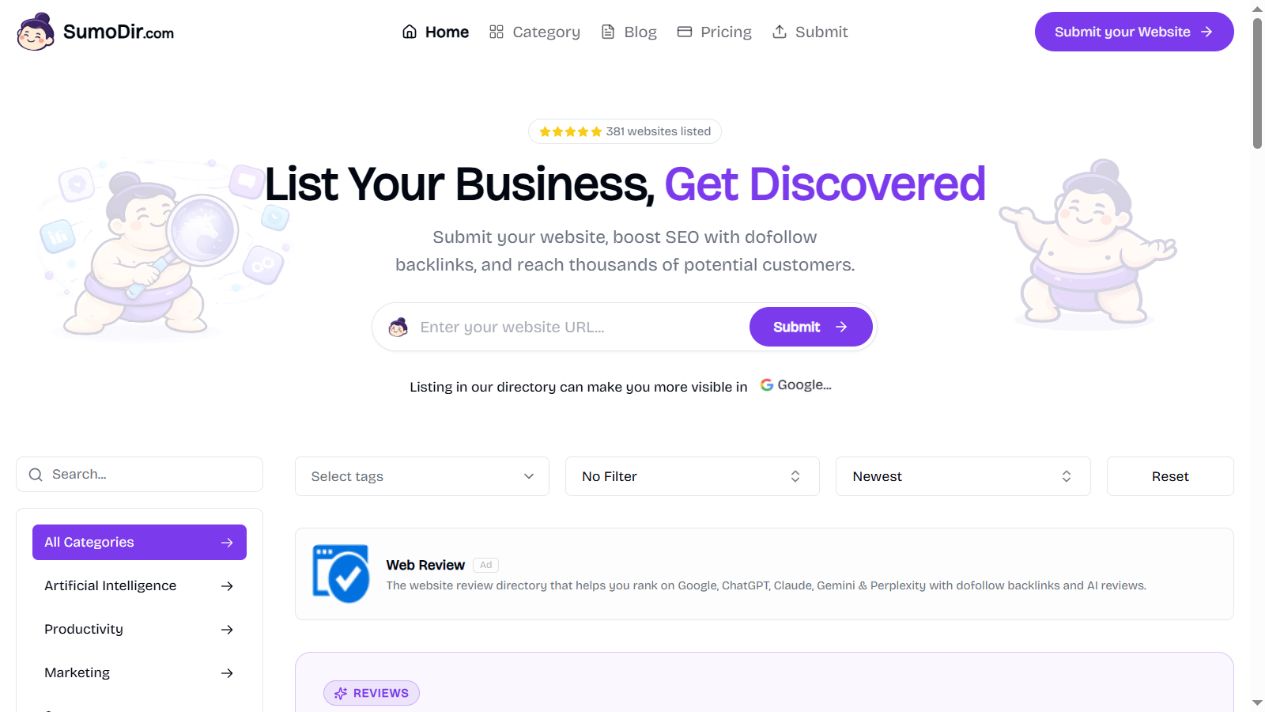
SumoDir is a business, SaaS, and startup directory with categories extending beyond software into services and professional businesses. Its homepage includes reviews and browsing by tags. That scope can fit a product-led company or a service business with an accurate category match. The broad audience makes a precise opening sentence important: identify who the offering serves and the problem it addresses.
The Free Listing option we reviewed required a backlink to SumoDir, described a two-week review period, and limited the description to fifteen hundred characters. Premium listing and review-article options were separate. Check the current verification and accepted page location before submitting a resource-page URL. Record the selected plan so a later reviewer can distinguish free submission from paid promotion.
A social media agency or software product should avoid describing itself as both unless accurate. Explain the service or workflow concretely, include a public contact, and use an appropriate image. After publication, review the wording and destination link, then measure useful inquiries or relevant visits. The business-directory scope does not guarantee qualified leads; the quality of the category match still matters.
46. AIHuntList
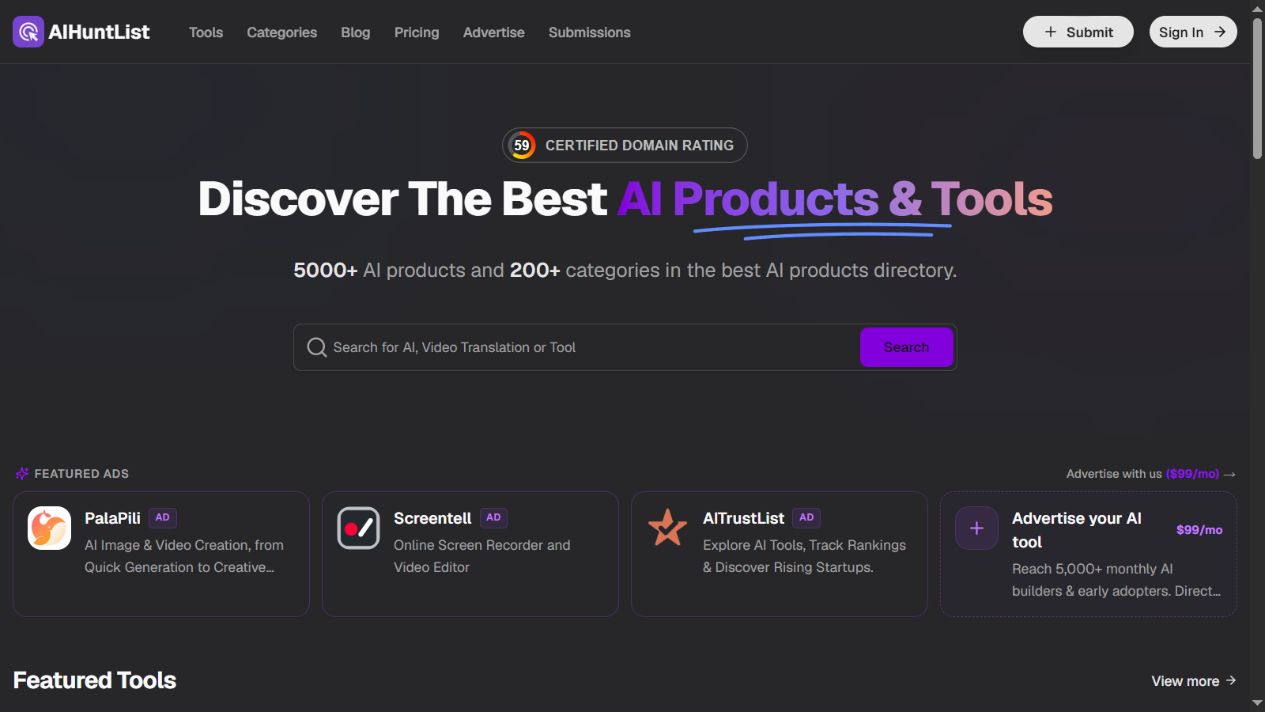
AIHuntList is an AI product directory with category browsing, a blog, featured tools, and separately labeled advertising. The homepage covers creative, business, marketing, and developer uses, making it a possible discovery surface for a product with tangible AI capability. Its category range means a submission needs a clear primary job so visitors can recognize the relevance quickly.
The free route we checked accepted a badge or text link to AIHuntList and indicated review from roughly seventy-two hours to a week. Earlier instructions did not clearly specify a homepage or footer location. A public article reference is worth testing through the current form, while the verification result remains the evidence that the condition is met. Paid fast-track and advertising options should be assessed separately.
For social media software, explain the AI-assisted workflow and any separate provider requirement. A useful screenshot and accurate pricing label distinguish the product from adjacent tools. Do not confuse an advertising audience claim with expected traffic for a free listing. Track the final profile and actual referrals after approval, and update the entry if pricing or setup changes.
47. MarketingDB
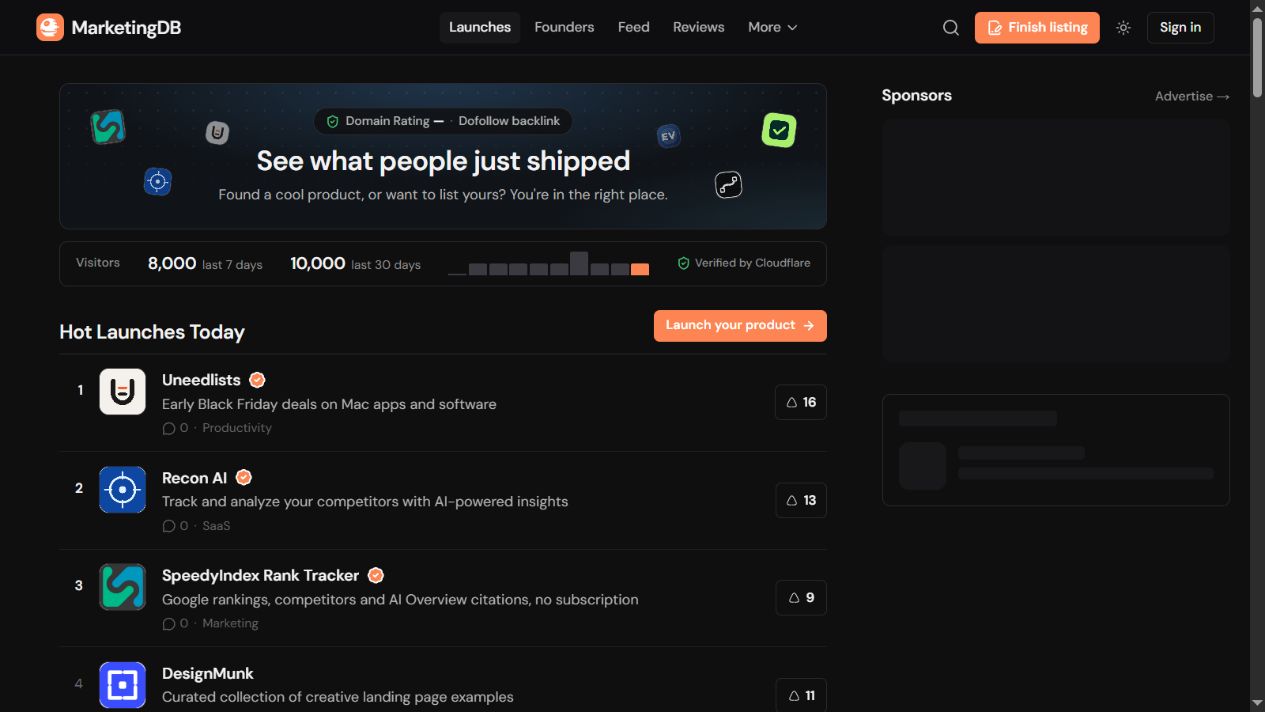
MarketingDB is a product-launch discovery site with launches, founders, a feed, reviews, and rankings from different periods. Despite its name, its visible product mix extends beyond marketing into design, education, mobile apps, and other software. This makes it useful for researching how small products are introduced to a maker audience, while a marketing tool can explain a particularly relevant use case.
The free route we checked required a live badge before launch, with several weeks of review and recurring checks afterward. Footer placement was accepted, and the verifier displayed the product’s homepage as the inspected page. A blog article may remain invisible to that check even when it contains a valid link. Confirm current behavior instead of changing the canonical product URL to force a pass.
Review imported descriptions and screenshots before saving a draft. For social media software, describe a real workflow and intended customer. Coordinate announcements with the confirmed publication date, then assess referrals and useful feedback. The founder feed can support a conversation, but a completed form differs from a published launch. Keep that distinction visible in your distribution report.
48. LaunchAF
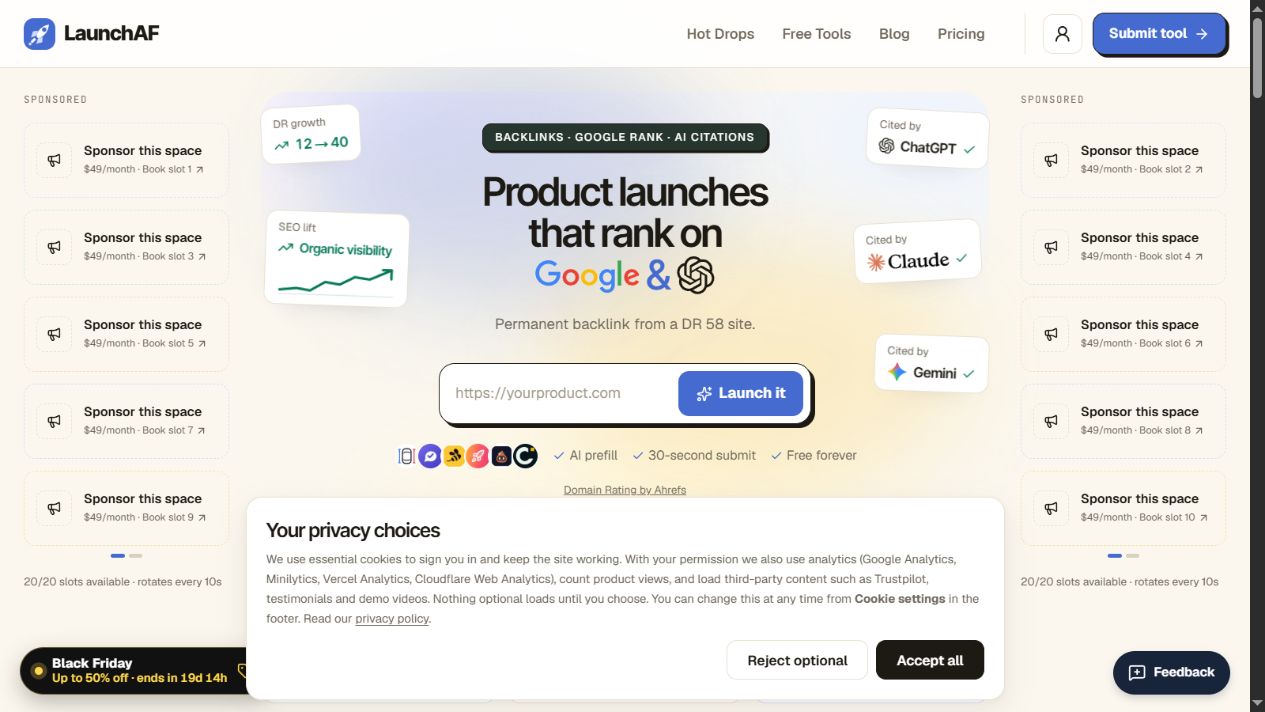
LaunchAF combines weekly product launches with founder-oriented resources, a newsletter, and software discovery. Its homepage shows the current launch cohort, earlier weeks, categories, and sponsored placements. The positioning emphasizes continued discovery after a launch, but a founder should distinguish that marketing message from a measured result. The visible product mix includes marketing tools, communication applications, utilities, and other small software businesses.
The free route we checked required badge verification before entering a community queue that could take thirty days or more. Paid tiers offered other arrangements. Check the current queue and what page the verifier examines before planning a launch announcement. A saved product draft is useful preparation, but it does not establish either a publication date or an approved profile.
A strong submission explains one recognizable customer problem and shows the product solving it. If the tool is complicated, link to a short public demonstration rather than filling the description with every possible feature. Use the eventual launch date to coordinate an announcement, then compare relevant visits, feedback, and trial activity. Keep sponsored exposure separate from the performance of the free listing when evaluating the channel.
49. LiftOff
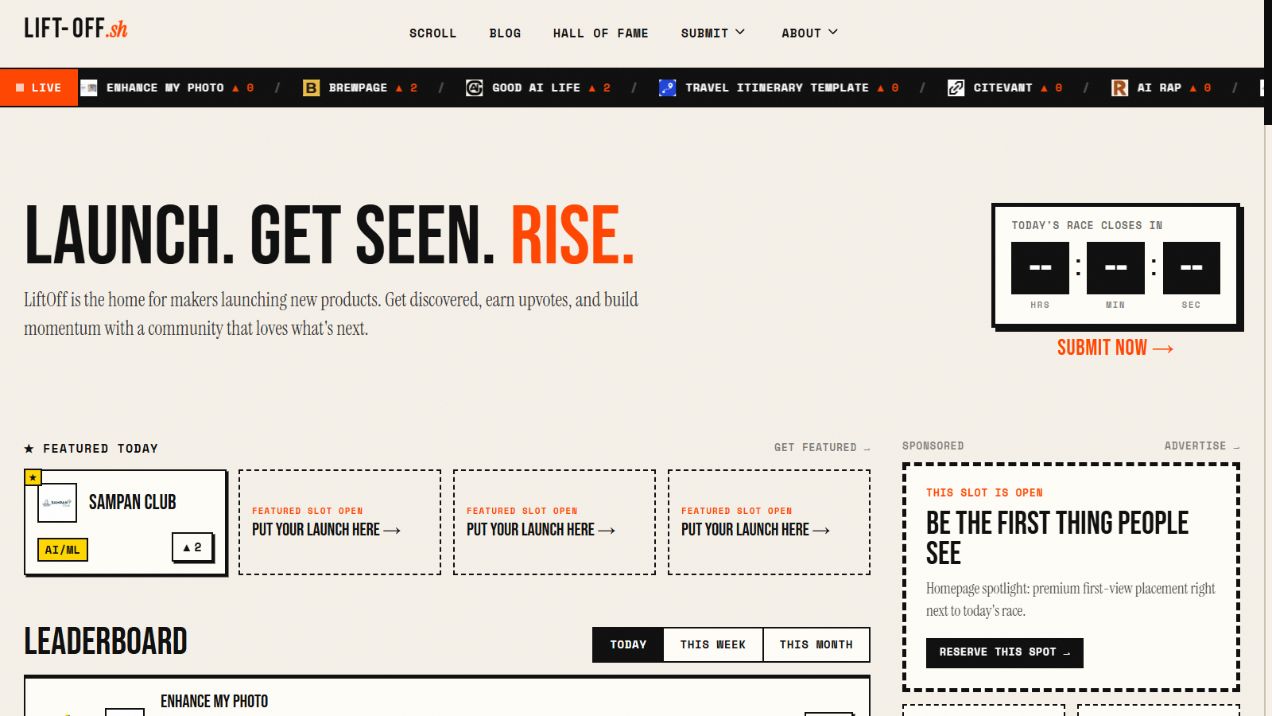
LiftOff is a maker-oriented launch board built around daily, weekly, and monthly discovery. Its homepage has a distinctive editorial appearance, a current leaderboard, featured products, and a record of earlier winners. The visible mix includes photography, developer tools, AI applications, and other focused products. That can suit a small launch with a simple explanation and a founder available to respond to relevant questions.
The free plan we reviewed required displaying a badge on the website. Followed-link benefits were limited to the top five products of the day rather than promised to every free entry. Confirm the current rules and accepted placement before treating a backlink inside an article as sufficient. A place on the board and a particular link treatment are separate conditions.
Timing matters on a daily board. Make the landing page and product demonstration ready before choosing a date, then support the launch with a useful message to the right audience. A social post can explain the problem behind the product without asking people to manufacture enthusiasm. Evaluate the questions and relevant referrals the launch creates, not only the final ranking.
50. Postmake
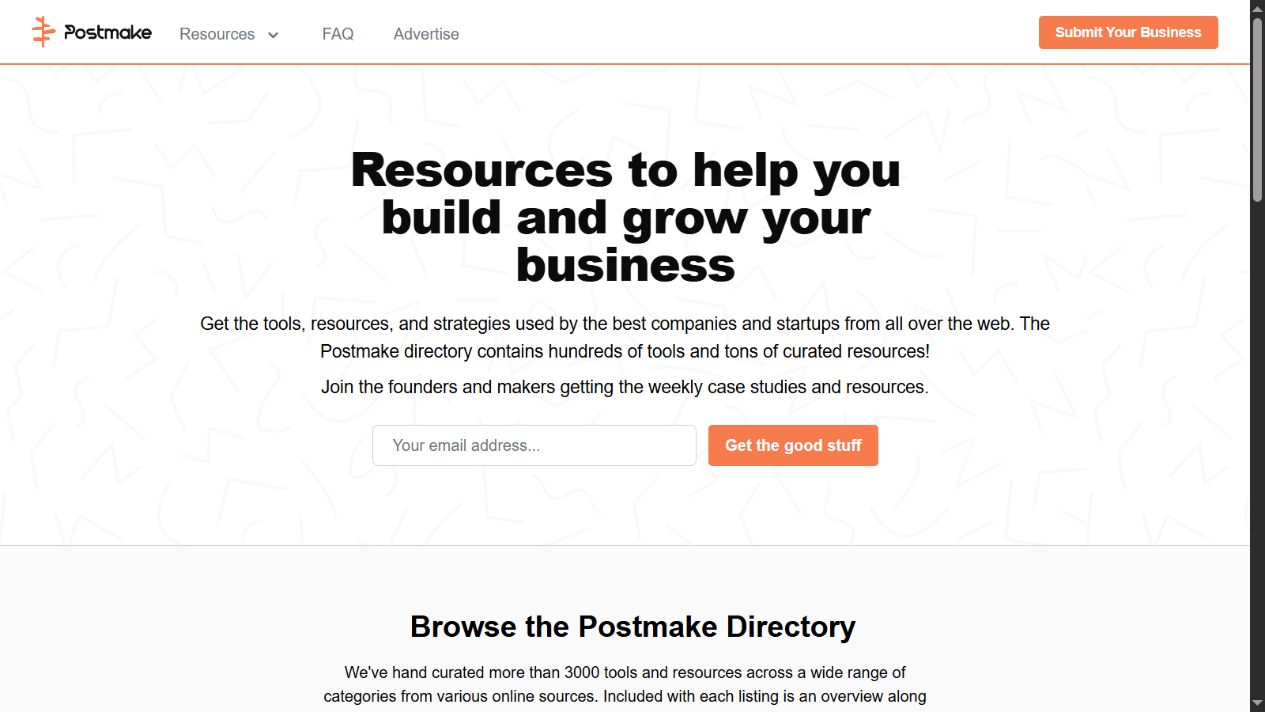
Postmake is a curated resource collection for building and growing a business. Its homepage organizes tools around productivity, design, development, marketing, launch, growth, and AI, with more specific tags beneath them. This task-based roadmap can be useful for a product that fits naturally into a working process. A founder can also use it to research adjacent tools that customers might already have in their stack.
The free Badge Listing route we checked required a Postmake badge to remain visible on the website while the listing is public. Other paid listing and spotlight offers were separate. Confirm the accepted location and any exact badge markup before submitting, particularly if you want to use a resource article rather than a footer. Record the maintenance obligation so a later redesign does not accidentally remove the reference.
Position the product in the workflow it serves. For example, explain whether it helps prepare assets, publish content, collect feedback, or analyze results. A concise use-case description can be more useful than a broad company introduction. After publication, check that tags and pricing information remain accurate, and compare relevant referrals with the effort required to maintain the profile.
51. IndieLineup
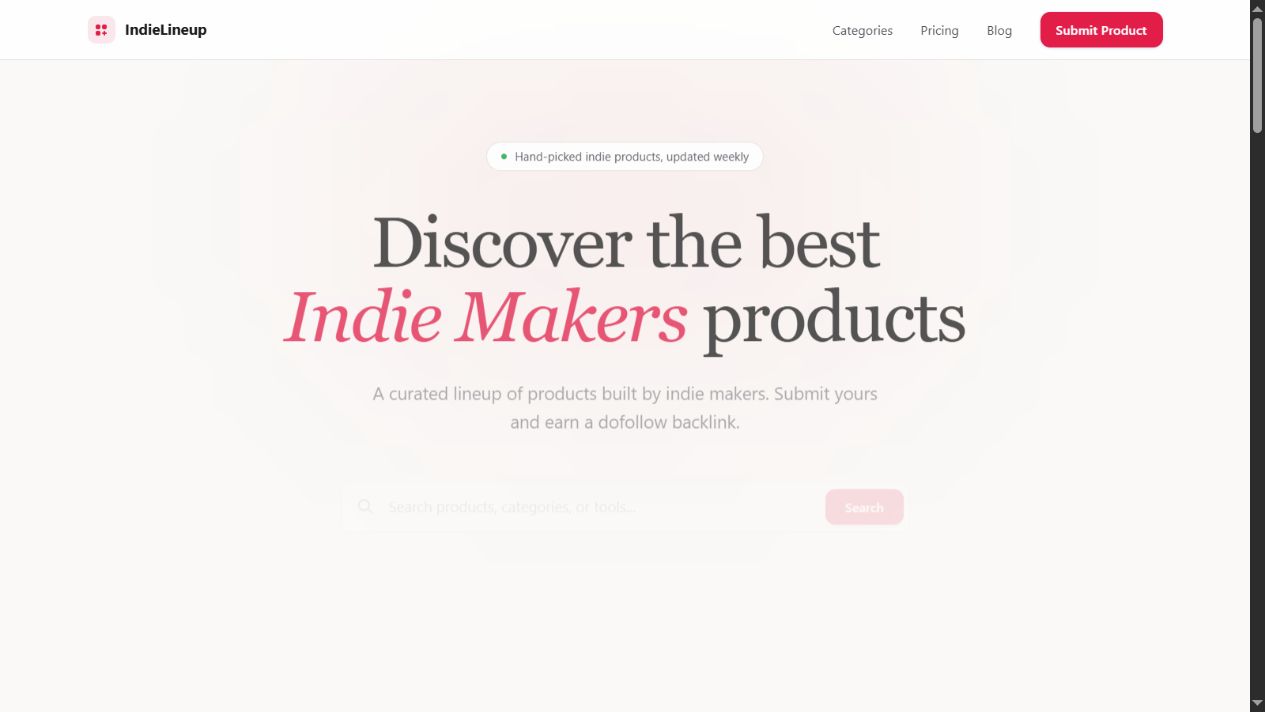
IndieLineup is a directory for products built by independent makers. Its categories range from micro-SaaS, APIs, extensions, and desktop apps to newsletters, courses, communities, and design assets. That breadth is useful for a small business whose offering is a focused product rather than a venture-style startup. The homepage separates featured products from recent additions and gives visitors short descriptions and tags.
The free submission route we reviewed did not require an account, but it did require a badge and a successful verification step. The instructions referred to a followed link on the website, giving the footer as an example. They did not explicitly establish that a separate editorial article would qualify. Test the current form and keep the verification result instead of assuming a public mention is enough.
Make the category and product type precise. An ebook, an API, and a subscription app need different descriptions and buyer expectations. Explain what the customer receives and how they start using it. For a small maker, a modest number of well-matched visitors can be useful; measure those visits and questions rather than treating the number of directory submissions as the outcome.
52. ShipBoost
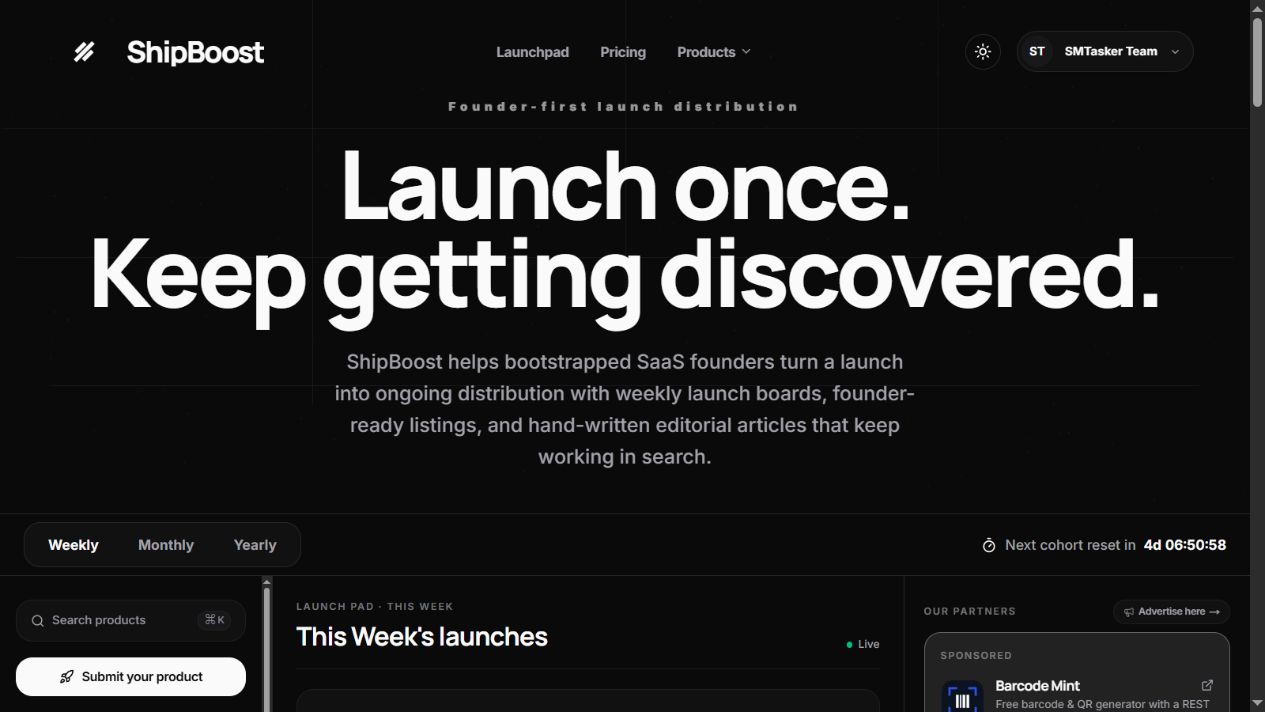
ShipBoost presents itself as ongoing distribution for bootstrapped SaaS founders, combining weekly launch boards, product listings, and separate editorial offerings. Its homepage includes launch periods, product discovery, and a directory research resource. This makes it worth examining when a product has a useful launch story and a recurring business workflow. Distinguish the free listing from paid articles or other promotion described on the site.
The free route we checked required a badge on the homepage or in the footer, plus three votes for other launches in the current week. The available free slot was far in the future. Adding a blog link addresses neither the explicit placement requirement nor the participation step by itself. Check current availability before organizing announcements, and assess other products honestly before any public interaction.
Prepare a strong short explanation and a demonstration that a new visitor can follow. A marketing team could coordinate a practical walkthrough with the actual launch date, while keeping other content running normally. Track the saved draft, verification, scheduled week, and public page separately. Those stages reveal what has really been completed and prevent a long queue from being mistaken for a published listing.
53. ConfettiSaaS
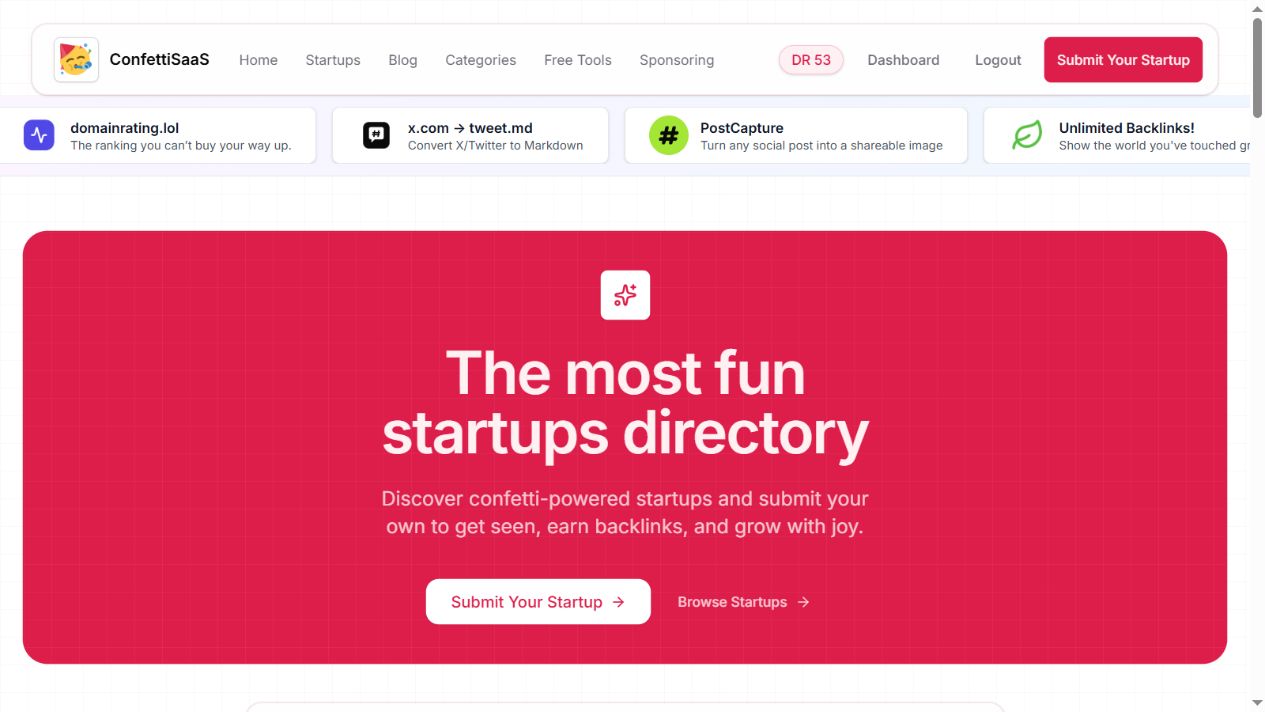
ConfettiSaaS is a startup directory with a playful positioning around products that use confetti. Its homepage includes categories, startup discovery, sponsorships, and other founder resources. The distinctive theme can make it relevant to a product with that interaction genuinely built into the experience. It also creates an eligibility question that should be answered before treating the site as a general destination for every SaaS business.
The free route we checked required a permanent homepage badge, a positive domain rating, and actual use of confetti in the product. The instructions described recurring badge checks, and the free review queue was exceptionally long. A backlink alone therefore does not resolve the submission. Do not add a fictional feature to a description just to match the directory’s theme, and recheck the current waiting period before committing effort.
If your product is a good fit, show the relevant experience in a public demonstration and describe the main customer workflow too. A celebratory interface detail should not obscure the product’s purpose. Evaluate whether the niche audience and maintenance obligation justify the listing, rather than relying on a general promise of extra visibility.
54. Gets.tools
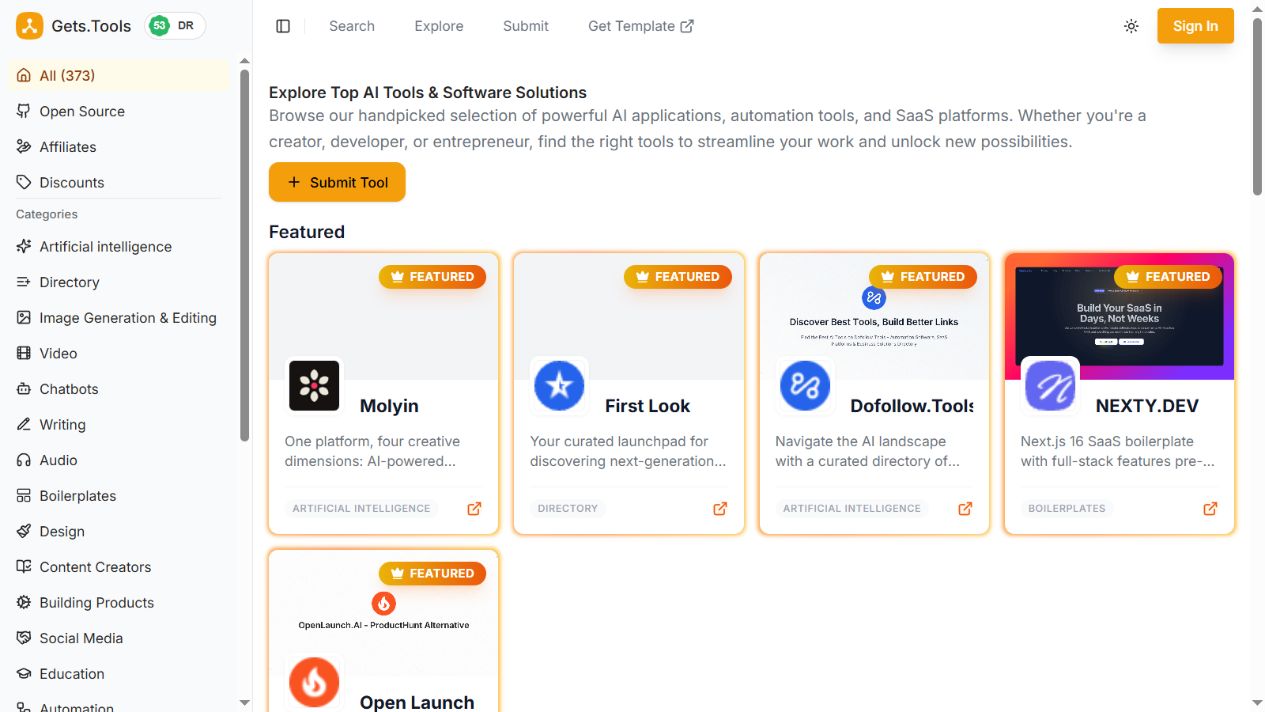
Gets.tools is a software discovery catalog with categories for AI, content creation, social media, automation, development, analytics, and other workflows. Its homepage combines featured products with recent tools, while additional navigation covers open source, affiliates, and discounts. The format can suit a product that helps a visitor complete a specific task and can explain that task in a compact description.
The free listing instructions we checked explicitly asked for a followed backlink in the website footer and indicated a two-day review period. Paid alternatives were separate. A reference in an article is not the same placement, so keep that requirement clear before submitting. Check the supplied markup and verifier, and record where the live link is installed.
Consider how a buyer will compare the product with neighboring entries. State the primary use case, supported environment, and pricing model without forcing every possible category into the profile. For a content or marketing application, show the stage of work it supports and what still requires a person. After publication, inspect the final description and URL, then measure relevant visits rather than assuming a followed link will produce a particular search outcome.
55. IndieTool
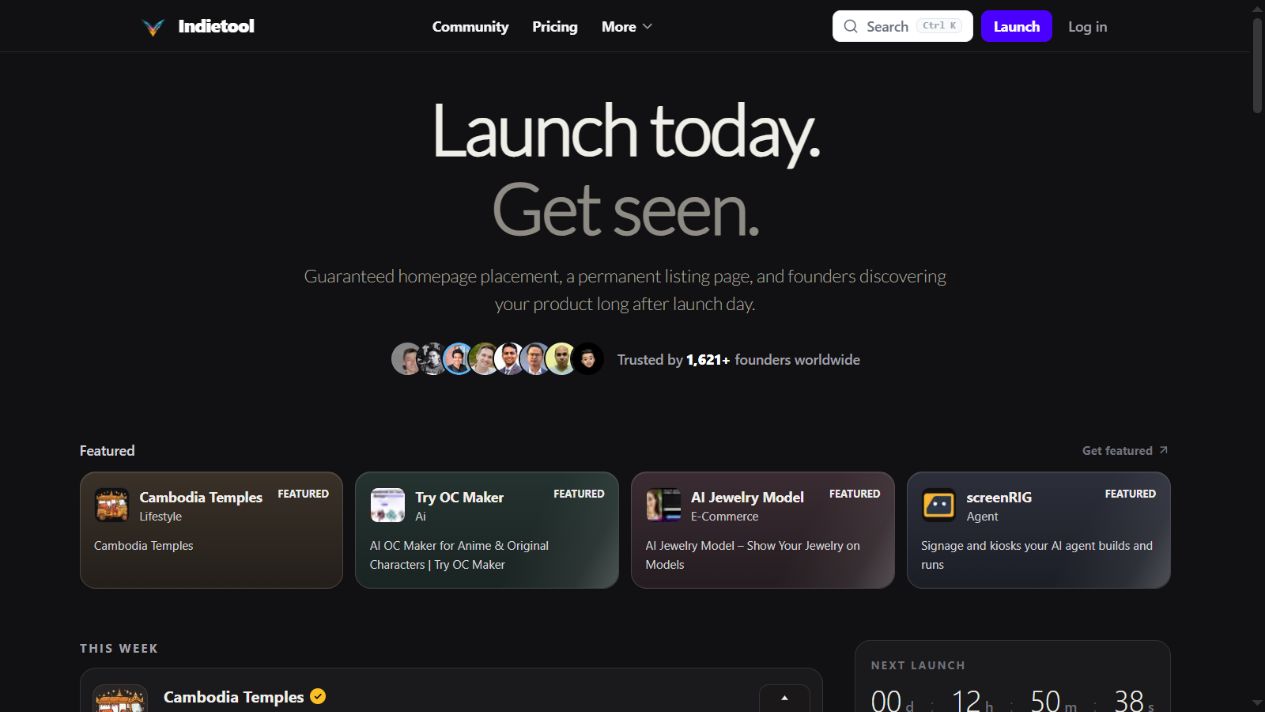
IndieTool is a startup launch platform and product directory with featured products, founder-oriented content, and multiple submission plans. Its homepage covers a broad range of tools rather than a single technical niche. It can be a research destination for a small software business with a clear use case and a landing page ready for visitors who have not encountered the brand before.
The free option we checked required embedding the IndieTool badge on the website and showed a waiting period of around two months. Paid plans removed that requirement or changed launch timing and promotion. Inspect the actual free-plan step, because prominent pricing messages may describe different packages. Confirm the accepted badge location and availability before assuming that a blog reference unlocks immediate publication.
Use the product description to make the customer, task, and result understandable. A concise screenshot of the core workflow is often more helpful than a dense marketing banner. If the queue is long, keep the draft accurate while waiting and recheck pricing before publication. Measure the quality of referrals and inquiries after launch, separating free-listing results from any optional paid exposure.
56. LaunchBoard
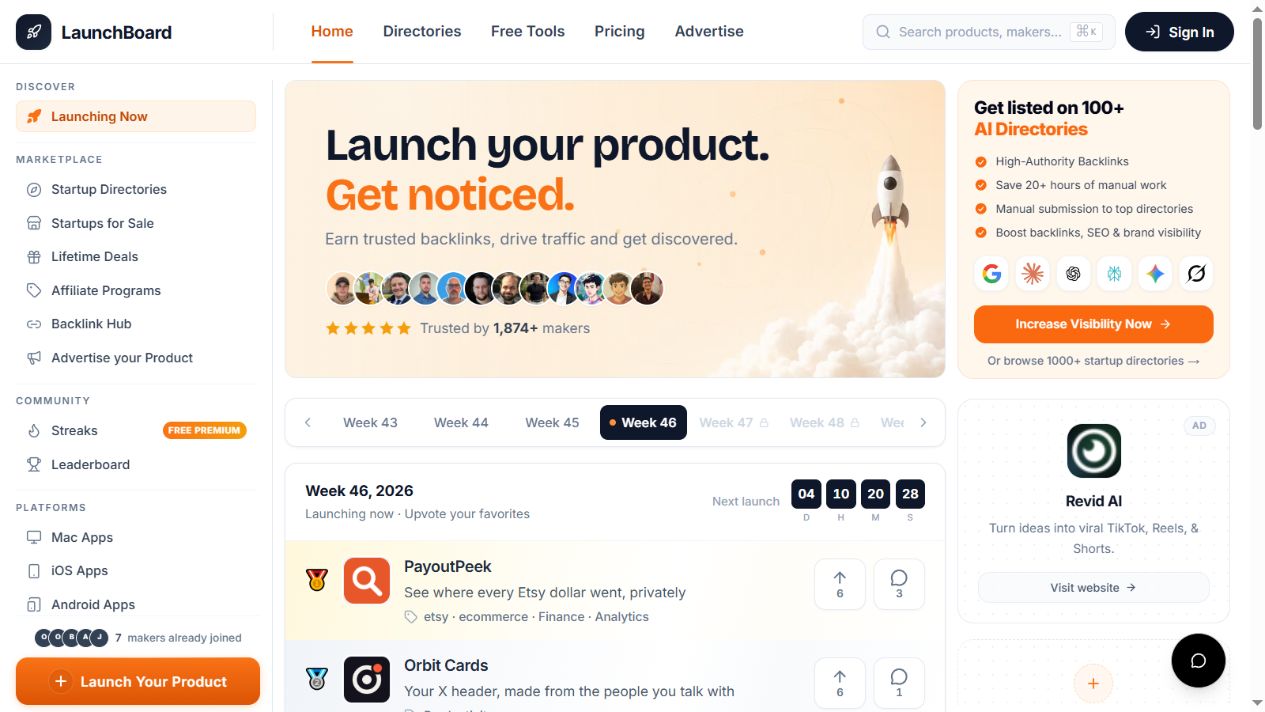
LaunchBoard combines weekly product launches with a wider discovery ecosystem covering categories, platforms, directories, and other founder resources. Its homepage includes AI, productivity, marketing, developer tools, design, and mobile applications. The product-and-week structure can help organize a coordinated introduction, while category and platform labels provide context for visitors researching software beyond the current board.
The free route we reviewed required a badge and limited available places each week. Followed-link treatment was tied to the weekly winner rather than every free launch. Check the current schedule and verification step before treating the free plan as an unconditional backlink offer. If using an article as the reference page, confirm whether the verifier can inspect it and whether the exact badge is required.
Prepare the launch around a useful demonstration and a clear customer problem. Keep platform labels accurate: a web dashboard with a required desktop client is different from a browser-only service. Once the product is scheduled, coordinate supporting content without promising a ranking. Evaluate useful referrals and questions after publication, and preserve the public profile URL in the distribution record.
57. SitePatent
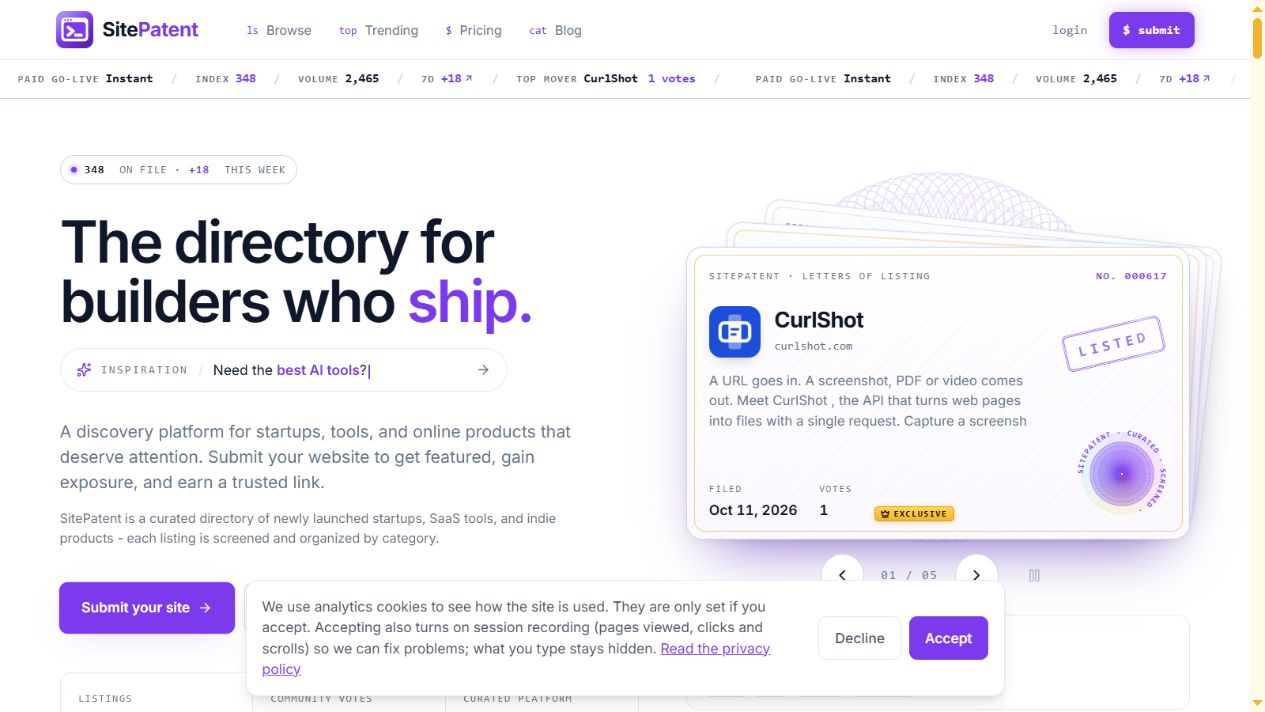
SitePatent is a discovery platform for startups, tools, and online products, with browsing, trending entries, categories, and product records. Its homepage uses an editorial presentation that gives each product a distinct place in the catalog. The visible mix includes developer services, marketing software, and other online tools. It can fit a product with a clear explanation and a public website that supports the submitted claims.
The free plan we checked required a homepage badge, a minimum waiting period, and a public Unverified label. Paid listings offered different timing and presentation. The word patent in the site’s name should not be interpreted as a grant of intellectual-property rights or a legal certification. Read the actual listing conditions and confirm badge verification before proceeding.
Describe the product and its intended audience precisely, using public screenshots and a suitable category. An article link can introduce readers to SitePatent but does not replace an explicit homepage requirement. After approval, inspect how the product is labeled and whether the description is accurate. Judge the profile on relevant discovery and useful visits rather than assuming the directory’s branding implies an independent endorsement.
58. Direct2App
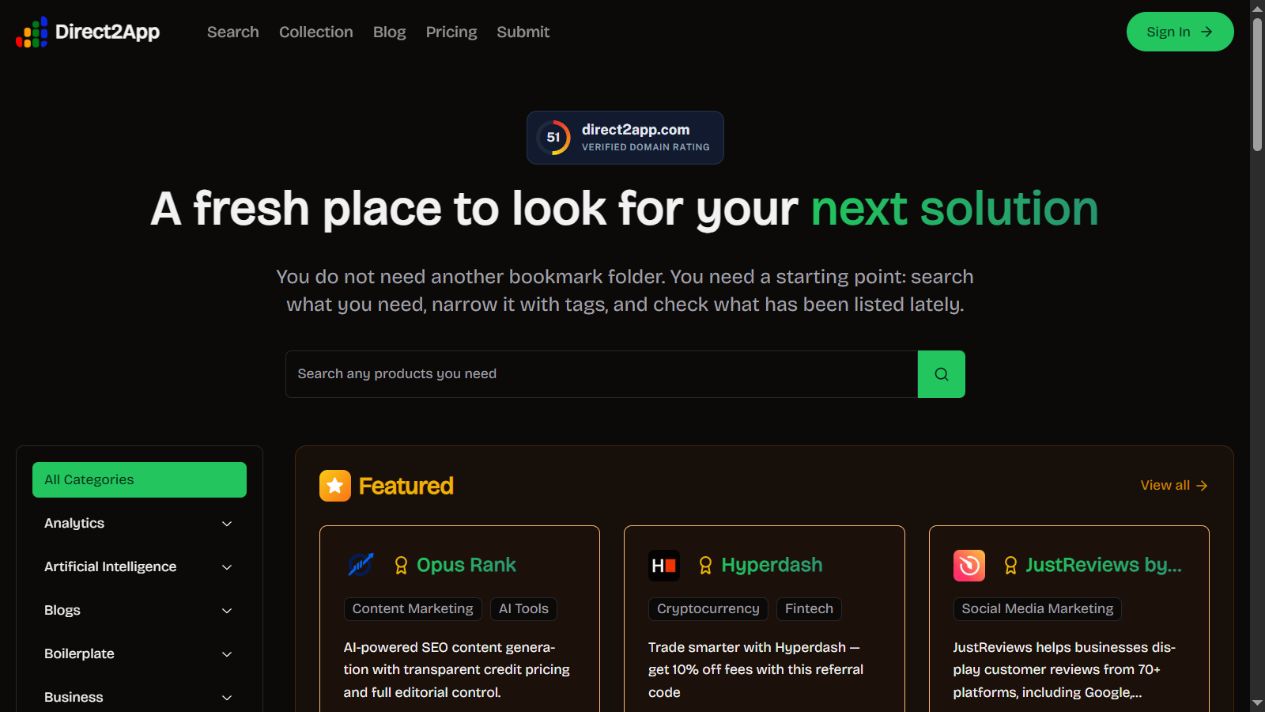
Direct2App is a broad software directory organized around search, categories, tags, and recent listings. Its homepage includes analytics, AI, development, business, marketing, productivity, and other topics. Product cards describe the use case and include additional labels, giving a visitor several ways to narrow a general search. This can suit a practical tool whose benefits are easier to explain through a workflow than through a launch slogan.
The free route we checked required a backlink that remains on the website and described a review period of up to thirty days. A paid option removed the backlink requirement. Confirm the current accepted location and verification process before using a blog article URL, because a public link and a passed eligibility check are different things. Keep the chosen plan and eventual confirmation in your records.
Choose categories and tags based on current capabilities. A social media or marketing application should explain its actual role alongside creation, analytics, or communication tools. Include the supported platform and accurate pricing information. After publication, inspect imported text and links, then measure relevant visitors and inquiries. A well-maintained profile is more useful than an outdated entry with an impressive list of generic features.
59. Mydentify
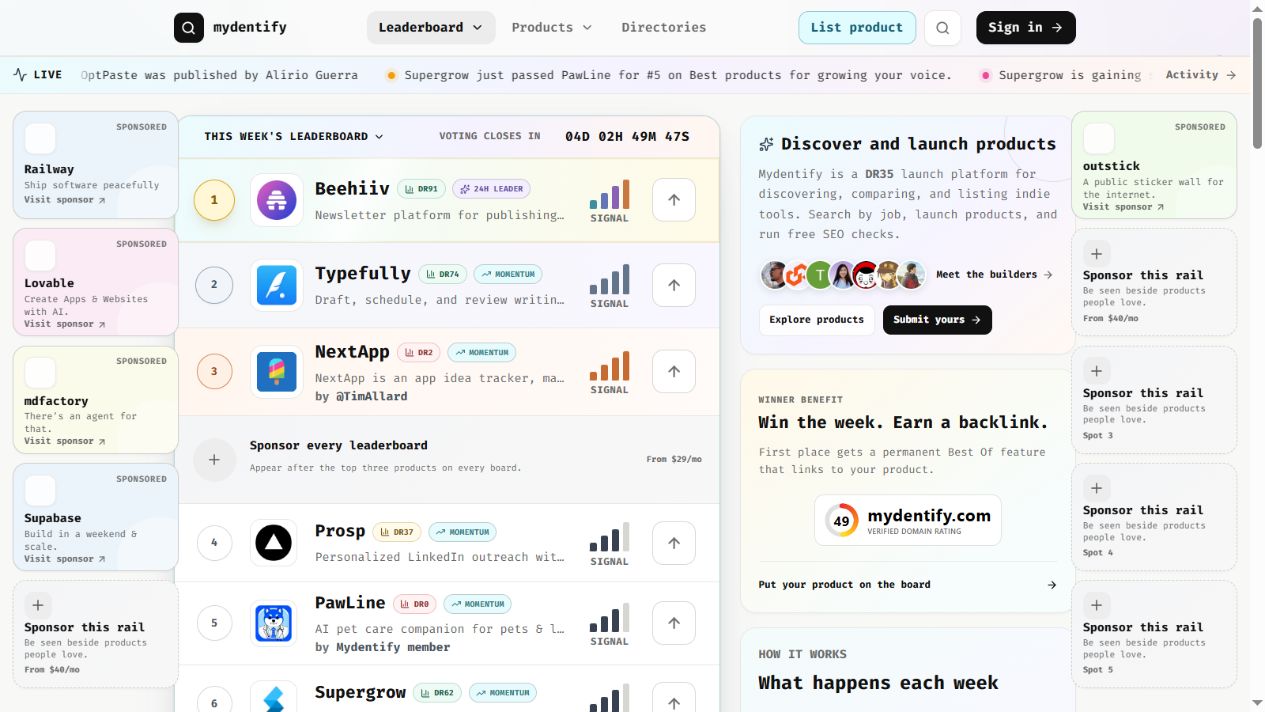
Mydentify organizes software discovery around jobs and themed product competitions. Its homepage combines a current leaderboard with products, categories, activity, and sponsorships. This can help a visitor start with a problem rather than a brand name, making the quality of a use-case description important. A product should explain the job it helps complete and the audience for whom that job matters.
The free route we reviewed required a public link or badge before the product’s backlink could be published, alongside editorial checks. Confirm the current theme, eligibility, and accepted reference location before submitting. A product may fit the wider catalog without being appropriate for every themed competition, so avoid forcing an unrelated category simply to join the current board.
For example, an outreach tool, a content planner, and an analytics product each support different parts of a marketing workflow. Describe that distinction clearly and show it in the screenshot. Evaluate the resulting profile through relevant visits, feedback, and whether people understand the intended use. A themed ranking can be an interesting launch moment, but it does not establish long-term demand or guarantee that the product suits every visitor.
60. SmolHunt
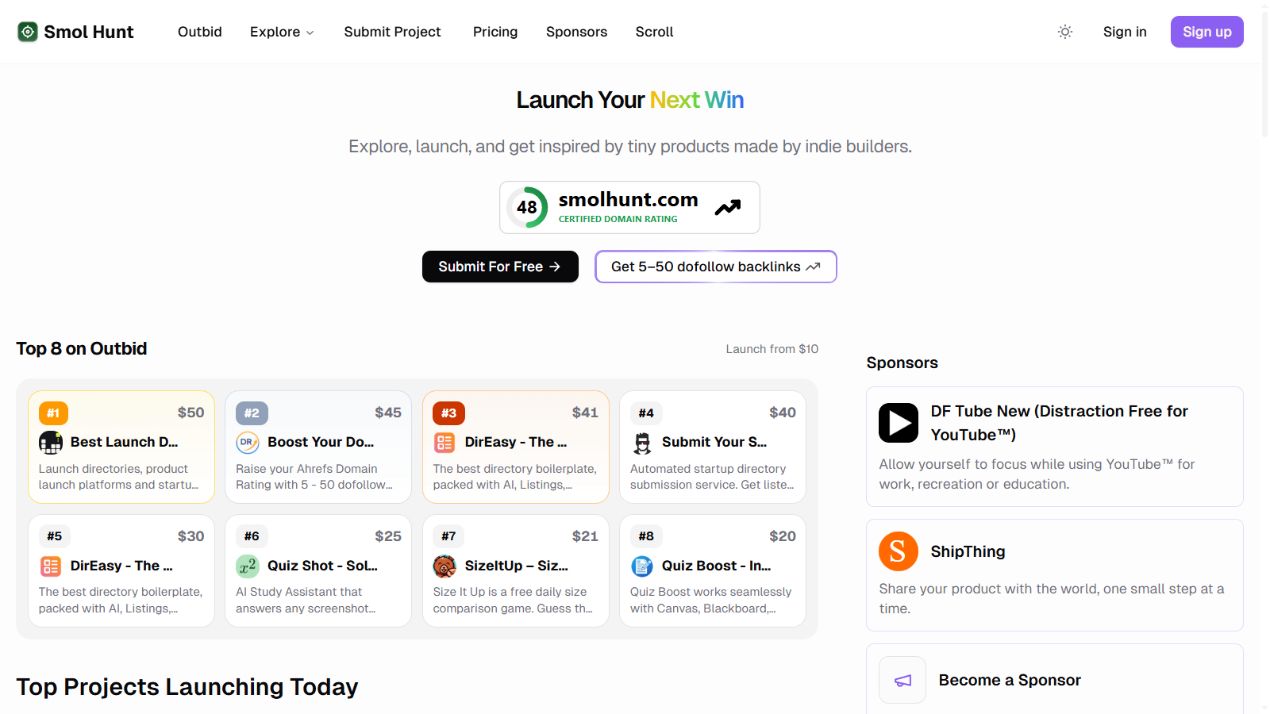
SmolHunt presents small independent products through current launches, earlier periods, categories, and featured placements. Its homepage also includes an Outbid area and additional promotion offers. Those paid placements should be considered separately from the ordinary product-discovery experience. The broad maker orientation can suit a focused application with a clear benefit, particularly when its value can be demonstrated quickly.
The free route we checked required a badge and backlink verification, with review taking up to thirty days. Adding a general editorial reference may help readers but does not establish that the exact verification condition has passed. Check the live free-plan step and accepted page location before submitting, and keep any confirmation separate from the saved draft.
Prepare a concise product story centered on the customer’s task. Use a screenshot that shows the interface or outcome, and label a trial accurately. Compare the neighboring products to understand the context in which visitors will see the listing. After approval, track relevant referrals and practical questions. Do not combine results from sponsored placements and the free listing when judging whether the directory deserves continued attention.
61. Smol SaaS
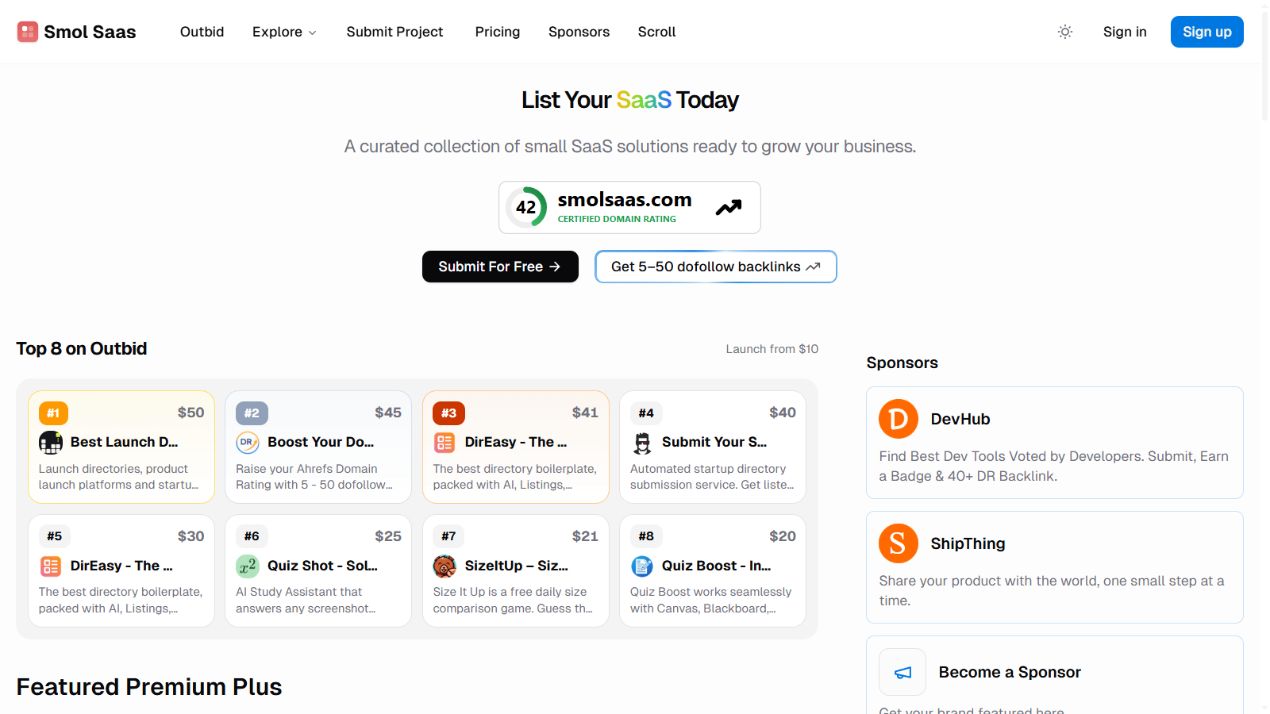
Smol SaaS is a discovery and launch platform positioned around small SaaS solutions. Its homepage includes current projects, featured entries, categories, and a separate Outbid promotion area. This makes it a possible fit for a focused subscription product aimed at independent operators or small teams. A clear problem statement is important because the surrounding catalog includes many different kinds of applications.
The free route we reviewed required a badge, backlink verification, and a minimum domain rating of five, with review taking up to thirty days. Check these conditions against the current form rather than relying on a broad Submit For Free headline. Confirm whether the verifier accepts an editorial resource page and whether it expects the directory’s exact badge markup.
Explain the recurring job that makes the subscription useful. For marketing software, distinguish planning, content production, execution, and reporting instead of presenting them as interchangeable capabilities. Include supported platforms and any setup dependencies. After publication, inspect the public profile for errors and monitor relevant visitors or trials. The site’s small-SaaS positioning can provide context, but the product still needs to make a convincing case on its own website.
62. TheMicroSaaSDir
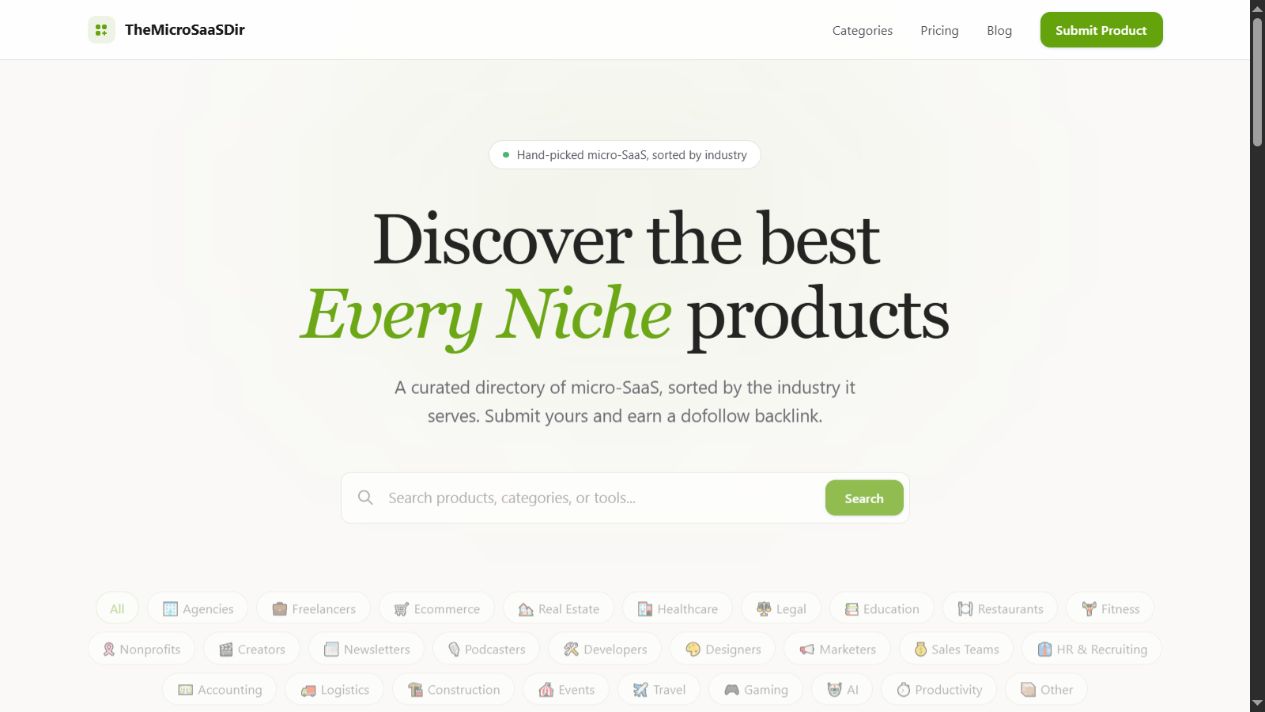
TheMicroSaaSDir organizes micro-SaaS by the industry or audience it serves. Its homepage includes agencies, freelancers, ecommerce, creators, educators, developers, marketers, and many other niches. That audience-first structure is useful for a specialist tool: the right category can communicate who needs it before the description explains the features. It also helps founders research neighboring products used by the same customer group.
The free route we checked used a badge exchange and did not require an account. Paid featured and multiple-listing options were separate. Confirm the exact badge, accepted placement, and current verification behavior before using a resource article as the reference page. A no-account form can still involve eligibility checks and manual approval; it does not necessarily mean instant publication.
Choose the industry category based on real users rather than every market the product could theoretically enter. For a social media application serving agencies, explain an agency workflow and any client-management limits accurately. A narrow description can be more persuasive than a list of unrelated niches. After approval, review the final category, pricing label, and website link, then track useful referrals and questions.
63. Webspot
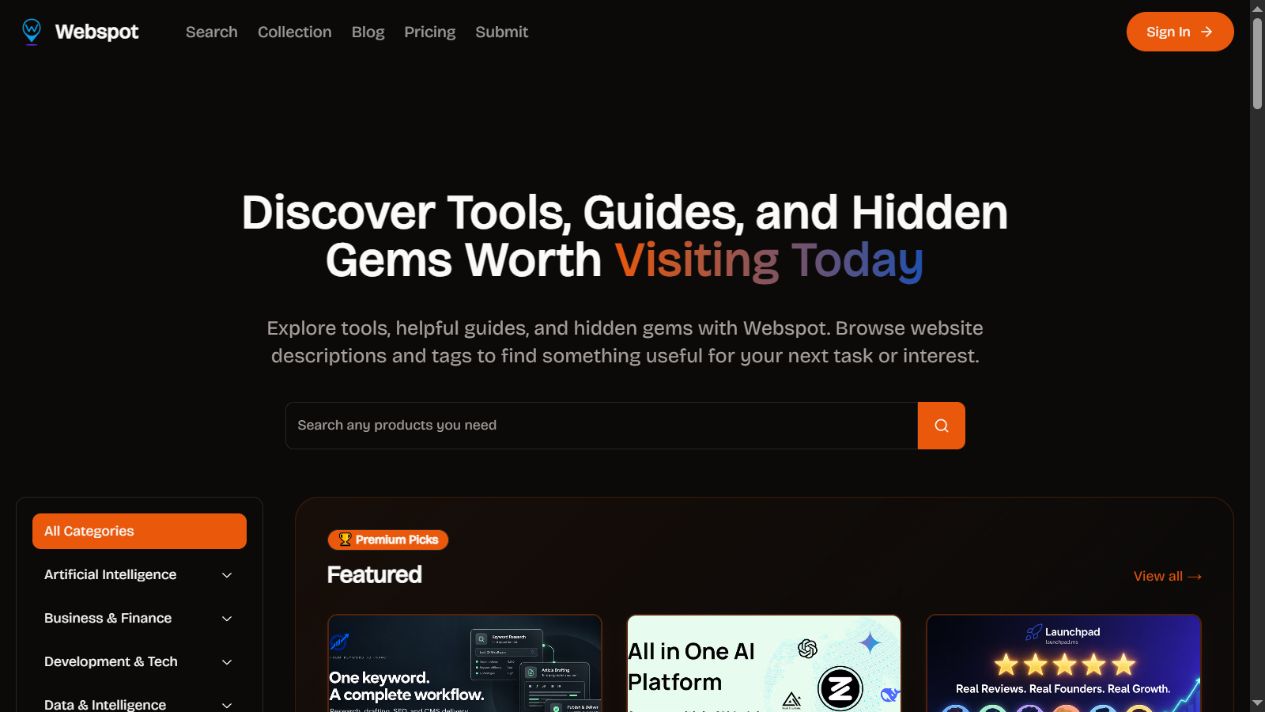
Webspot is a website and software discovery directory with search, collections, categories, and descriptive tags. Its homepage covers business, development, productivity, marketing, content, learning, and other topics. That scope can suit useful online tools and resources as well as conventional SaaS products. A clear category match matters because a visitor browsing a broad collection needs a quick explanation of why a particular website is relevant.
The free route we checked required a maintained backlink and described review taking up to thirty days. The accepted location was not clearly confirmed for a separate article page. Inspect the current verification step and supplied badge instructions before treating an editorial link as sufficient. Keep the selected plan and final confirmation separate from the initial draft or account setup.
Use the listing to explain a specific task or benefit, with a representative image and accurate tags. A useful guide or utility may need different positioning from a subscription platform. After approval, inspect the public description, pricing label, and destination URL. Track relevant visits and feedback rather than assuming the directory’s broad range will automatically bring a large or well-matched audience.
64. MediaProNet
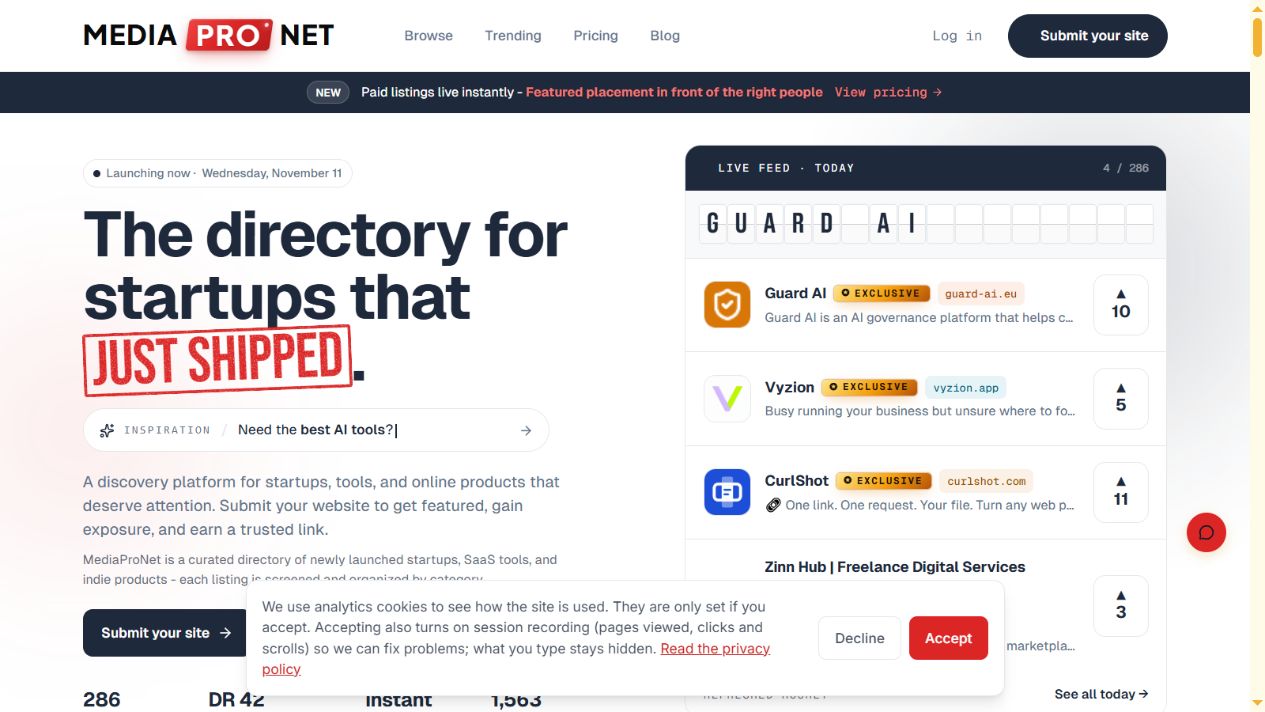
MediaProNet is a discovery platform for newly shipped startups, software tools, and independent online products. Its homepage combines a live product feed, trending entries, category context, and sponsored placements. The presentation gives each product a short editorial introduction rather than only a logo. This can help a new visitor understand a focused product quickly, provided the submitted description explains what it does in concrete language.
The free plan we reviewed required a homepage badge, a minimum waiting period, and a public Unverified label. Paid listings used different timing and promotion. A blog reference may introduce readers to the platform but should not be represented as satisfying an explicit homepage requirement. Check the current badge and review instructions, including how a listing is labeled after approval.
Prepare public assets and a short explanation of the intended customer. A marketing application can show a real workflow instead of promising a universal improvement in reach. After publication, review the profile for imported inaccuracies and verify its website link. Measure relevant referrals separately from any sponsored exposure, and keep the badge obligation in maintenance notes if the listing remains dependent on it.
65. AiHubs
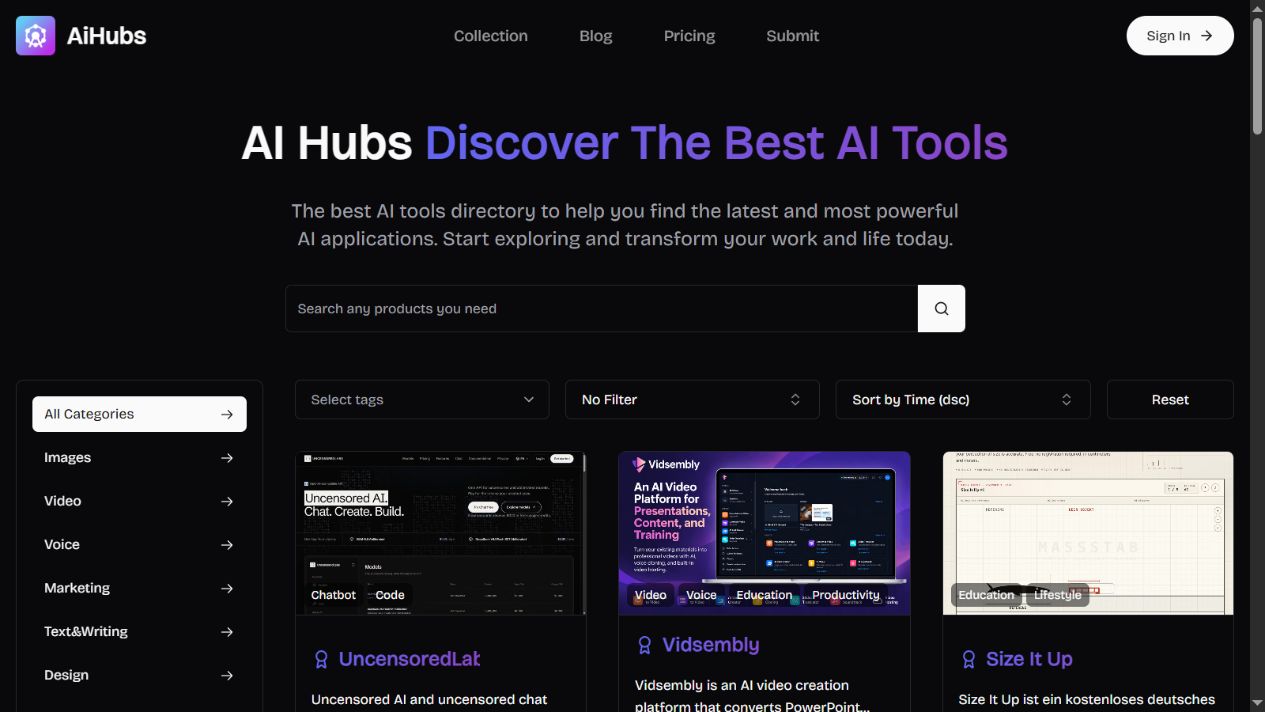
AiHubs is an AI application directory organized around images, video, voice, marketing, writing, design, coding, education, productivity, and other uses. Its homepage includes product descriptions and tags, allowing visitors to start from a task rather than a company name. That makes it most relevant for products with a genuine AI capability that can be explained and demonstrated clearly.
The free route we checked required a followed badge, verified before submission, and stated a seventy-two-hour listing period while the badge remains on the website. Recheck current timing and accepted placement before relying on that estimate. A general text reference may be helpful for readers but can differ from the exact badge expected by the verifier. Preserve the verification result and eventual public profile in your records.
For an AI-assisted marketing workflow, explain which steps the assistant supports and which decisions remain with the user. Include accurate pricing, supported platforms, and any external provider requirements. Avoid presenting an open-source category label as applicable unless the product actually qualifies. After publication, inspect the description and tags, then compare referral quality with the effort involved in maintaining the listing.
66. Lifto
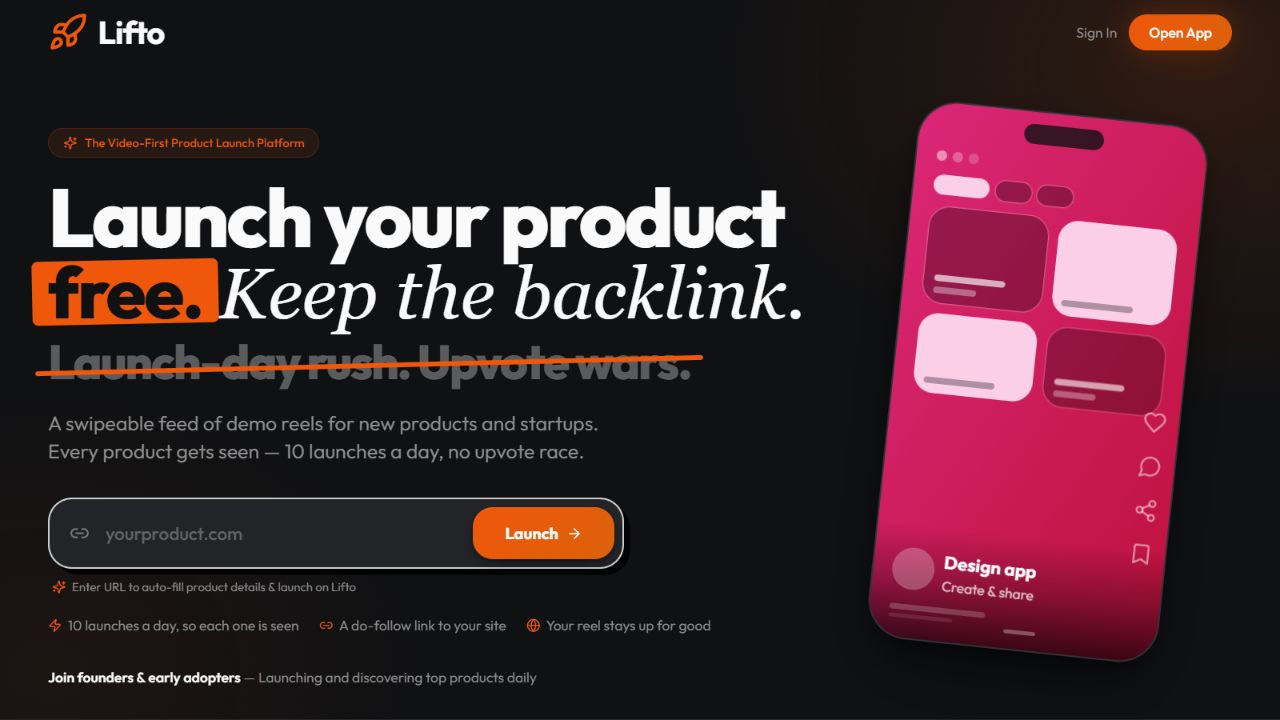
Lifto is a video-first product launch platform built around a swipeable feed of demonstrations. Its homepage emphasizes discovering products through short visual explanations rather than only a traditional ranking grid. This can be particularly relevant to software whose benefit becomes obvious when someone watches it perform a task. A clear product reel may do more work here than a long written feature list.
The free launch instructions we reviewed required a badge, while a separate paid option allowed skipping it. The platform also limited daily launches, so availability matters alongside verification. Confirm the current video requirements, accepted badge location, and publication process before planning the campaign. An active account and completed product form still need to be distinguished from a launched reel.
For a social media product, reuse the discipline of a good demo video: show the problem, perform one workflow, and make the next step clear. Remove private account information before recording and use sample data. Include accurate setup requirements so viewers understand what runs in the browser and what requires another device. Evaluate watch interest, relevant visits, and useful inquiries after publication rather than assuming a video format guarantees engagement.
67. AI Agents Listing
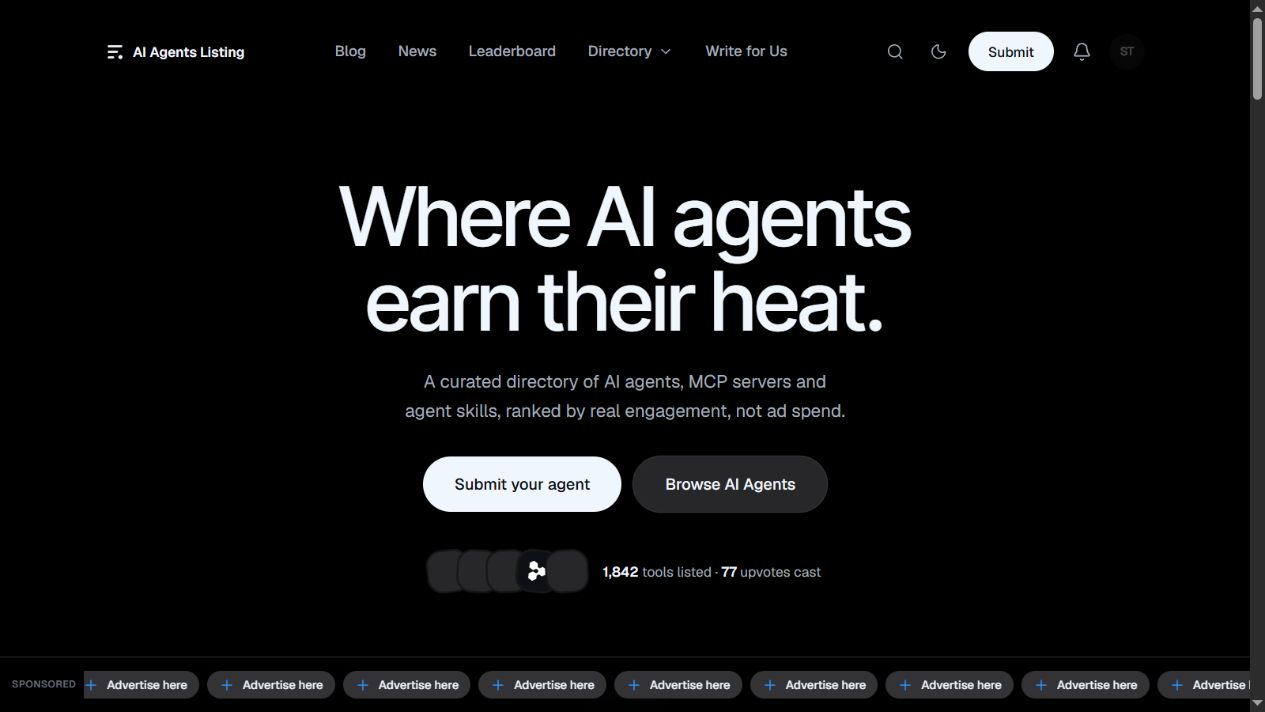
AI Agents Listing focuses on AI agents, MCP servers, and agent skills, with a directory, leaderboard, news, and product discovery. Its homepage distinguishes sponsored areas from community activity and recently listed tools. This is a more technical context than a general startup catalog, so an application benefits from explaining the integration or agent workflow precisely. A public MCP capability can be relevant without requiring disclosure of private implementation details.
The free route we reviewed exchanged a listing for a followed link and required badge verification. Its displayed instructions explicitly allowed placing the snippet anywhere on the website. That makes a public resource article a plausible location, although the current verifier must still confirm the actual markup. A saved draft alone does not mean the product has passed that step or become live.
Describe what the agent or integration can access and change, how permissions are chosen, and what the user needs to connect it. Link public documentation where useful; never upload private keys, internal repositories, or customer data to demonstrate a capability. After publication, inspect the technical labels and website link, then assess whether the profile attracts developers or operators with a relevant use case.
68. SuperLaunch List
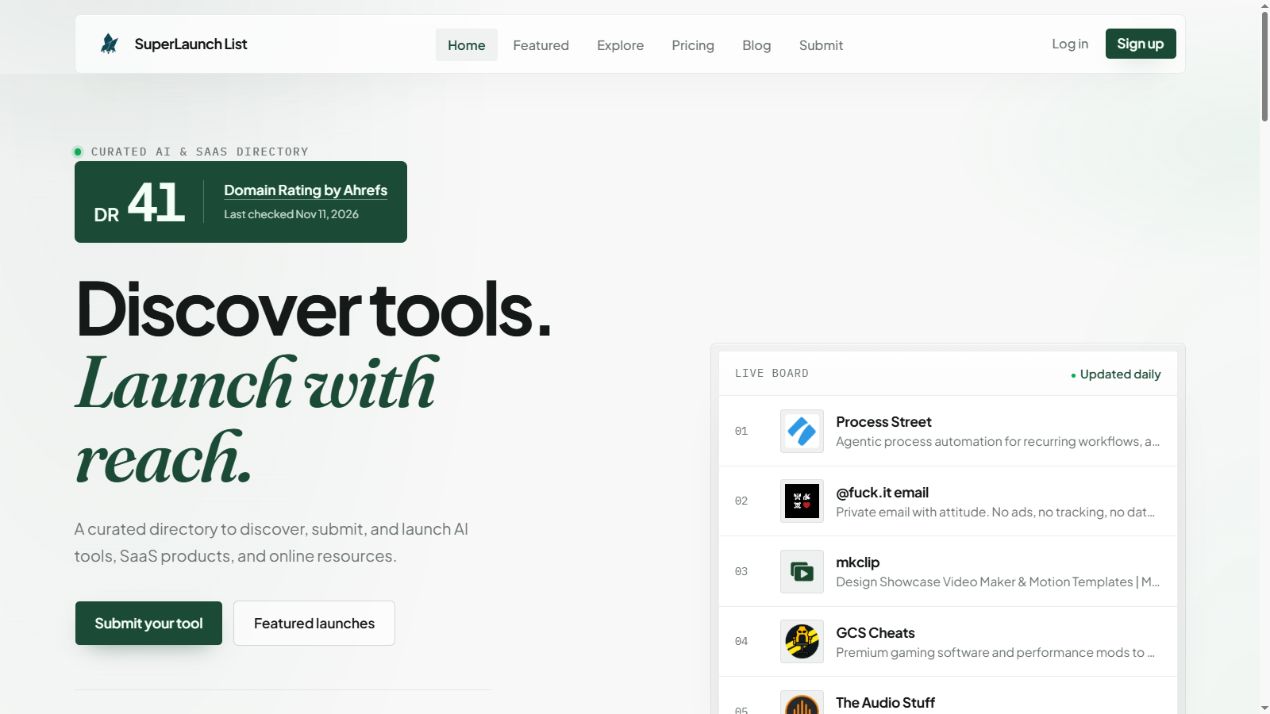
SuperLaunch List combines a curated AI and SaaS directory with featured placements and recent product discovery. Its homepage includes business workflows, creative tools, developer resources, and other online products. The broad catalog can be useful when a product has an identifiable job and a short description that a new visitor can understand. Explore both ordinary entries and sponsored areas to see how the listing will be presented.
The free route we checked required a followed badge on the website, backlink verification, and administrator review. Paid options offered different arrangements. Confirm the accepted location and exact badge markup before assuming a resource article is sufficient. Keep the successful verification and final submission message, because a completed draft is not the same as a product approved by the administrator.
Choose the primary use case and include accurate pricing and platform details. A marketing tool should explain its role alongside the other software a customer already uses, rather than claiming to replace every workflow. After publication, inspect the final profile for errors and monitor relevant referrals. Treat domain metrics displayed by the directory as context and assess the channel using observed visitor quality and useful conversations.
69. Launchdog
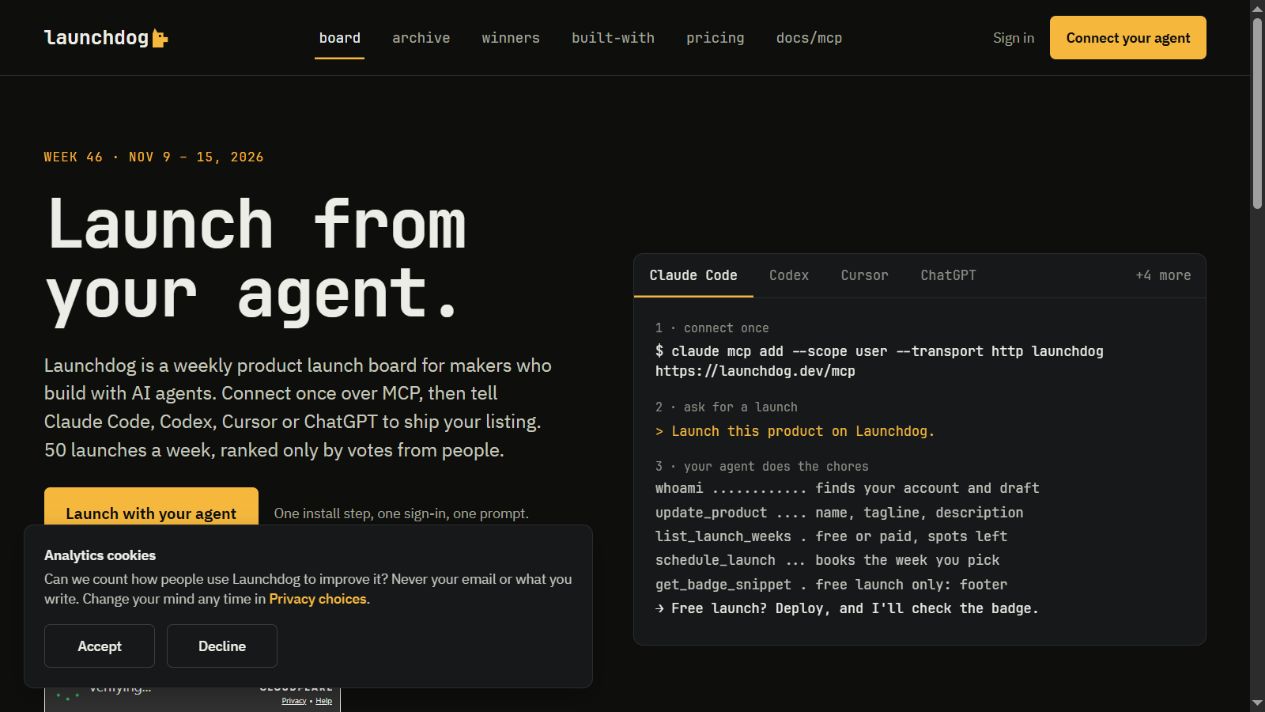
Launchdog is a weekly product launch board with an unusual emphasis on submitting through an AI agent over MCP. Its homepage explains an agent-connected workflow alongside a domain-based starting point, weekly capacity, and voting by people. This makes it particularly interesting for makers who already use development assistants and want structured product information carried into a launch workflow. The public product board remains a separate experience from connecting an agent.
The free route we previously checked required a homepage badge and limited launch frequency. The current homepage also refers to badge deployment during its agent workflow, so read the latest pricing and verification details before relying on an older placement note. A blog article should not be assumed to satisfy a homepage condition. Any new account connection or permission should be evaluated for its actual scope.
Prepare a public description, categories, logo, and product URL before starting. Do not provide private code or credentials merely to establish that a product exists. If an agent drafts the listing, review every field before scheduling. After launch, evaluate relevant referrals and feedback independently of the convenience of the submission method or the position on the weekly board.
70. Thank John
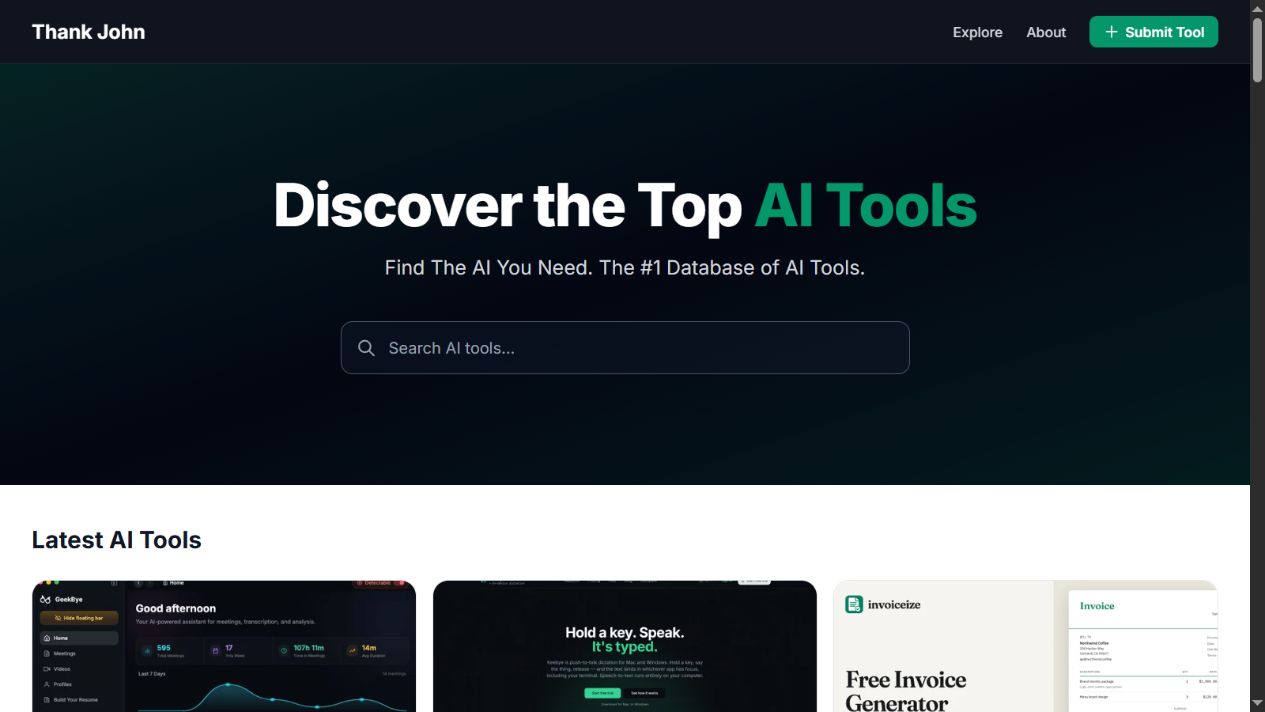
Thank John is an AI tools directory with a straightforward discovery page, recent products, pricing labels, and a submission route. The visible collection includes developer assistants, dictation tools, business utilities, creative applications, and other AI-enabled products. The simple presentation makes the opening description important: a visitor should quickly understand the task a tool performs and why they might want to investigate it.
The free submission option we checked required a backlink to the site and indicated review within two days. The earlier instructions did not clearly specify a homepage or footer location. A public article link is worth testing through the current form, while the verifier or submission response remains the proof that it qualifies. Confirm any required badge markup rather than assuming a text reference always substitutes for it.
Keep the product summary practical and accurate. Explain the main capability, intended audience, pricing model, and relevant setup conditions. An AI label should identify something the product actually does, not simply a marketing angle. After approval, inspect the public entry for mistakes and verify the destination URL. Track relevant visits and inquiries to decide whether maintaining the listing is worthwhile.
71. MicroHunts
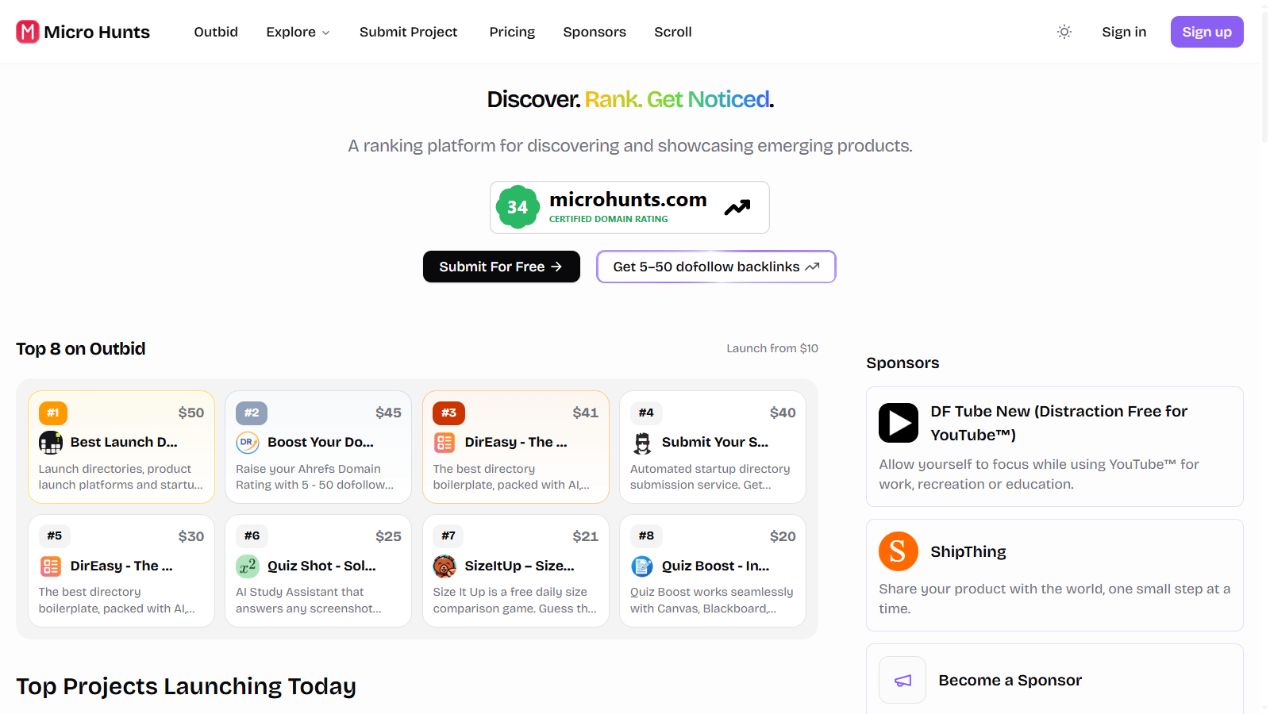
MicroHunts is a discovery and ranking platform for emerging products, with current launches, earlier periods, categories, and additional paid promotion. Its homepage includes an Outbid area that should be distinguished from ordinary product discovery. The broad maker audience can fit focused applications with a concise explanation and an identifiable customer problem. Inspect neighboring products before deciding how your listing should be categorized.
The free route we checked required adding the directory’s badge and passing backlink verification, with review taking up to thirty days. Followed-link language appeared in the offer, but the current plan and successful verification should establish the actual arrangement. Check accepted placement rather than assuming any page on the same domain is sufficient. Save the final submission confirmation separately from the draft.
Prepare a product demonstration and description that make sense without a lengthy sales pitch. For content or marketing software, explain the stage of work supported and any platform requirements. After publication, review the page and measure relevant referrals. Keep sponsored traffic, community votes, and free-listing visits separate when evaluating results; combining them can make a small launch look more effective than the evidence supports.
72. SaaS.fyi
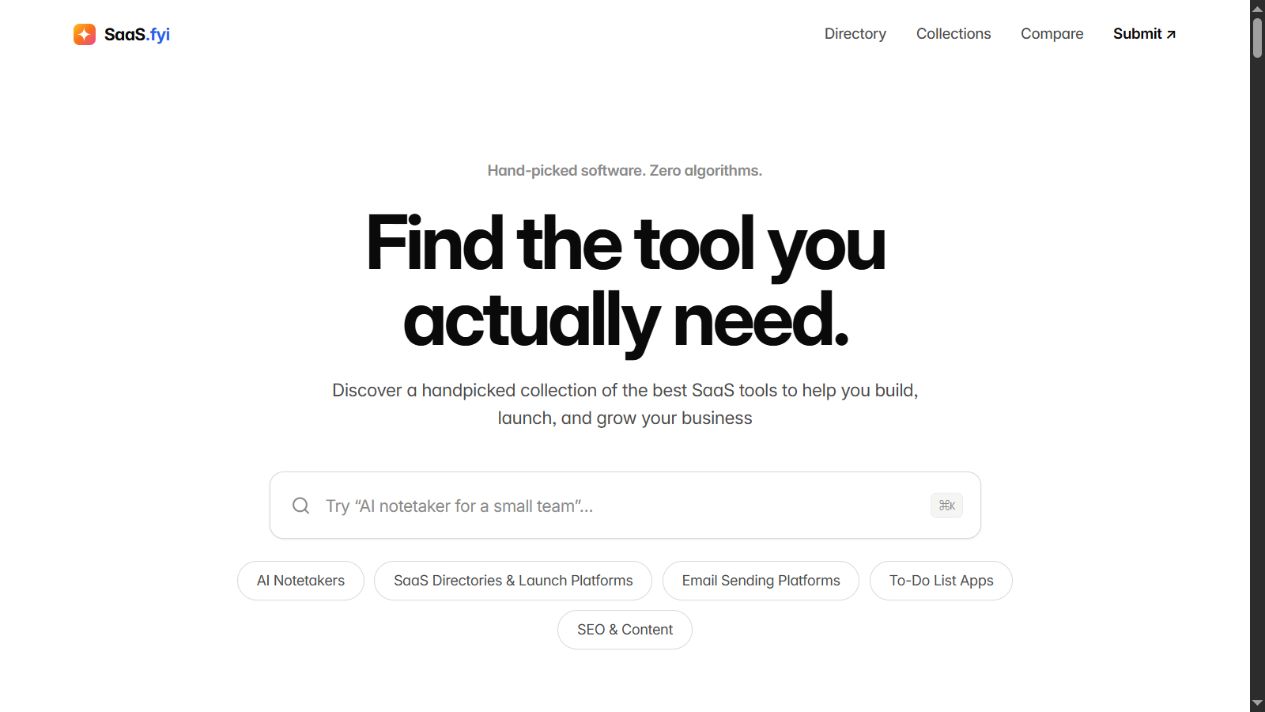
SaaS.fyi is a curated software directory with collections and comparison-oriented discovery. Its homepage organizes tools around practical needs such as meetings, email, productivity, analytics, forms, notes, and launch resources. That problem-based approach can be useful for software with a defined recurring use case. A product profile should make the intended customer and workflow clear enough to sit meaningfully beside alternatives.
The free route we checked required a badge within seven days and explicitly listed several possible locations: homepage, footer, press page, or an as-seen-on area. Removing the badge could lead to archiving. This is more flexible than a homepage-only rule, but an editorial article should still be checked against the current form and exact snippet. A guide discussing a directory should not falsely imply the product has already been featured there.
Choose a category based on the buyer’s task, not only the technology used. A marketing product might fit a workflow collection, while a developer API needs a more technical explanation. Include accurate pricing and setup details, then inspect the published profile. Judge the listing on relevant visitors and useful comparisons rather than assuming that a curated label guarantees a particular commercial outcome.
73. ShipLaunch
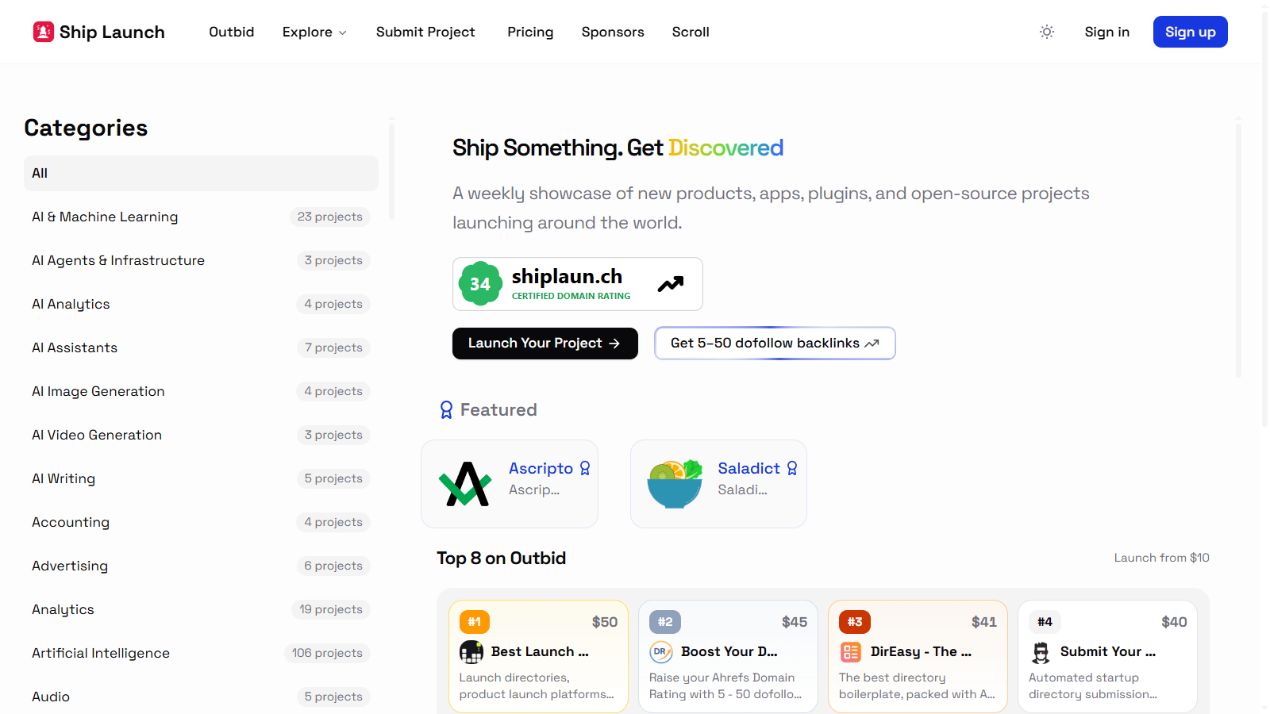
ShipLaunch is a broad product-launch platform with categories, current projects, featured entries, and other promotion areas. Its homepage covers AI, automation, analytics, development, content, marketing, and many other software subjects. The extensive category system can help a focused product find the right context, provided the listing describes a concrete job instead of trying to appear in every available niche.
The free route we reviewed required a badge and backlink verification, with review taking up to thirty days. Other paid offers were displayed separately. Confirm the current accepted location and exact markup before treating an article reference as sufficient. Record the selected plan, verification outcome, and final confirmation; none of those should be replaced by a screenshot of a partially completed form.
Prepare a clear customer problem, short description, logo, and representative product image. A social media application should distinguish content creation from publishing, engagement, or reporting so visitors know what they are comparing. After publication, check the category and destination URL, then measure relevant visits or trials. A broad catalog gives many possible contexts, but the quality of the match still determines whether the entry is useful.
74. AI Directory
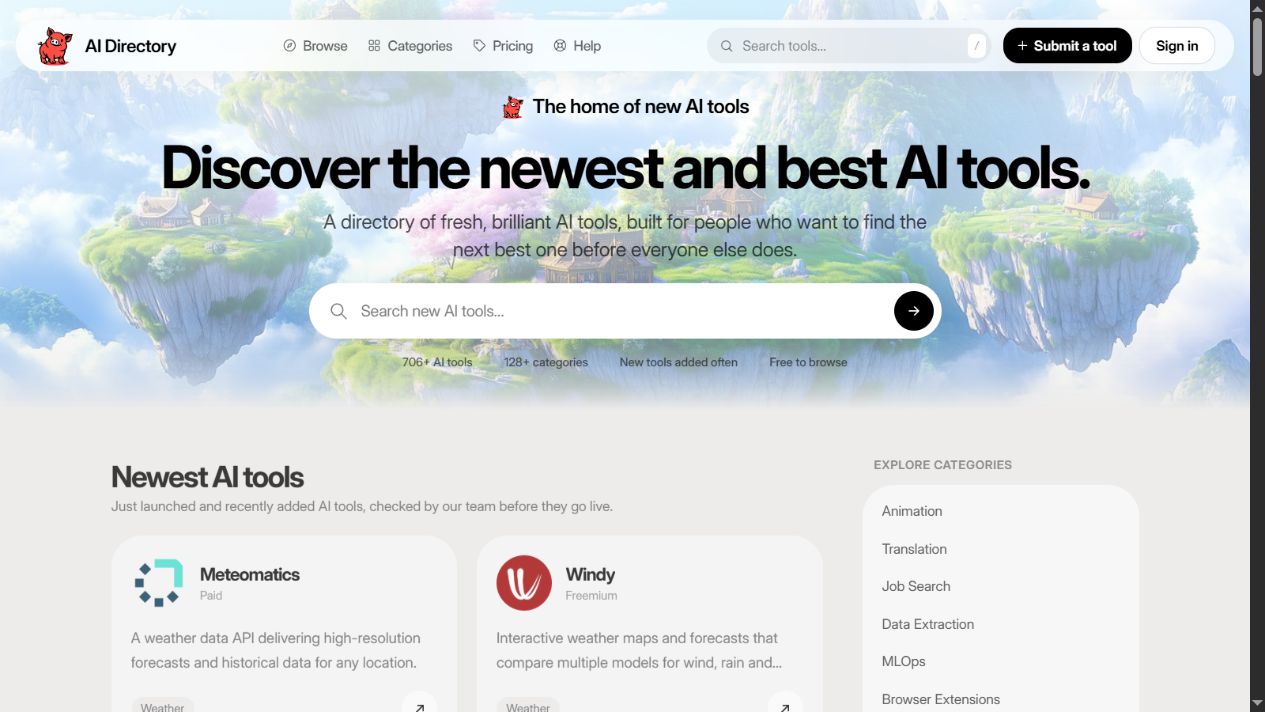
AI Directory, at aidirectory.website, is a catalog of AI tools with categories, search, recent additions, and pricing labels. The homepage includes a wide range of tasks, from content and subtitles to business utilities and specialist applications. This makes it a possible research destination when a product’s AI capability is easy to describe and belongs in a specific task category. A precise summary helps visitors compare tools without opening every website.
The free route we checked required the directory’s badge on the website, while paid options changed timing or visibility and removed the badge obligation. Confirm the current verification process and accepted page location before using a resource article. A general homepage promise about discovering new tools does not establish that an individual submission will be approved or published immediately.
Explain what the software actually does, who should use it, and which costs or setup requirements apply. For marketing applications, avoid presenting a content feature as unrestricted campaign automation. Use a real product screenshot rather than only a conceptual illustration. After approval, review the public description and website link, and evaluate actual referrals and useful questions as evidence of whether the listing helps.
75. DevPages
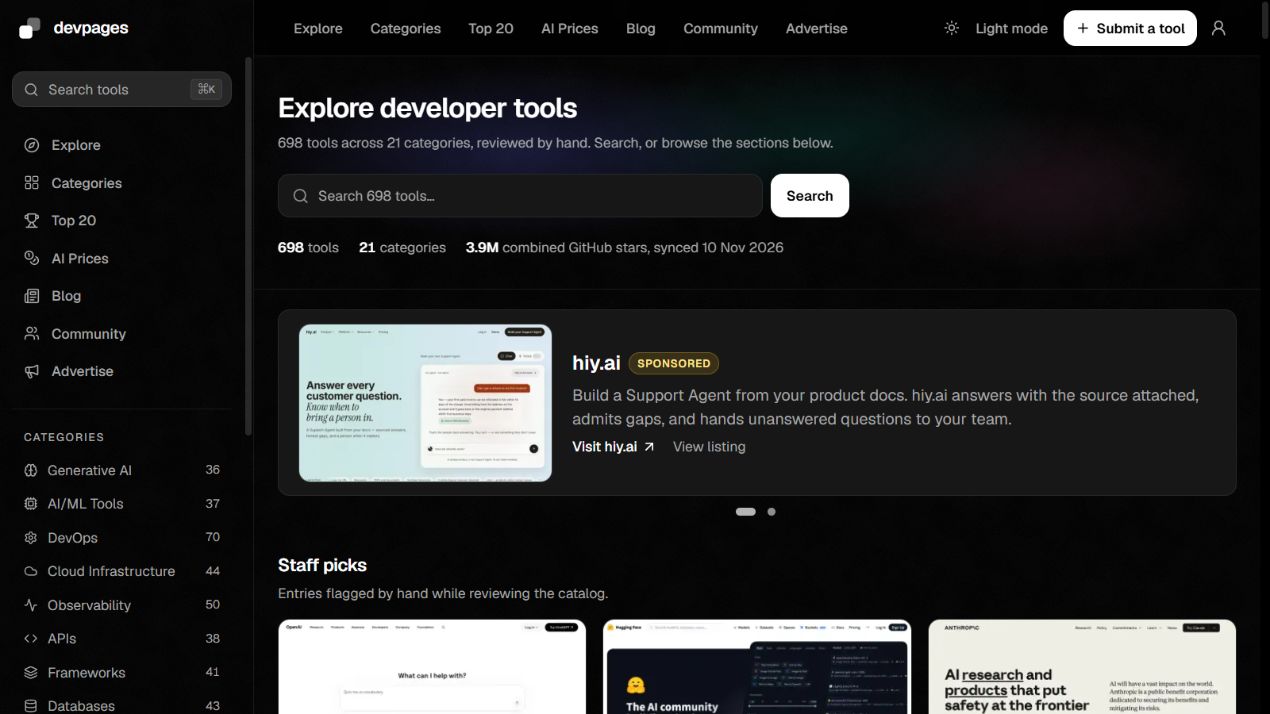
DevPages is a developer-tools directory with categories such as APIs, frameworks, infrastructure, observability, testing, documentation, AI assistants, and productivity. Its homepage includes staff picks and separately labeled sponsored placements. This is a technical comparison context, so a product should explain its integration, supported environment, and documentation clearly. A general marketing description may be less effective than a concise account of the problem a developer can solve.
The free route we checked required badge verification at submission and did not guarantee a review deadline. A separate instant option was paid. Confirm that the product fits the current categories before spending time on verification, especially if the core offering is aimed mainly at nontechnical operators. The accepted location of a separate article page should also be checked directly.
A public API or MCP integration can provide a relevant angle when it is genuinely part of the product. Describe access controls and setup requirements using public documentation, without uploading private code or credentials. After publication, inspect technical labels and links for accuracy. Evaluate whether the profile attracts developers with a real use case rather than treating any directory backlink as equally useful.
76. Launchype
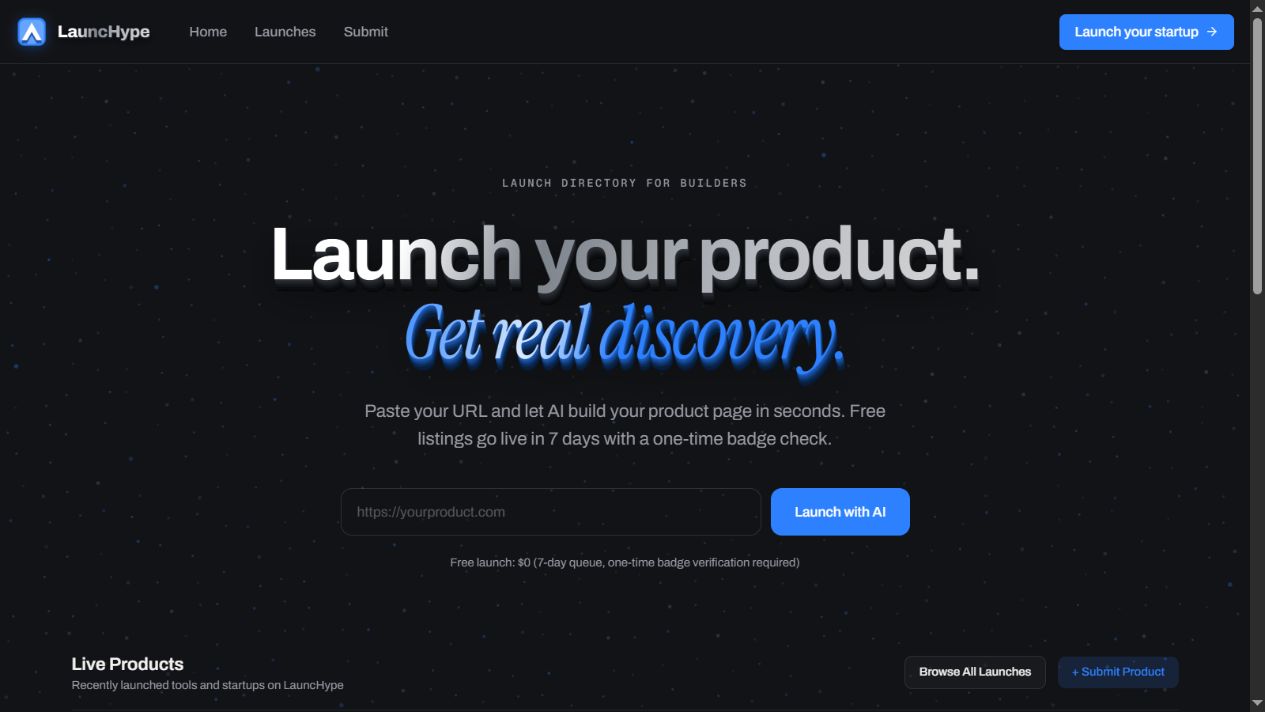
Launchype is a startup and AI-product discovery platform with a launch feed and an AI-assisted submission flow. Its homepage invites a founder to begin with a website URL, then build a product page from public information. That can reduce initial data entry, but the resulting description still needs careful review. Imported text can misunderstand a feature, pricing model, or the platforms required to run the application.
The free route we checked stated a seven-day queue and a one-time badge verification requirement. Confirm the current badge snippet, accepted placement, and final submission response before counting the product as submitted. A generated page preview is not the same as an approved or published entry. Keep the canonical product website correct rather than replacing it with a backlink article to influence verification.
Prepare a clear tagline, a representative screenshot, and an accurate description of the customer problem. A social media application should make the supported workflow and setup requirements understandable to a new visitor. After publication, inspect the final page and destination link, then track relevant visits and trial activity. Use any useful questions from the launch to improve both the profile and the product website.

Choose the next directory by fit, then measure the result
A directory campaign works best when it is treated as a series of small distribution experiments. The 76 sites in this guide share a backlink or badge condition, but they differ in audience, presentation, review speed, eligibility, and the attention a free profile receives. Some are useful software catalogs; others are weekly launch boards or specialist AI resources. Those differences matter more than putting every available logo on your website.
Start with a handful that fit the product and customer. Prepare accurate descriptions and public screenshots, read the free-plan conditions, and keep a private record of accounts and confirmations. If a directory requires a homepage badge, do not pretend that an article link satisfies it. If the queue is long or the audience poorly matched, it can be reasonable to wait or leave that site out. A completed spreadsheet should reflect what actually happened: draft, submitted, scheduled, approved, or published.
Connect the profiles to a wider communication plan. A useful demonstration can support a directory page, a blog explanation, and several social posts, each adapted to its audience. The message should explain the task and show the product’s limits as well as its strengths. For teams using SMTasker, supported publishing and engagement routines can help organize ongoing social work around a launch, with settings and activity still reviewed by the people responsible for the accounts.
Review the evidence after a consistent period. Which listings brought relevant visitors? Which led to questions, trial starts, or useful feedback? Which required ongoing website changes without a clear return? Keep the profiles that help the right people understand the product, update outdated details, and recheck badge obligations after website changes. Avoid using votes, domain metrics, or promises about AI citations as a substitute for those observations.
The strongest reason to use a directory is straightforward: it gives a potential customer another useful place to discover and assess your product. A clear listing, a trustworthy destination website, and relevant follow-up content can make that path worthwhile. Choose deliberately, measure patiently, and let the quality of the conversations guide the next round of submissions.
Explore SMTasker’s supported workflows or read the SMTasker blog for more practical social media operations guides.


